
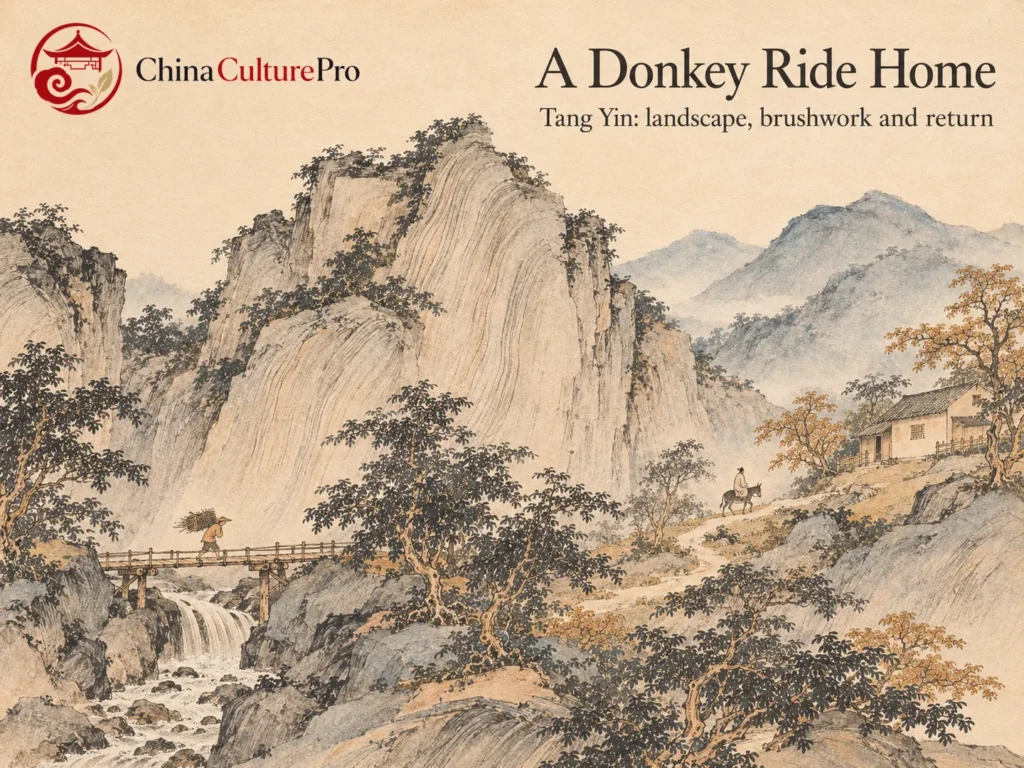

Quick Answer: What Should You Notice in Tang Yin’s Donkey Ride Home?
Contemplating on a Donkey Ride Home (骑驴归思图, Qí Lǘ Guī Sī Tú), by Tang Yin (唐寅, Táng Yín), places a small traveler within a landscape of steep cliffs, trees, water and a winding route. Its long rock lines deserve as much attention as its homecoming theme.
- Collection: Shanghai Museum.
- Medium and size: Ink and light color on silk, 77.7 × 37.5 cm.
- Look first: Find the small rider near a dwelling on the right.
- Then compare: Follow the long lines across the pale rock faces.
The poem invites a personal reading, while the precise dating remains debated.

The mountains dominate. Tall cliff forms rise behind rounded, projecting rock faces, and dense trees occupy much of the lower landscape. Small buildings and travelers emerge only after the larger masses have been noticed.
The rider’s route passes close to rock, water and places of habitation. Compare its narrow passages with the much larger cliffs around them.
Identify the Shanghai Museum Painting
A Palace Museum essay reproduces the work as a Shanghai Museum hanging scroll, on silk, measuring 77.7 cm high by 37.5 cm wide. Its reproduction shows both the painted field and additional writing associated with the mounted object. [1]
Keep that museum, size and material with the translated title when checking an image. Generic titles such as “riding a donkey” can refer to other pictures, and a modern copy may repeat the familiar scene.
The Ming dynasty guide provides the wider period. For this work, the immediate questions are more specific: how the route enters the landscape, how the rocks are drawn and how the accompanying words have shaped interpretation.
Look at the whole composition before isolating the traveler. The rider’s smallness is part of the effect; an enlarged figure alone would lose the disproportion between human passage and the surrounding terrain.
Find the Rider, Bridge and Mountain Route
Near a small building at the right, a rider on a donkey follows the path through the middle distance. Lower and farther left, a narrow bridge crosses beside flowing water and broken rock.
Compare those two positions. The bridge gives a definite crossing within one small area; the rider occupies a different part of the route. Trees and projecting forms interrupt an easy view of everything between them.
A pale path can be distinguished locally by its relation to darker banks, trunks or rock edges. Follow only the portions you can see before imagining how a hidden connection might continue behind the scenery.
The landscape-painting guide explains how paths, water and buildings organize a view. Here, compare the rider’s position with the nearest dwelling, then with the high cliff above.
Compare the route of the water with the traveler’s route. A fall at the left descends toward the bridge area and the broader water below. Its downward movement contrasts with the rising cliffs and with the smaller turns made by a traveler’s path.
The trees vary too. Dense clusters of small leaves make dark passages, while thinner branches stand against paler rock. The changing density can hide a small architectural form or make a gap more conspicuous.
Compare Long Ink Lines with Dark Rock Edges
The 2017 museum essay describes the transformation of Song-derived rock handling into longer, wet-looking texture lines. It emphasizes the resulting clarity and fluidity of the painted surface. [1]
Choose a broad, pale rock face near the center. Its long lines curve with the mass rather than simply filling it with disconnected dark patches. Compare them with a darker broken edge where the rock changes direction.
The 2021 study proposes the name wet-ink gossamer-thread texture strokes (湿墨游丝皴, Shī Mò Yóu Sī Cūn) for this supple, fine but forceful handling. That is a scholar’s proposed descriptive term, not a claim that every historical painter used the same label. [2]
The techniques guide introduces texture strokes more broadly. Here, look for the difference between a line that describes the outside boundary and lines continuing across the interior face.
Some passages leave narrow light intervals between neighboring strokes. Elsewhere, darker ink joins into a more continuous area. Compare those effects with the separate small marks in the foliage below.
The literati-painting guide provides a wider context for expressive brushwork and literary associations. Compare a broad rock mass with the fine, curving lines across its face.
Read the Poem and the Dating Debate
Tang’s poem describes returning after an unsuccessful quest, still riding toward green hills, weathered by wind and dust, with a wife sharing modest circumstances at home. Its words make disappointment and return central to the picture’s interpretation. [1]
What happened before that return is less straightforward. The 2021 study reviews an earlier reading connecting the work with the aftermath of the 1499 examination scandal, then argues for a context after Tang’s return from Nanchang in 1515. These are interpretations of poetry, biography and painting style, rather than two dates written on the image. [2]
That distinction changes how the rider should be described. The poem supports an autobiographical reading, but a personal theme does not by itself establish a physiognomically recognizable portrait of Tang Yin.
Zhu Yao (朱曜, Zhū Yào) added a responding poem. The study also distinguishes commentary by later collectors from Tang’s own writing. Different voices therefore contribute to the mounted object’s present appearance. [2]
The inscriptions-and-seals guide helps separate those layers. Begin with which person wrote a passage, then ask what that passage contributes to the work’s meaning or dating.
Return to the rider after reading the poem. The small figure, winding passage and dwelling can sustain the theme of homecoming without requiring a single disputed date or an imagined likeness to do all the interpretive work.
FAQs About Tang Yin’s Donkey Ride Home
Is the donkey rider a confirmed portrait of Tang Yin?
An autobiographical interpretation is supported by the poem’s themes. The cited evidence does not establish a recognizable portrait likeness of the artist.
Does the scroll have an uncontested execution year?
The studies discuss competing chronological readings. A proposed connection with a particular homecoming should be identified as an interpretation, not an inscribed date.
Who wrote the different inscriptions?
Tang supplied his poem, Zhu Yao added a response, and later collectors contributed further commentary. Check the author and placement before treating every passage as Tang’s own words.
資料來源
[1] Wang Lianqi, Palace Museum. Some Questions about Tang Yin’s Calligraphy and Painting, Forbidden City, April 2017, pp. 122–123
[2] Che Xudong, Palace Museum Journal. Periodization, Classification and Naming of Texture Strokes in Tang Yin’s Landscapes, Centered on Riding a Donkey Home, 2021 no. 12, pp. 87–90 and 94–97