


Quick Answer: What Defines Chinese Temple Architecture?
Chinese temples can use gates, courts, timber halls and tiled roofs to organize movement toward a place of worship. Those features appear across several religious and civic traditions. The dedication, images and arrangement of buildings help explain the role of a specific site. [1][2][3][4][5]
- A Buddhist monastery (佛寺, fósì) can center an image hall. Other halls, teaching rooms and monuments can support different parts of monastic life. [1][2][6]
- A Daoist temple (道观, dàoguàn) can belong to a larger landscape. In a mountain sanctuary, halls and shrines can occupy different elevations. [3]
- A local shrine (庙, miào) can serve a neighborhood. Worship may share a compound with spaces for study, meetings or other community needs. [4]
Treat the plan as evidence of how people approach and use a site. Read it alongside the name, images and history of the compound.
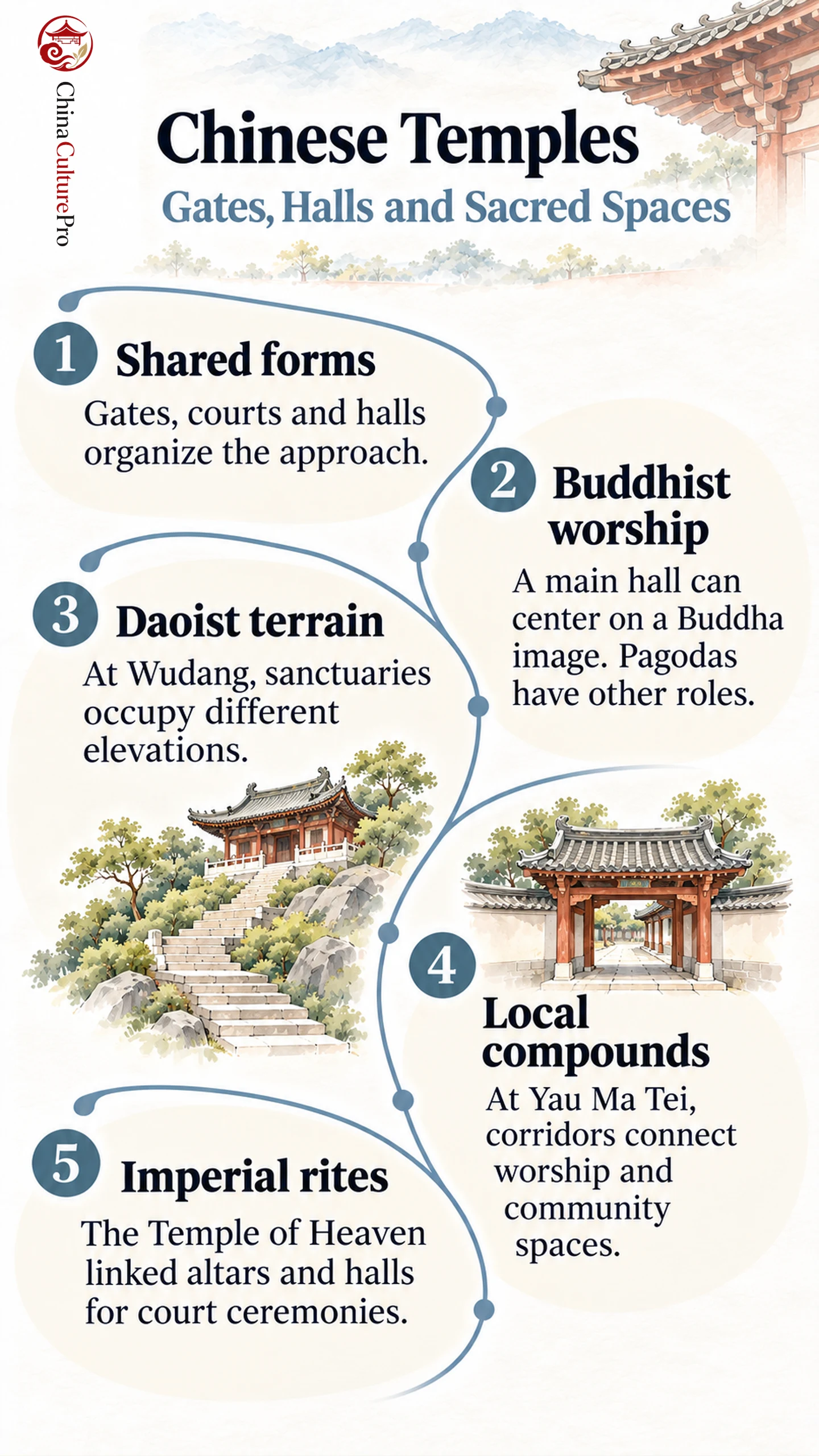
At a monastery in Hangzhou, visitors pass through a series of halls. In a Hong Kong neighborhood, corridors connect a temple to former study rooms. Both plans take shape around worship, at different scales and with different uses for the surrounding buildings.
The Shared Vocabulary of Gates, Halls and Courts
A gate establishes a threshold. A court gives people a place to gather or approach a hall. Covered passages and steps can connect spaces while marking changes in level and access. A compound can arrange these elements on an axis, add rooms at the sides or adapt the sequence to sloping ground. [1][3][4]
These are part of the shared vocabulary of traditional Chinese architecture. Different Chinese roof shapes and timber dougong (斗拱, dǒugǒng) brackets help describe a building’s form and construction. To identify a temple’s use, look at which hall receives worship, which images are installed and what records say about the site. [1][2][3][4]
Buddhist Monasteries and Worship Halls
At Lingyin Temple (灵隐寺, Língyǐn Sì) in Hangzhou, the central sequence includes the Hall of Heavenly Kings (天王殿, Tiānwáng Diàn), then the Mahavira Hall (大雄宝殿, Dàxióng Bǎodiàn). The second hall is the main place of worship for the image of Shakyamuni Buddha. Other halls in the compound have different devotional or institutional uses. Walking from one building to the next reveals a sequence of functions as well as an axis. [1][2]
A worship hall can also be the focus of a compound on uneven mountain terrain. The East Main Hall at Foguang Temple (佛光寺, Fóguāng Sì) on Mount Wutai preserves a Tang timber structure and clay figures. The building and the images together give a clearer view of its role than the roof alone. [7]
A pagoda can also appear within a Buddhist compound. Chinese pagodas developed from Buddhist relic traditions and can serve a different function from a worship hall. Their position and prominence varied among sites and over time. [6]
Daoist Temples and Sacred Terrain
The Wudang Mountains (武当山, Wǔdāng Shān) in Hubei are an example of a sacred landscape with buildings at different elevations. Palaces, temples and shrines occupy valleys, ravines and slopes. The position of each site and the routes among them help explain a larger arrangement than one courtyard plan could show. [3]
Ming imperial patronage shaped much of the organized complex. An elaborate approach or formal hall can therefore reflect court support as well as the needs of worship. What identifies the complex with Daoist traditions is its religious history and dedication, together with the practices associated with the mountain. [3]
At the top of Tianzhu Peak (天柱峰, Tiānzhù Fēng), the Golden Hall (金殿, Jīndiàn) houses an image of the Daoist deity Zhenwu (真武, Zhēnwǔ). Its cast metal columns and roof reproduce the forms of timber construction. The summit position and dedication explain its place in the larger sanctuary. [8]
Local Temples and Community Use
In Yau Ma Tei, Hong Kong, a temple dedicated to Tin Hau (天后, Tiānhòu in Mandarin) anchors a compound historically used for worship, study and arbitration. Corridors connect the main shrine with four adjoining buildings. Rooms used for schooling and settling disputes served functions distinct from worship in the main hall. Its plan reflects institutions that grew up around a religious focus for both boat people and land dwellers. [4]
On Meizhou Island, temple fairs bring together residents to honor the sea goddess Mazu (妈祖, Māzǔ). [9]
A useful comparison is the Tang Ancestral Hall in Ping Shan. It also has halls and courtyards, but its rear altar holds ancestral tablets, and the building serves lineage gatherings. Such ancestral halls can share architectural forms with local temples while organizing worship around a lineage. [10]
Why the English Word Temple Covers Several Forms
The Temple of Heaven (天坛, Tiāntán) in Beijing is an imperial sacrificial complex. Its arrangement links open-air altars with covered ritual buildings. The routes connected places where the emperor performed rites to Heaven. A familiar English label can therefore cover a site with a different institutional purpose from a monastery, Daoist establishment or neighborhood shrine. [5]
The framework of the Three Teachings (三教, sānjiào) helps explain the broader cultural setting. A specific building is best understood through its dedication, plan, patronage and recorded use. Those clues tell you which parts of a compound belong to worship, residential life or public activity. [1][3][4][5]
FAQs About Chinese Temple Architecture
How can I tell a Buddhist temple from a Daoist temple?
Start with the dedication, the main figures and the recorded religious history. Timber halls, gates, courts and projecting tiled roofs can appear in both. A central Buddha image hall and documented Daoist mountain sanctuary represent different uses of architectural elements. [1][2][3]
Does every Buddhist temple have a pagoda?
No. A monastery can center on a hall for worship. Pagodas are one possible addition, and their position and purpose vary by site. [2][6]
Is the Temple of Heaven a Buddhist or Daoist temple?
It is a complex used for imperial sacrifices. Its altars, halls and connecting routes were organized for court rites. [5]
資料來源
[1] Lingyin Temple. Introduction
[2] Lingyin Temple. The Grand Hall
[3] UNESCO World Heritage Centre. Ancient Building Complex in the Wudang Mountains
[4] Hong Kong Antiquities and Monuments Office. Tin Hau Temple and the Adjoining Buildings in Yau Ma Tei
[5] UNESCO World Heritage Centre. Temple of Heaven: An Imperial Sacrificial Altar in Beijing
[6] Asian Art Museum. Great Wild Goose Pagoda
[7] UNESCO World Heritage Centre. Mount Wutai
[8] Wudang Mountain Daoist Association. The Golden Hall on Tianzhu Peak
[9] UNESCO Intangible Cultural Heritage. Mazu Belief and Customs
[10] Hong Kong Antiquities and Monuments Office. Tang Ancestral Hall