


Quick Answer: What Is China’s Local Opera Revival?
China’s local opera revival keeps regional forms of xiqu (戏曲, xìqǔ) in performance. Each tradition has a distinctive mix of song, accompaniment, roles and repertoire. A revival can involve teaching an older scene, producing a new play or introducing the form to new audiences.[1][2][3]
- Local vocabulary: Speech and song can identify a place, as Quanzhou pronunciation does in Liyuan opera (梨园戏, líyuánxì).[1]
- Training: Performers learn how gesture, voice and musicians work together onstage.[1][3]
- New work: Companies can apply those skills to a different story or stage arrangement.[4][5]
A living repertoire needs performers and audiences.
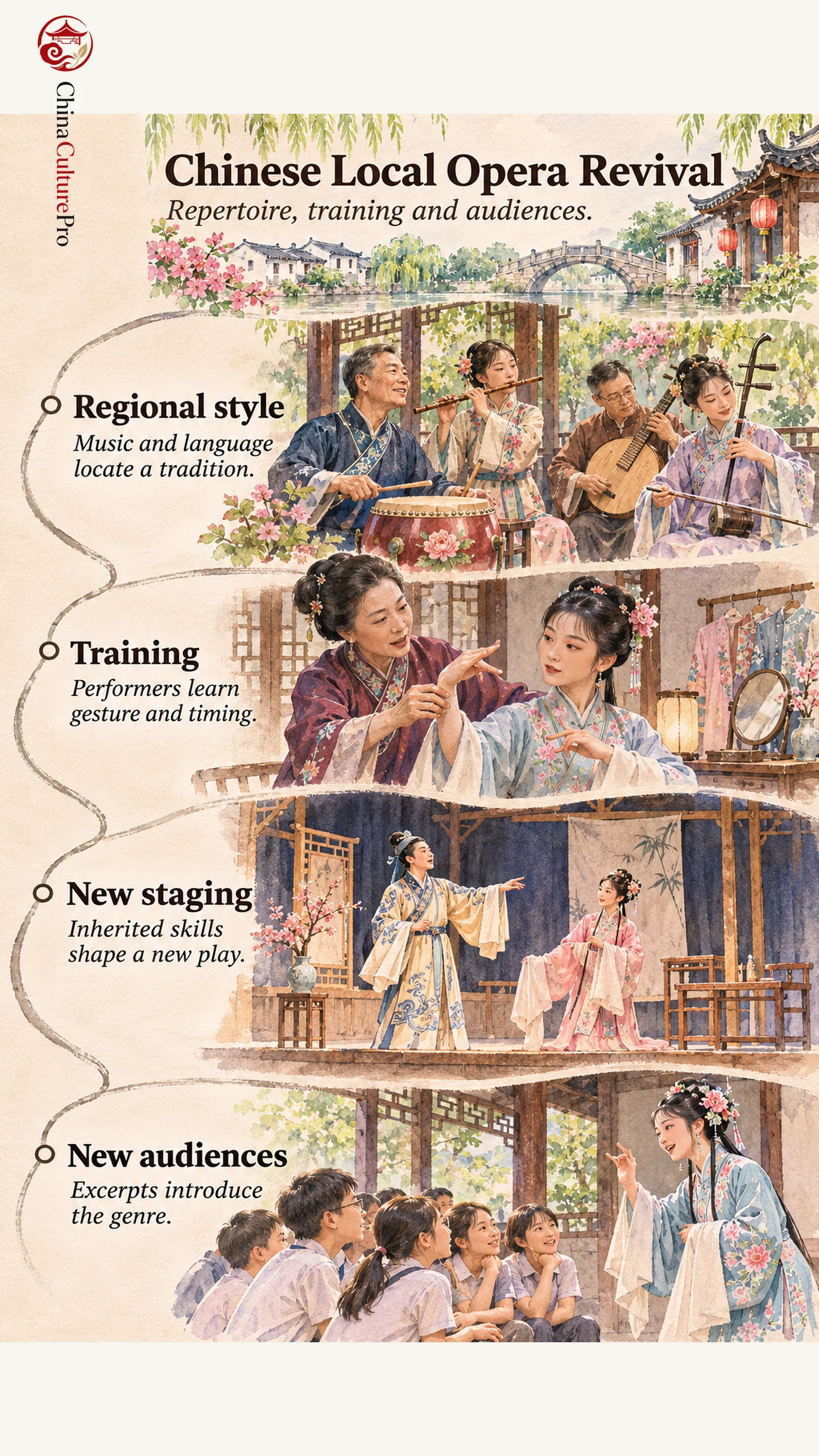
An actor takes a measured step while a drum marks the movement. The audience may hear a local pronunciation before it learns the name of the play. In local opera, these details carry much of a tradition’s identity, which is why revival involves more than putting a familiar title on a poster.[1][2]
What Makes a Local Opera Distinct
In Quanzhou, Liyuan opera draws on the language and theater traditions of southern Fujian. Singers use the Quanzhou variety of Southern Min, and musicians accompany them with drums, flutes and strings. Several performance lineages maintain their own repertoires, so a shared genre name can cover differences even within one city’s tradition. The language is also part of the wider story of Minnan culture.[1]
Kunqu (昆曲, kūnqǔ), which developed in the Kunshan area, gives a different listening experience. Its characteristic melodies and bamboo flute accompaniment shape a repertoire that includes The Peony Pavilion. When two regional traditions tell a familiar story, their music and physical expression can still give the scenes very different rhythms.[2]
Keeping the Skills in the Troupe
A script can preserve what characters say. A recording can show a posture or capture a melody. Training lets a performer learn the timing behind both, including when a gesture begins and how it aligns with the sound of a drum. Troupes pass on the sound of the accompaniment alongside singing and gesture.[1][2][3]
School visits and apprentice training serve different purposes. An introductory performance can give a class a first encounter with the genre. Sustained teaching in a troupe or a specialist program gives performers time to learn a role and put it onstage.[3]
New Plays and Older Repertoires
At a national showcase announced in 2025, Fujian’s selections included a new Liyuan opera based on Pu Songling’s story about a cricket and a traditional Liyuan excerpt featuring the servants of Liang Shanbo and Zhu Yingtai. One adds a new play to the genre’s repertoire, while the other brings a surviving scene to a new audience.[4]
In Red Wedding Bed, director Zeng Long drew on two versions of Chen San and Wuniang and arranged the stage around a bridal bed. Traditional instruments stayed visible while movable railings changed the acting space. The result shows how a company can change the audience’s viewpoint while working with inherited music and stories.[5]
How New Audiences Find Local Opera
A short excerpt can bring a particular gesture or melody into focus. A full play gives it a narrative context, and a filmed version can bring the viewer closer to the actor. Chinese opera films are another way to explore that relationship between performance and framing. In any format, knowing the genre and company helps you understand which tradition you are seeing.[3][4]
FAQs About Chinese Local Opera Revival
Is Local Chinese Opera the Same as Peking Opera?
Peking opera is one form of Chinese opera. Liyuan opera and Kunqu have their own regional histories, musical conventions and repertoires.[1][2]
Does Revival Mean Restaging Old Plays?
Revival can include restoring an older excerpt, training new performers or commissioning a new play using an established performance vocabulary.[3][4]
What Should I Look for in a First Performance?
Pick an excerpt with a synopsis. Listen for the percussion around a movement and watch how the performer uses hands, eyes and posture to express the character’s response.[1][2]
資料來源
[1] Fujian Provincial People’s Government. National intangible cultural heritage: Liyuan Opera
[2] UNESCO. Kun Qu opera
[3] Ministry of Culture and Tourism. Reply on opera transmission and education
[4] Fujian Provincial People’s Government. Fujian selections for the national showcase of new opera talent
[5] Eugene Chan for Hong Kong Arts Festival. Ancient Echoes, New Voices: Liyuan Opera’s Next Generation Returns to the Roots