
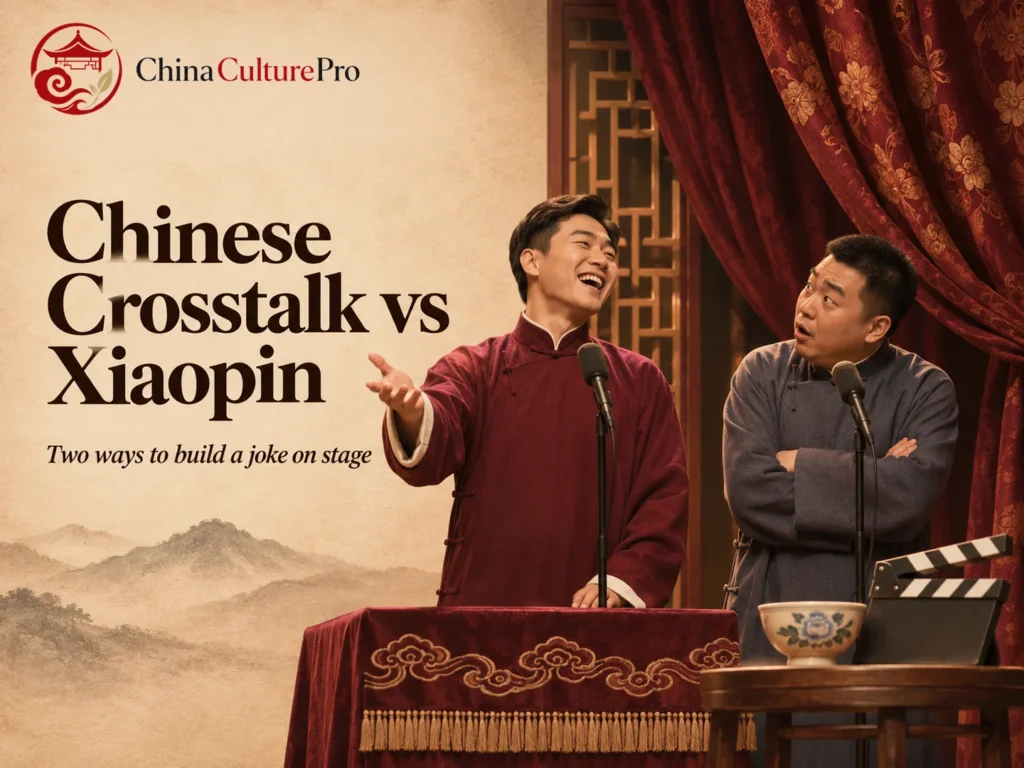

Quick Answer: How Do Chinese Crosstalk and Xiaopin Differ?
Chinese crosstalk, or xiangsheng (相声, xiàngsheng), usually builds comedy through speech, timing and interaction between performers. Xiaopin (小品, xiǎopǐn) is a short theatrical sketch. Its actors usually play characters in a recognizable situation, with actions and props helping the joke develop. Both forms have appeared on CCTV’s Spring Festival Gala, and both can use wordplay or physical comedy. [1][2][3][4]
- Crosstalk: Listen to how a setup, a correction or a misunderstanding changes the rhythm of an exchange. [1][2]
- Xiaopin: Watch how the characters’ situation changes when someone acts or uses a prop. [3][4]
- Overlap: A sketch can feature rapid dialogue, and a crosstalk performer can imitate a character. [1][2][3]
Follow how the joke develops. Either form can have two performers.

Two people can make a theater laugh while standing by a table. Two people can also make it laugh by playing a director and a film extra. The difference is in the work the performers ask you to follow. One may turn on how a story gets told. The other may turn on what happens in the scene. [1][2][3][5]
Crosstalk and Xiaopin at a Glance
| 比較項目 | Crosstalk | Xiaopin |
|---|---|---|
| Main comic structure | An exchange, story or imitation driven by the performers’ words and timing. [1][2] | A short acted situation in which characters’ choices create the joke. [2][3] |
| Performers | Commonly a pair, with solo and group forms also documented. [1] | A cast suited to the scene, which may also be a pair. [3][5] |
| Role of objects | Can be sparse, leaving the exchange at the center. [1][2] | A prop or repeated physical action can become part of the plot. [2][5] |
How a Crosstalk Pair Builds a Joke
China’s national intangible heritage inventory describes crosstalk as a performing art that took shape in Beijing around the mid-19th century and spread through northern China, with a strong tradition in Tianjin. It documents solo, paired and group forms. Two-person routines are the most familiar format. [1]
In a pair, the dougen (逗哏, dòugén) usually carries the main comic thread. The penggen (捧哏, pěnggén) helps shape it through questions, corrections or reactions. A pause or skeptical reply can make the next line land. Listen for the response that changes your expectation of what the speaker will say. The guide to xiangsheng explores the form’s history and performance skills. [1][2]
How a Xiaopin Builds a Scene
The sketch format is associated with dramatic training as well as television. In the TV sketches studied by historians, an actor plays someone inside a situation, and the joke grows as that person tries to accomplish something. A viewer can follow the changing situation through action as well as dialogue. [2][3][4]
In “Eating Noodles” (吃面条, Chī Miàntiáo), a sketch performed at the 1984 Spring Festival Gala, Chen Peisi and Zhu Shimao stage a film shoot. Chen’s character has to eat noodles as part of a take. Each repeated take turns the same physical task into a larger problem for the character. See Chinese xiaopin comedy for more on the form. [3][5][6]
Why Both Appear on the Spring Festival Gala
CCTV’s Gala began in 1983 and put a variety of forms into a single broadcast. It gave spoken comedy and short acted sketches a shared stage. Researchers describe the televised sketch as a way of presenting recognizable situations and social tensions through comic characters. The Spring Festival Gala guide places both alongside music, dance and other acts in the New Year broadcast. [2][3][4]
If you start watching a clip halfway through, look for the premise. A crosstalk exchange can change topic or voice while the performers remain in direct conversation. In a sketch, the setting and the characters’ objectives usually carry through the scene. An individual performance may borrow devices from both. [1][2][3]
FAQs About Chinese Crosstalk and Xiaopin
Is crosstalk always performed by two people?
The paired form is the most common one in the national heritage description. Solo and group crosstalk are also documented. [1]
Does a sketch need props?
A prop can carry the action, as it does in “Eating Noodles.” The defining feature is an acted scene with characters and a situation. [2][3][5]
What should I watch for when subtitles miss a joke?
In crosstalk, listen to pauses and changes in the speaker’s tone or pace. In a sketch, watch how actors react to an action or an object. Those cues can give you part of the joke’s setup. [1][2][3]
資料來源
[1] China Intangible Cultural Heritage Digital Museum. Xiangsheng: National Intangible Cultural Heritage Inventory Entry
[2] Sheng Qu, University of Manchester. Research on Chinese Television Sketch Comedy
[3] Hongjian Wang, The China Quarterly. From Court Fools to Stage Puppets
[4] The China Quarterly. Xiaopin: Chinese Theatrical Skits as Both Creatures and Critics of Commercialism
[5] China Culture. Spring Festival Gala Highlights
[6] Jin Liu, Cornell University. Signifying the Local: Media Productions Rendered in Local Languages