

Quick Answer: What Defines a Traditional Chinese Garden?
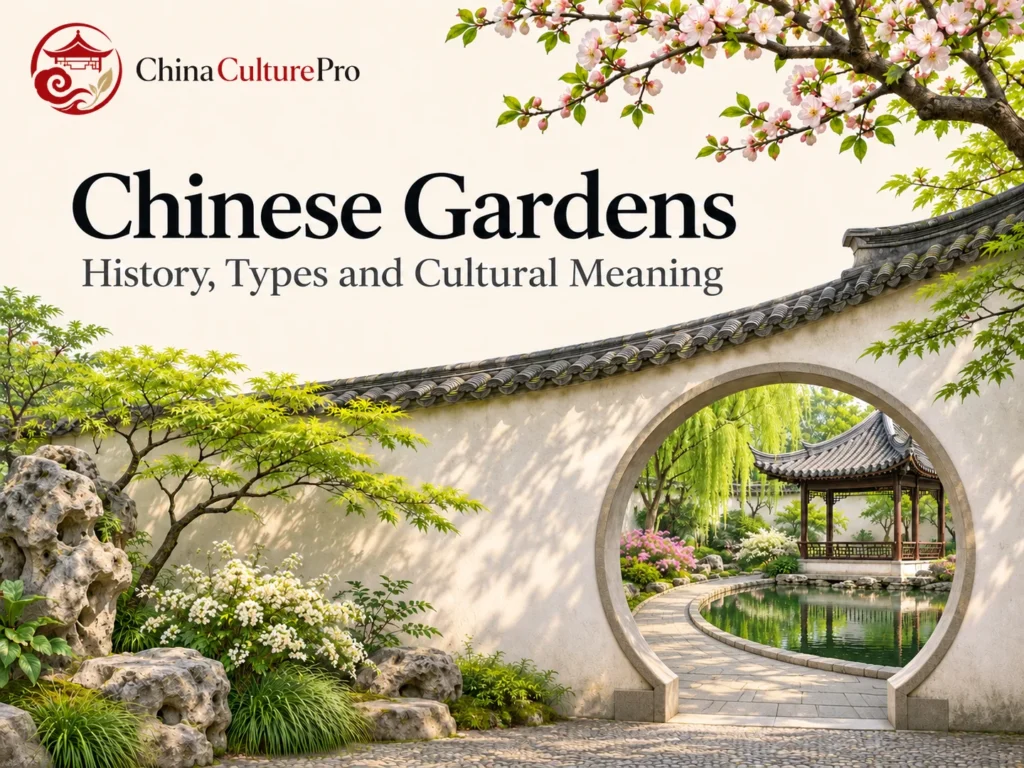
A traditional Chinese garden (园林, yuánlín) can bring water, rocks, plants and architecture into a landscape that people experience by moving through it. The scale ranges from compact urban gardens to imperial grounds with large lakes and hills. In both settings, a pavilion, opening or change in direction can shape what comes into view. [1][2][3][4][5]
- Private gardens could create landscapes within a city residence. Rocks, ponds and covered walks made space for looking, reading and gathering. [1][2][6][7]
- Imperial gardens had several kinds of use. The Summer Palace (颐和园, Yíhéyuán) combined garden scenery with residences, worship and government functions. [3][4]
- Views change as you move. A window can frame one part of a scene. A path can lead to a broader view. Features outside the garden can also become part of the composition. [2][5][8]
Start with the route and the intended viewpoint. They help explain why water, stones and buildings stand where they do. [1][2][5]
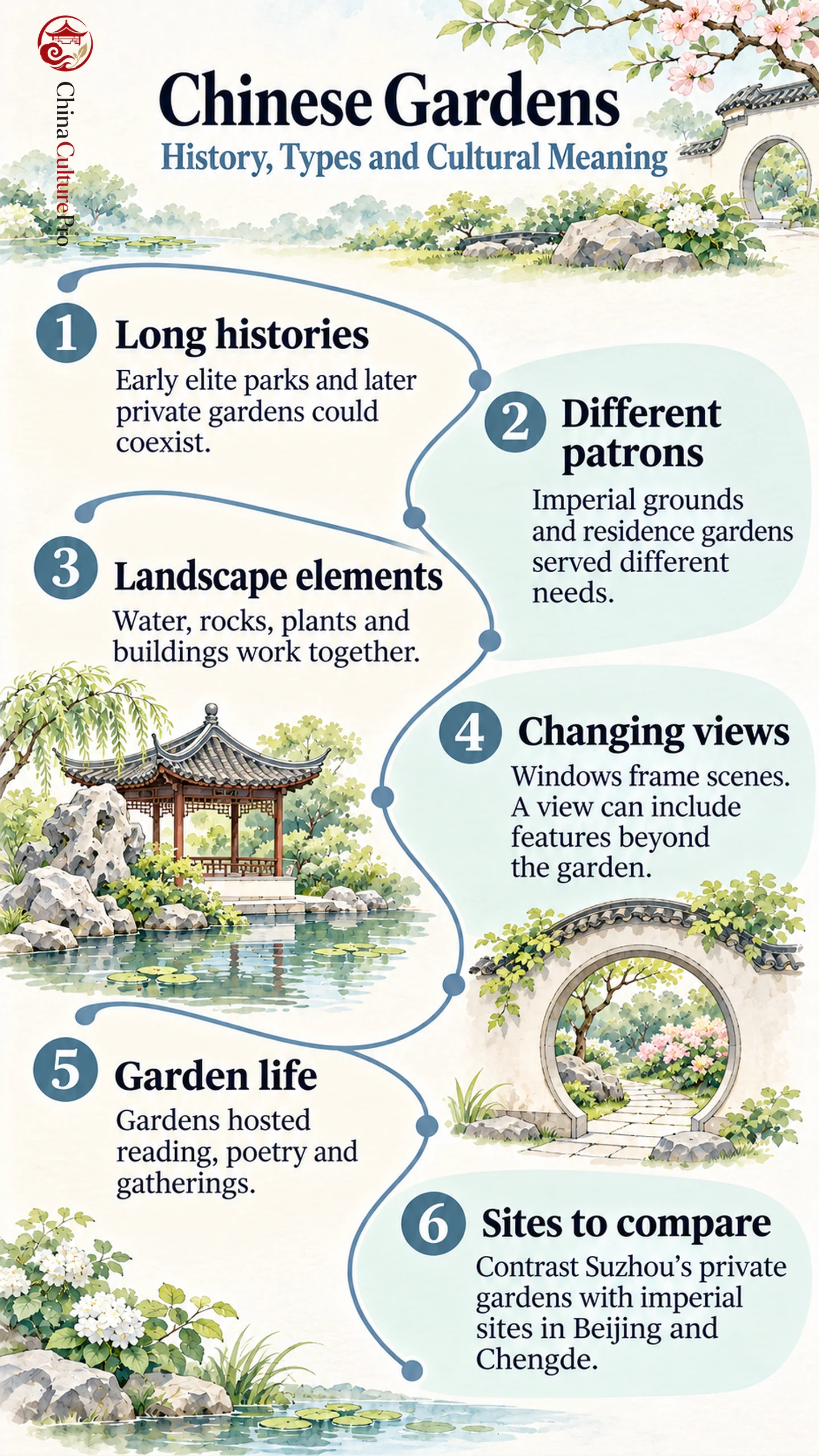
From a covered walk, a window can show only a rock and a branch. A few steps farther along, the route may open onto a pond. The view changes because the path brings you to another position, even before any of the plants or buildings change.
How Chinese Gardens Developed
Historical records describe large parks used by Zhou aristocrats for hunting and pleasure. By the fourth century CE, literature also celebrated smaller gardens associated with educated owners. The forms developed over many centuries and could coexist. Around Suzhou, private gardens multiplied as commerce and agriculture created wealth that owners could invest in urban residences. [1][2]
The surviving classical gardens of Suzhou cover several historical periods. Their plans and buildings changed with later owners. In the garden now known as the Master of the Nets, a site with a Southern Song history was reworked under a Qing owner in the eighteenth century. A date attached to a garden can therefore refer to its founding, a later layout or the buildings that survive. In the seventeenth century, Ji Cheng (计成, Jì Chéng) wrote The Craft of Gardens (园冶, Yuányě), discussing how a garden could respond to its site and draw on views around it. The Qing imperial projects at Chengde and Beijing also worked with terrain, water and views, though at a different scale. [1][3][4][9][6]
Imperial Parks and Private Gardens
An imperial garden could accommodate many activities. In Beijing, the Qing court used the Summer Palace for residence, administration, religious observance and recreation. Kunming Lake and Longevity Hill give the complex a large geographical framework. Different groups of buildings served different purposes around that framework. The main administrative hall stood beyond the eastern gate, while residences clustered against the hill. The garden that the Qianlong emperor commissioned in the eighteenth century was damaged in war and rebuilt in the late Qing. [3]
A smaller urban garden could provide rooms and outdoor spaces for receiving guests, reading, walking or looking out over water. At the Master of the Nets Garden (网师园, Wǎngshī Yuán) in Suzhou, the residence lies to the east and the garden to the west. Buildings around the central pond offer views from several sides. The comparison between imperial and scholar gardens is about ownership and use as well as area. The two categories explain much about patronage. They leave room for shared devices such as waterside buildings and views that shift along a path. [1][2][3][6][7]
Water, Rocks, Plants and Buildings
The phrase “mountains and waters” (山水, shānshuǐ) helps explain how a garden can suggest a much larger landscape. Rocks can evoke peaks or cliffs, and a pond can suggest open water beyond the scale of the grounds. Scholars’ rocks could also be collected as individual objects. Several rocks at a pond edge can suggest a range of hills. One stone on a stand gives a viewer a smaller landscape to examine up close. [1][2][10]
Water separates buildings and brings roofs or plants into view in reflection. In the middle section of the Humble Administrator’s Garden (拙政园, Zhuōzhèng Yuán), buildings of different shapes and heights look onto a large pond. Small Chinese pavilions provide shelter and make visible stopping points. Garden plants soften edges, filter views and mark seasonal change. What each element does in relation to the others is central to Chinese garden design. [1][2][5][11][7]
Views That Change as You Move
A covered walk can hide one view and open another. Paths and windows create different experiences because they control where a person moves and what can be seen from there. Openings such as circular moon gates (月洞门, yuèdòngmén) also connect the spaces they frame. From the nearer side you see a selected part of the court. Passing through reveals what the wall had concealed. [2][5][12]
Borrowed scenery (借景, jièjǐng) incorporates a feature from beyond the immediate garden space into the view. The North Temple Pagoda stands outside the Humble Administrator’s Garden and appears in a documented view from within it. A window or door can frame a scene regardless of whether the objects are inside or outside the garden. Borrowing and framing can work together. For instance, an opening in a wall may isolate a small piece of an outside view. Step to one side and the frame may show something else, even though the distant object stays in the same place. [5][8][9]
Gardens as Places for Reading and Gathering
For some owners, the garden formed an extension of domestic and intellectual life. People gathered to look at paintings, listen to music, compose poems or examine collected objects. The sheltered places to sit or read help explain how a garden could relate to a scholar’s study. The traditions are associated with literati, but patrons included officials and wealthy merchants as well. [2][6][7]
Names and inscriptions could invite a particular kind of attention. A waterside pavilion in the Master of the Nets Garden bears a name referring to the arrival of moonlight and breeze. Garden names and couplets can direct attention toward a season, a view or an older text. At a smaller scale, penjing (盆景, pénjǐng) can suggest a miniature landscape in a container using plants, rock or a combination. [2][6][10][7][13]
In 1981, the Metropolitan Museum of Art opened its Astor Chinese Garden Court, modeled on a court in the Master of the Nets Garden. The court brought a Suzhou model into a museum setting while the source garden remained in place. [14]
Four Gardens to Compare
These examples make it easier to compare different scales, from a residence garden with a central pond to an imperial complex using existing hills and water. [1][3][4][6][11]
| Garden | 場合 | What to compare |
|---|---|---|
| Humble Administrator’s Garden | Private garden in Suzhou | Multiple buildings and paths around the central pond |
| Master of the Nets Garden | Residence and garden in Suzhou | Compact views from several sides of a pond |
| Summer Palace | Qing imperial garden in Beijing | Lake and hill with separate groups of court buildings |
| Chengde Mountain Resort (承德避暑山庄, Chéngdé Bìshǔ Shānzhuāng) | Qing imperial retreat in Hebei | Built places set into a larger landscape of hills and water |
FAQs About Chinese Gardens
What are the main types of traditional Chinese gardens?
Imperial gardens and private residence gardens are two important categories. Imperial grounds could combine residences, ceremonies and government uses. Private gardens often connected a home to spaces for looking, gathering and retreat. [1][2][3][4][6]
What is borrowed scenery in a Chinese garden?
Borrowed scenery brings a feature from beyond the immediate garden space into a composed view. A pagoda outside a garden can become part of the scene from a chosen viewpoint inside. [5][8][9]
Why are rocks and water important in Chinese gardens?
Rocks can suggest mountains or cliffs. Water creates open space, reflections and a setting for views from different points. Together they can evoke a landscape larger than the garden itself. [1][2][11]
資料來源
[1] UNESCO World Heritage Centre. Classical Gardens of Suzhou
[2] The Metropolitan Museum of Art. Chinese Gardens and Collectors’ Rocks
[3] UNESCO World Heritage Centre. Summer Palace, an Imperial Garden in Beijing
[4] UNESCO World Heritage Centre. Mountain Resort and Its Outlying Temples, Chengde
[5] Suzhou Bureau of Gardens and Landscaping. Architecture in Garden Design
[6] Suzhou Bureau of Gardens and Landscaping. Master of the Nets Garden
[7] The Metropolitan Museum of Art. 中國園林
[8] Shanghai Landscaping and City Appearance Administration. Borrowed Scenery in the Humble Administrator’s Garden
[9] Stanford Encyclopedia of Philosophy. Aesthetics in Chinese Philosophy: Painting and Calligraphy
[10] National Museum of Asian Art. Rock and Acorus in a Planter
[11] Suzhou Bureau of Gardens and Landscaping. The Humble Administrator’s Garden
[12] Suzhou Bureau of Gardens and Landscaping. Architectural Elements in Suzhou Gardens
[13] U.S. National Arboretum. National Bonsai & Penjing Museum
[14] The Metropolitan Museum of Art. The Astor Chinese Garden Court