


Quick Answer: What Was a Chinese Scholar’s Study?
A Chinese scholar’s study could provide room for reading, writing, painting or looking at collected objects. Furniture gave those activities a place to happen. The Four Treasures of the Study (文房四宝, wénfáng sìbǎo) are the brush, inkstick, paper and inkstone. An adjoining garden could offer views and a place to pause. [1][2][3][4]
- The working surface mattered. A broad table gave paper and scrolls room to open. [5]
- An object could be both a tool and something to look at. A brush holder might carry a carved scene, and a mounted stone could evoke a mountain. [6][7]
- A room could be part of a garden setting. The Met’s Astor Court shows how a furnished room can open onto a planted courtyard. [3][4]
Start with what a person could do at the table or see from a seat.
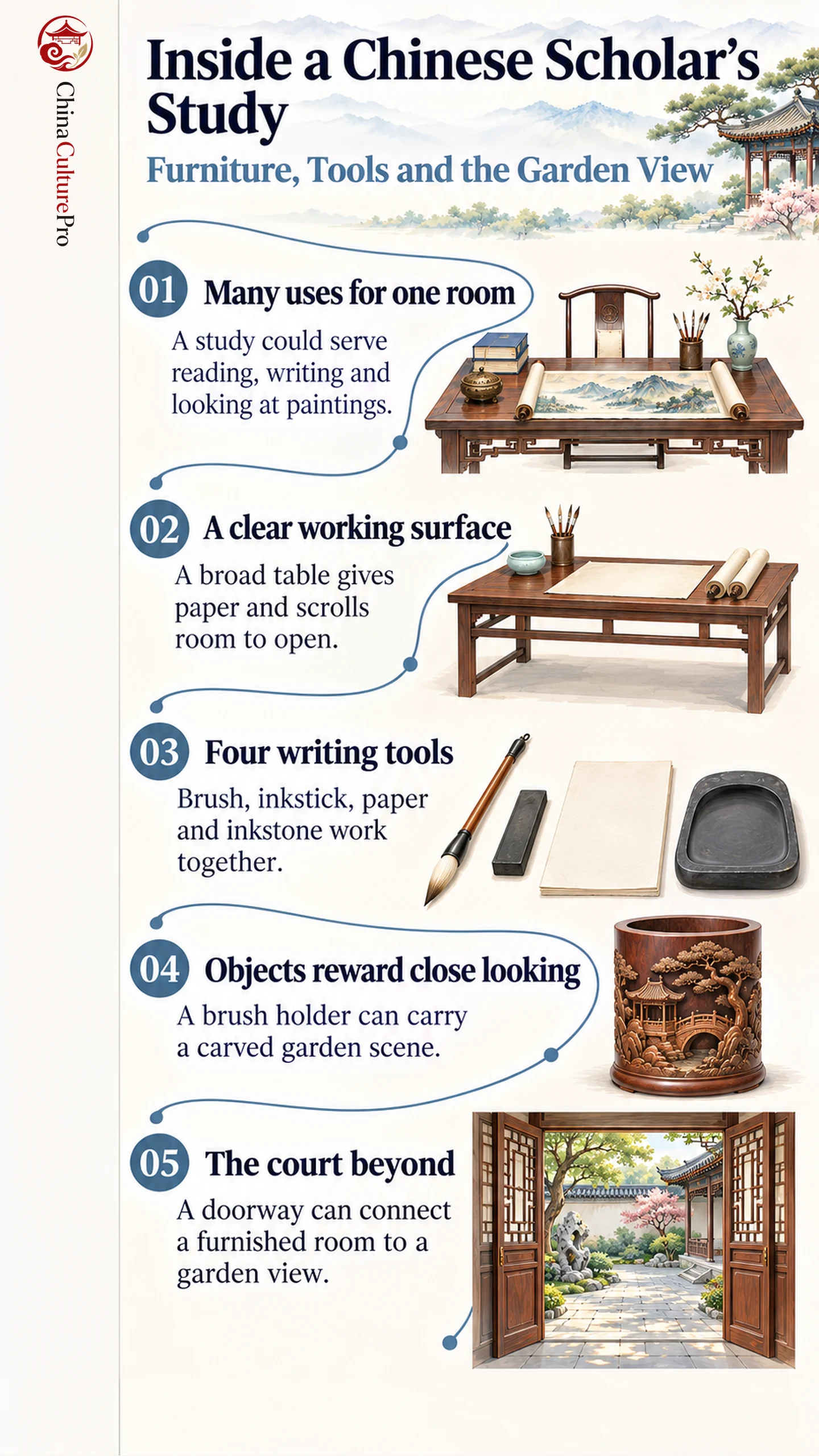
A table can hold an inkstone and a sheet of paper in the morning, then become a place to unroll a painting for a visitor. The objects nearby tell you what the room could do, and the view outside tells you how it belonged to a larger residence.
What Happened in a Scholar’s Study
The study belonged to a tradition of reading, writing, painting and other cultivated pursuits. A person could study texts, compose poetry, practice calligraphy or play music. The room could also hold objects for looking and contemplation. The mix of furniture and objects depended on what an owner did and how much room was available. [1][2]
A study could offer solitude, and some activities could also be shared. A visitor might join a conversation about a work of art or be served tea. A broad surface could change from a writing desk to a place to set down an object for a closer look. Related spaces in Chinese gardens could extend reading and conversation into a waterside room or a courtyard. [2][3][4]
Furniture and the Working Surface
A worktable is one way to see how the furniture supported a task. The Met holds a huanghuali wood painting table from the late sixteenth or early seventeenth century. It measures about 186 centimeters across and 76 centimeters deep. A surface on that scale makes room for a sheet or scroll and leaves space for equipment beside it. [5]
Other pieces could support looking or receiving a visitor. Chairs can orient people toward one another or toward a view. A side table can hold objects while leaving the main surface clear. In the Ming Room at the Met, a formal furniture arrangement illustrates reception and garden viewing. The catalogued painting table illustrates another task: a long surface used for work with paper or a scroll. [2][5][4]
The Four Treasures of the Study
Four basic tools give a picture of how a writer or painter could work with ink. The National Museum of Asian Art documents a set that the collector Pang Yuanji presented to Charles Lang Freer in 1918. [1][8]
- Brush. A flexible tip carries ink and allows the user to vary a stroke.
- Inkstick. Solid ink can be ground with water to prepare liquid ink.
- Paper. A sheet takes the marks of the brush and provides a surface for writing or painting.
- Inkstone. A hard surface lets the user grind the stick and hold the prepared ink.
Other objects supported the same work. A water dropper could supply a small amount of water, a brush rest kept the wet tip off the table, and a seal could add an impression to a completed work. These were useful accessories alongside the four basic tools. [1][8][2][9]
Things to Look At as Well as Use
A brush holder could hold brushes upright and carry imagery on its outer surface. One late eighteenth-century example in the Met is carved red lacquer. Its relief shows scholars in a garden. The figures and scenery continue around the outside, so looking at the design can mean changing your position around the holder. The object brings an image of literary company into the space where someone could read or work with a brush. [9][6]
Small scholars’ rocks were objects for close looking. A piece of limestone on a fitted stand could suggest a ridgeline or cliff. Chinese penjing offers a related approach to imagining a landscape at close range, using an arrangement in a container. The fitted stone’s silhouette can be the whole scene. In a tray, another element such as a tiny tree or a second rock can help suggest depth. [2][7][10]
How the Study Opened to a Garden
Astor Court opened at the Met in 1981 and took inspiration from a courtyard in the Master of the Nets Garden, one of the Suzhou gardens. The adjoining Ming Room was made to display furniture. Its tall lattice doors and windows open toward the court, allowing a viewer to see planting, rocks and paving from the room. [3][4]
The south-facing room and its open doors give the seated viewer a direct view into the court. Across a threshold, garden paths and windows can set the angle of a view. Garden names and plaques can give that place another layer of meaning. At Astor Court, a large wooden plaque inside identifies the Ming Room. The garden and hall were built together to show how furniture can relate to a view. [3][4]
FAQs About Chinese Scholars’ Studies
What are the Four Treasures of the Study?
The four are the brush, inkstick, paper and inkstone. A seal, brush rest or water dropper can support the work as a separate accessory. [1][8][9]
Was a scholar’s study used only for writing?
A study could be used for reading, writing, painting, music and looking at objects. Some rooms could also accommodate conversation or a visitor. [2][4]
Is Astor Court an original Chinese scholar’s residence?
It is a museum installation modeled on a courtyard in a Suzhou garden. The adjoining Ming Room was designed as a setting for the Met’s collection of furniture. [3][4]
資料來源
[1] National Museum of Asian Art. Four Treasures of a Scholar’s Studio
[2] McClung Museum of Natural History & Culture. Treasures of the Chinese Scholar
[3] The Metropolitan Museum of Art. The Astor Chinese Garden Court
[4] The Metropolitan Museum of Art. A Chinese Garden Court
[5] The Metropolitan Museum of Art. Painting Table
[6] The Metropolitan Museum of Art. Brush Holder with Scholars in a Garden
[7] The Metropolitan Museum of Art. Scholar’s Rock
[8] National Museum of Asian Art. Ink
[9] Asian Art Museum. The Four Treasures and Other Utensils for a Scholar’s Desk
[10] The Huntington. Penjing