
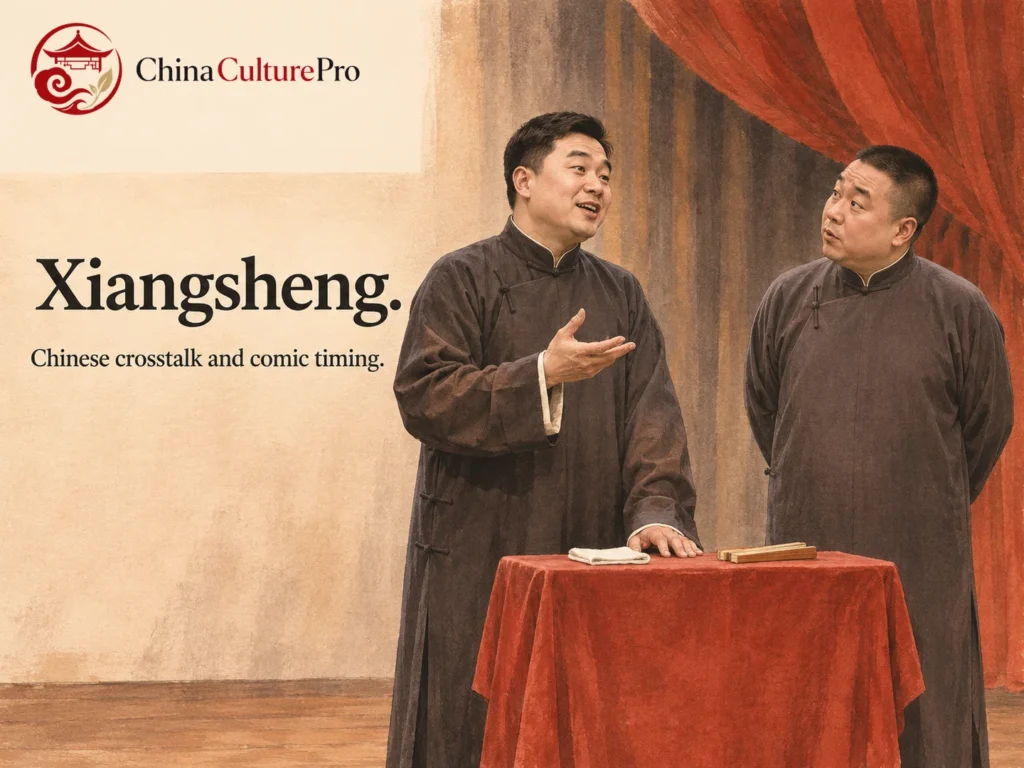

Quick Answer: What Is Xiangsheng?
Xiangsheng(相声,xiàngsheng), often called Chinese crosstalk, is a comic performance built around speech, timing and the audience’s expectations. A performer can imitate a voice, tell a story or build a misunderstanding. In a pair, the other performer can question the setup, interrupt it or give it the reply that makes the joke work.
The paired format is well known. The tradition also includes solo and group routines. Listen for what the performers let the audience assume and for the moment a reply or new detail changes that assumption.

A reply of just a few words can turn a long explanation into a joke. To hear what is happening in a crosstalk routine, follow the reply as closely as the speech that sets it up.
Beijing, Tianjin and a Tradition of Spoken Comedy
Xiangsheng is part of quyi(曲艺,qǔyì), a broad field of Chinese spoken and sung performance. The Beijing project entry traces its formation to the mid-nineteenth century and documents its spread across northern China. The project entered China’s national heritage inventory in 2008. Beijing and Tianjin became important centers. The Tianjin tradition includes the satirical work of performers such as Ma Sanli. [1]
A routine can draw on storytelling, mimicry or argument, then use a shift in wording to reveal an inconsistency. The form can work with a simple stage and a few performers because so much of the action takes place in what people say and what the audience thinks they mean. [1]
Solo, Pair and Group Formats
The number of performers changes the way a routine can handle a setup and response. The three forms below are documented in the national heritage inventory. [1]
| Format | Who performs | Example to find |
|---|---|---|
| Solo | One performer supplies the voices and changes of pace. | Ma Sanli in *Douni Wan*. [2] |
| 成對組合 | Two performers can develop a premise through exchanges. | Ma Sanli and Wang Fengshan in *Mai Guapiao*, a routine about selling tickets. [2] |
| 組合 | Three or more performers can build a setup across several voices. | Liu Baorui, Guo Qiru and Ma Ji in *Ba Magua*, a classic group routine. [3] |
To compare the first two, listen for a change of voice in the solo and the arrival of another person’s reply in the pair. In the group recording, listen for which performer answers and who changes the subject.
How the Lead and Supporting Performer Work Together
In a pair, the dougen(逗哏,dòugén) often drives the premise. The penggen(捧哏,pěnggén) responds. Those terms describe how the pair divide the work of establishing and turning a joke. The lead may keep pushing an improbable claim. The partner can repeat part of it, raise an objection or ask a question that lets the next detail land. [1]
Listen for a partner’s shortest lines. A repeated word may expose an ambiguity. A plain answer can make an extravagant claim sound stranger, and a pause can give the audience time to anticipate what comes next. The roles can share the work differently in different routines. The supporting part has its own timing and judgment.
Four Skills and the Timing of a Reveal
A familiar description of the craft is shuo xue dou chang(说学逗唱,shuō xué dòu chàng), usually explained as speaking, imitation, joking and singing. A routine can shift between these skills. A performer may imitate someone’s speech, for instance, to give the audience a voice to recognize when the performer returns to that person in the story. [4]
A comic reveal is often called a baofu(包袱,bāofu), literally a bundle. In performance, the setup lets one meaning seem obvious before a detail changes the listener’s understanding. The reveal may be a word, an answer or the return of something said earlier. Listen for the moment when an ordinary detail becomes part of the joke.
Where to Start Listening
Start with a recording whose title and performers are credited. The Ma Sanli collection includes both solo and paired routines. Compare the moment a voice changes in one with the moment the partner enters in the other. Listen again for the silence before the reply. It can tell you when the performer expects the audience to have caught up. [2]
Subtitles can help with the setup. Sound-alike words, accents and levels of formality may take more explanation than the subtitle can carry. A short routine with notes or a transcript gives you room to stop and check which words are doing the work.
FAQs About Xiangsheng
Is xiangsheng always performed by two people?
Pair routines are common. Solo and group routines are also established formats.
Is the supporting performer just a straight man?
The partner helps set the timing, tests the premise and can deliver important turns in the joke. The balance varies by routine.
Can subtitles fully convey a xiangsheng routine?
Subtitles can explain the story and some jokes. Sound-based wordplay and accents may need additional context.
資料來源
[1] China Intangible Cultural Heritage Digital Museum. Xiangsheng
[2] CCTV. Ma Sanli Crosstalk Collection
[3] CCTV Opera Channel. Recorded Performance of Bamagua
[4] China Culture Daily, via China Intangible Cultural Heritage Digital Museum. Tradition and Innovation in Xiangsheng