
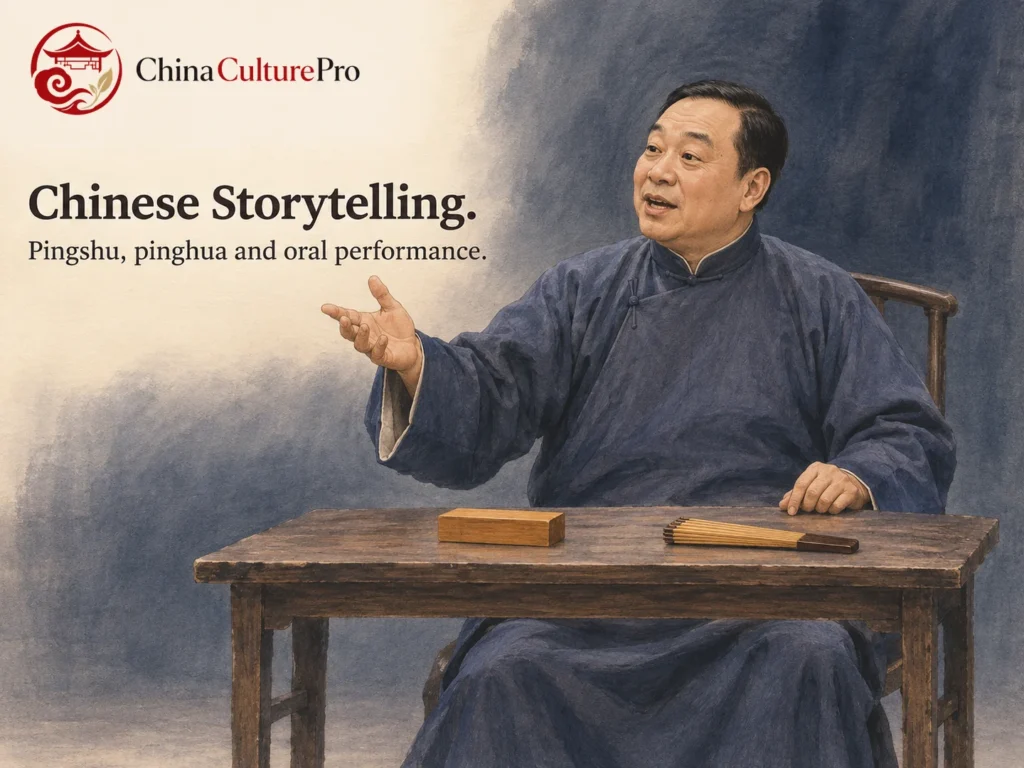

Quick Answer: What Is Chinese Storytelling?
Chinese storytelling includes performed narratives told in different regional traditions. Pingshu(评书,píngshū) is associated with northern spoken storytelling. Pinghua(评话,pínghuà) appears in the names of spoken forms such as those of Yangzhou and Suzhou. Suzhou pingtan(苏州评弹,Sūzhōu píngtán) includes both a spoken form and a form with singing and instruments.
A storyteller can narrate an event, switch into a character’s voice and pause at the point when a listener wants to know what happens next. The language, music and division into episodes can help identify the performance.
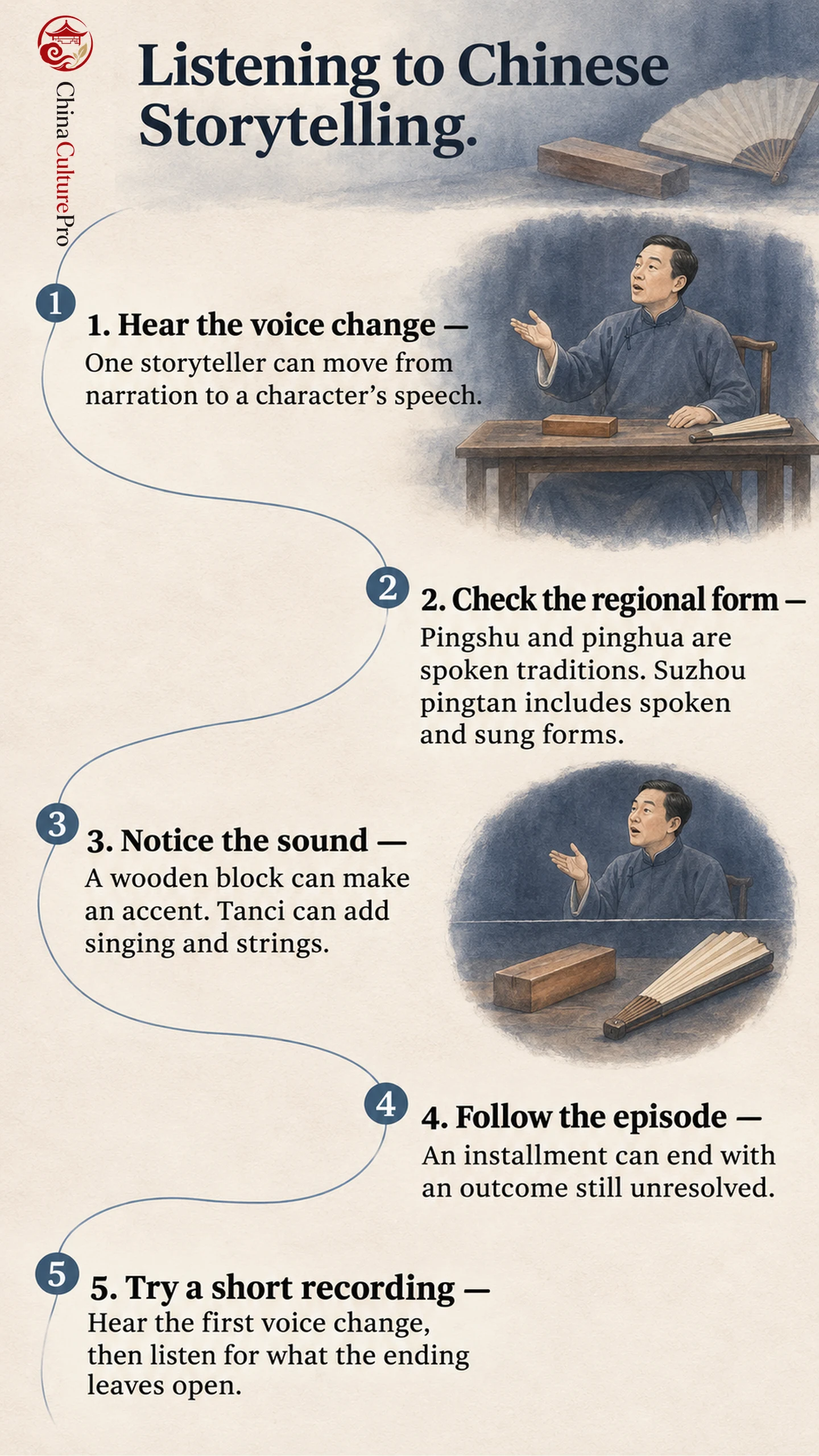
One storyteller can become a narrator, a general and an anxious messenger within a few lines. A change in voice, gaze or pace tells the audience whose voice you are hearing. Watch for those changes before trying to follow every name in the story.
From Narrator to Character
In Beijing pingshu, one performer can sit behind a table and build a scene with speech, facial expression and gesture. The storyteller can describe a place, shift into a character’s words or imitate a sound. Those changes let the listener follow both the larger sequence of events and one person’s response. [1]
In Suzhou pinghua, a narrator can tell the story in the third person and then speak or act as one of its characters. The return to narration gives the listener a sense of what happened and what it means for the next part of the story. The actor can change pace or add detail depending on the passage and the audience. [2]
Pingshu, Pinghua and Pingtan Compared
The names overlap in English translation. The place named in the programme and the presence or absence of sung passages help distinguish these forms.
| 形式 | Speech or music | Where to place it |
|---|---|---|
| Beijing pingshu | Spoken narration and character voices, often by one performer | A northern tradition with repertoire including historical and adventure narratives. [1] |
| Yangzhou pinghua | Spoken performance using Yangzhou speech | A distinct tradition with its own ways of telling stories such as *Three Kingdoms* and *Water Margin*. [3] |
| Suzhou pinghua | Spoken performance in Suzhou speech within the Wu language area | One of the forms grouped under Suzhou pingtan. [2] |
| Suzhou tanci(弹词,táncí) | Storytelling that can combine narration, singing and string instruments | The other form grouped under Suzhou pingtan. [2] |
Check the specific Suzhou form named in the recording. A pingtan programme may include pinghua, tanci or selections from both.
Props, Voice and Musical Accompaniment
A Beijing pingshu storyteller may use a folding fan and a wooden block called xingmu(醒木,xǐngmù). The performer still carries the scene mainly through voice and gesture. A strike can draw attention to a moment. Listen to the next line to hear how the storyteller uses the accent. [1]
Suzhou tanci can add a sung passage and plucked strings to narration. The accompaniment changes the texture of the passage. Compare a point where a performer moves into song with one where a speaker simply changes character voice. Both can shift the listener’s attention. [2]
How Stories Continue Across Installments
A long story can be broken into episodes, with an opening that helps listeners recall the situation and an ending that builds interest in the next session. Beijing pingshu’s performance structure includes headings and points of suspense. A storyteller can delay an outcome even when the audience knows the larger story. [1]
Different storytellers can develop different versions of a narrative. Yangzhou’s tradition includes named approaches to Three Kingdoms 及 Water Margin. A performance can dwell on one character or event and compress another. The title identifies a shared story. In Yangzhou, Wang Shaotang became known for shaping sets of episodes around particular characters from Water Margin. [3]
How to Listen to a Storyteller
Find a credited performer and story title. Listen once for the change from narration into a character’s speech. Listen again to the end of the passage. Ask which fact the performer gives you and which outcome remains unresolved.
If comparing an excerpt with xiangsheng, listen for what organizes the passage. A storyteller may lead you toward the next event in a narrative. A crosstalk routine can build a comic turn through the timing of a reply. Individual performances can use both storytelling and humor.
FAQs About Chinese Storytelling
Are pingshu and pinghua the same?
Both can refer to spoken storytelling. Regional labels such as Beijing pingshu, Yangzhou pinghua and Suzhou pinghua identify distinct practices.
Is all Suzhou pingtan sung?
Suzhou pingtan includes spoken pinghua and tanci, which can combine speech, singing and string accompaniment.
Is xiangsheng the same as storytelling?
Xiangsheng is comic performance that can use storytelling. Pingshu and pinghua are organized around narrating and performing stories.
資料來源
[1] China Intangible Cultural Heritage Digital Museum. Beijing Pingshu
[2] China Intangible Cultural Heritage Digital Museum. Suzhou Pingtan
[3] China Intangible Cultural Heritage Digital Museum. Yangzhou Pinghua