

Quick Answer: What Did China Invent?
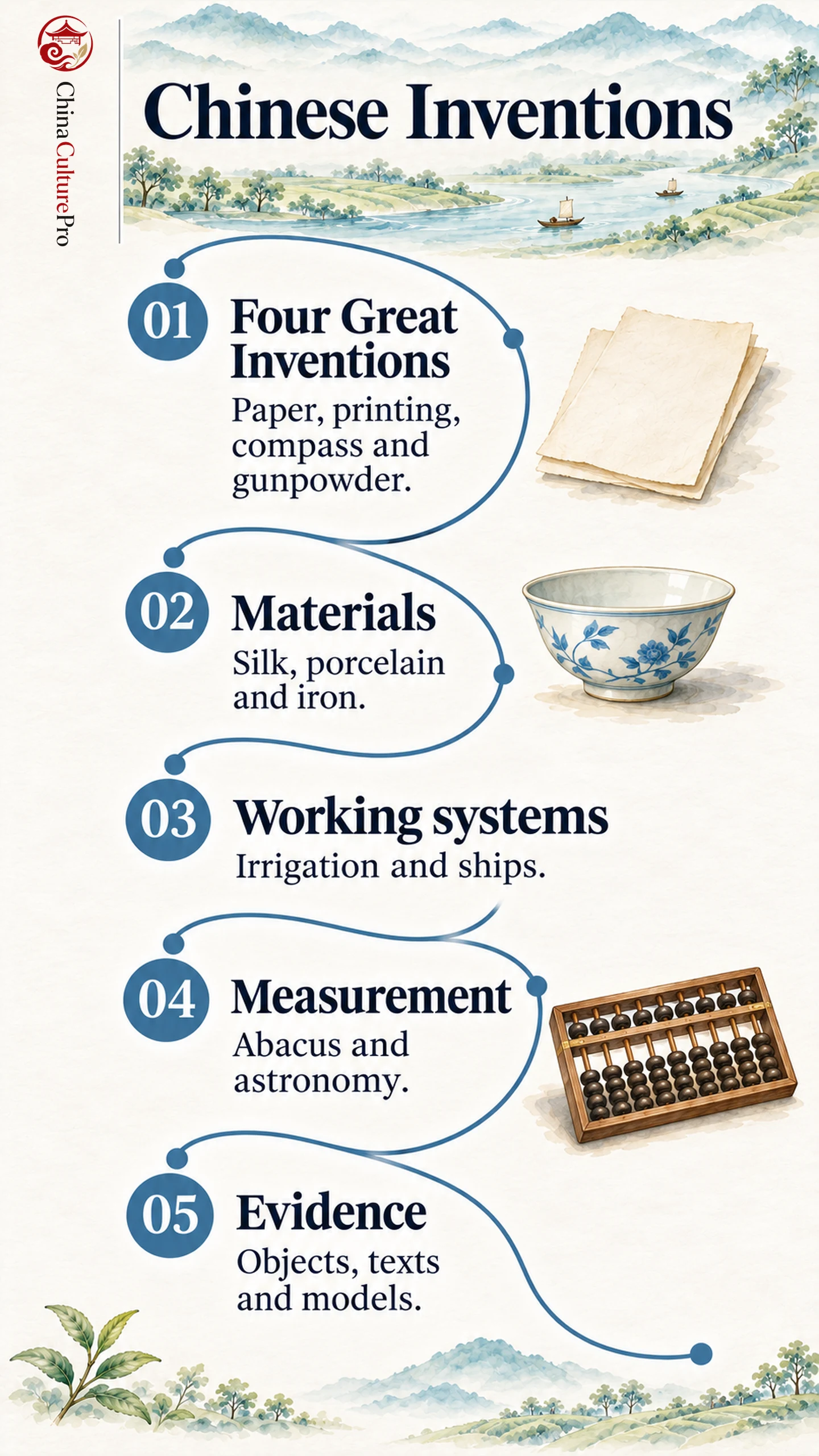
The Four Great Inventions (四大发明, sì dà fāmíng) are papermaking, printing, the magnetic compass and gunpowder. The familiar group is one way into the wider history of Chinese technology.
- Recording and copying: Paper provided a surface for writing. Printing made it possible to reproduce a text from a prepared surface.
- Direction and combustion: Magnetic instruments helped people find directions, while gunpowder had military and celebratory uses.
- Craft and construction: Silk, porcelain, ironworking, irrigation and shipbuilding developed through long traditions of practice.
- Measurement and calculation: Calendars, instruments and the abacus turned observations or numbers into usable information.
An excavated object, a dated text and a modern reconstruction offer different kinds of evidence about how a technology developed.
A Buddhist scroll with a dated dedication shows that printers could reproduce a long text by 868. The method itself had to be in use by then, and could be older. The same distinction applies to many technologies in Chinese history. Some innovations took shape in workshops over generations. Others appear first in government records or survive as objects whose earlier forms have been lost. [1][2][3]
What the Four Great Inventions Explain
The Four Great Inventions of China are a retrospective grouping. Their earliest evidence comes from different periods and sources. [1][2][3][4][5]
- Papermaking: The official Han history associates Cai Lun (蔡伦, Cài Lún) with a process presented to the court in 105 CE. Archaeological paper fragments are older. The history of paper distinguishes early material remains from recognition by the court. [2]
- Printing: The woodblock-printed Diamond Sutra from Dunhuang has a dedication dated 868. Chinese printing history includes both the printing of an entire page from a carved block and the later use of separate pieces of movable type. A printer could store an intact block for another impression of the same page, while a set of individual pieces could be reset to print a different text. [1][3][16]
- Compass: Magnetic direction finding gave sailors a reference when landmarks or stars were difficult to see. Different maritime designs appear in the historical record as use spread. The evidence for the Chinese compass includes accounts of its use rather than the name of one proven inventor. [1][4]
- Gunpowder: A Song military manual completed in 1044 documents gunpowder. Its military history and the use of related materials in fireworks tell different stories about how people applied knowledge of combustion. [5][6]
Making Things: Silk, Porcelain and Iron
Silk production joins agricultural work and textile skill. The process includes growing mulberry trees, raising silkworms, reeling the filament and weaving it. Cloth could travel far beyond the places that made it. Learning to produce it still required local knowledge of the silkworm’s life cycle and instruction in handling its filament. [1][7]
瓷器 shows how materials and firing skill created a distinct category of ceramic and a valuable export. A mid-fourteenth-century Jingdezhen plate in the Met has dark concentrations of blue within its painted decoration. The museum links those spots to how the cobalt pigment behaved during firing. The object records a stage in a technique that potters continued to refine. [1][15] Iron and steel history raises a different set of questions about furnaces, fuel and the treatment of metal. Research on Han blast furnaces points to sustained technical work in producing iron at scale. Each branch of manufacture depended on both equipment and expertise. [1][8]
Building Systems: Water, Crops and Ships
Construction at Dujiangyan began in the third century BCE. The system channels water from the Min River toward the Chengdu Plain. Its works direct water toward fields rather than simply holding it in one place. A working system depends on the relationship between the river, control structures and canals. It belongs to Chinese engineering history and to agricultural history, where the results depend on how water reaches fields. [9]
At sea, a technique associated with the shipbuilders of Fujian used watertight divisions within wooden vessels. If water entered one compartment, the divisions could limit its spread. The practice is an example of why the history of Chinese sailing ships includes what craftsmen built inside the hull as well as what sailors raised above it. [14]
Measuring, Counting and Recording
The Chinese abacus is a tool. Zhusuan (珠算, zhūsuàn) is the body of calculation practices associated with it, including spoken rules for moving beads. The device and the learned technique give complementary views of Chinese mathematics. Historical astronomy similarly joined observation with calculation, including the use of extra months to keep a lunisolar calendar aligned with the seasons. [10][11]
The Eastern Han scholar Zhang Heng is associated with an earthquake-detection instrument described for 132 CE. The Science Museum Group holds a cutaway model. Its visible interior represents one proposal for how Zhang Heng’s seismoscope could have worked. A working model tests a possible mechanism. Identifying the original mechanism would require evidence connecting it to the Han instrument. [12]
How to Read a Claim About an Invention
Start with the part of the claim the evidence can date. An early paper fragment demonstrates a material. A dated printed scroll demonstrates the use of a printing method. A woodblock edition of the Yellow Emperor’s Inner Canon made in 1339 shows how printing carried texts in Chinese medical history. Its printing date tells us when that edition was made. The material, the printing method and the much older text each have their own chronology. [2][3][13]
FAQs About Chinese Inventions
What are the Four Great Inventions of China?
They are papermaking, printing, the magnetic compass and gunpowder. The group brings together technologies documented in different periods.
Did Cai Lun invent paper?
He is credited in the official Han history with presenting a papermaking process in 105 CE. Earlier excavated fragments show that paper existed before then.
Why do museums display modern reconstructions of ancient instruments?
A reconstruction can show one way to interpret a description when the original device is missing or incomplete. Its date and label distinguish the modern object from the historical instrument.
資料來源
[1] Smithsonian National Museum of Asian Art. Technology and Production
[2] University of Oxford. Origins of Paper
[3] British Library International Dunhuang Programme. Cave 17: The Library Cave
[4] Smithsonian Institution. Time and Navigation: Magnetic Compass
[5] Peter A. Lorge. The Asian Military Revolution: China Through the Yuan
[6] Smithsonian Science Education Center. The Evolution of Fireworks
[7] UNESCO Intangible Cultural Heritage. Sericulture and Silk Craftsmanship of China
[8] Jesus College, University of Cambridge. Iron and Steel in Chinese History
[9] UNESCO World Heritage Centre. Mount Qingcheng and the Dujiangyan Irrigation System
[10] UNESCO Intangible Cultural Heritage. Chinese Zhusuan, Knowledge and Practices of Mathematical Calculation Through the Abacus
[11] British Library International Dunhuang Programme. History of Astronomy in China
[12] Science Museum Group. Model of the Zhang Heng Seismoscope
[13] UNESCO Memory of the World. Yellow Emperor’s Inner Canon
[14] UNESCO Intangible Cultural Heritage. Watertight-Bulkhead Technology of Chinese Junks
[15] Metropolitan Museum of Art. Plate with Fish
[16] Columbia University Asia for Educators. Technological Advances During the Song: Printing