
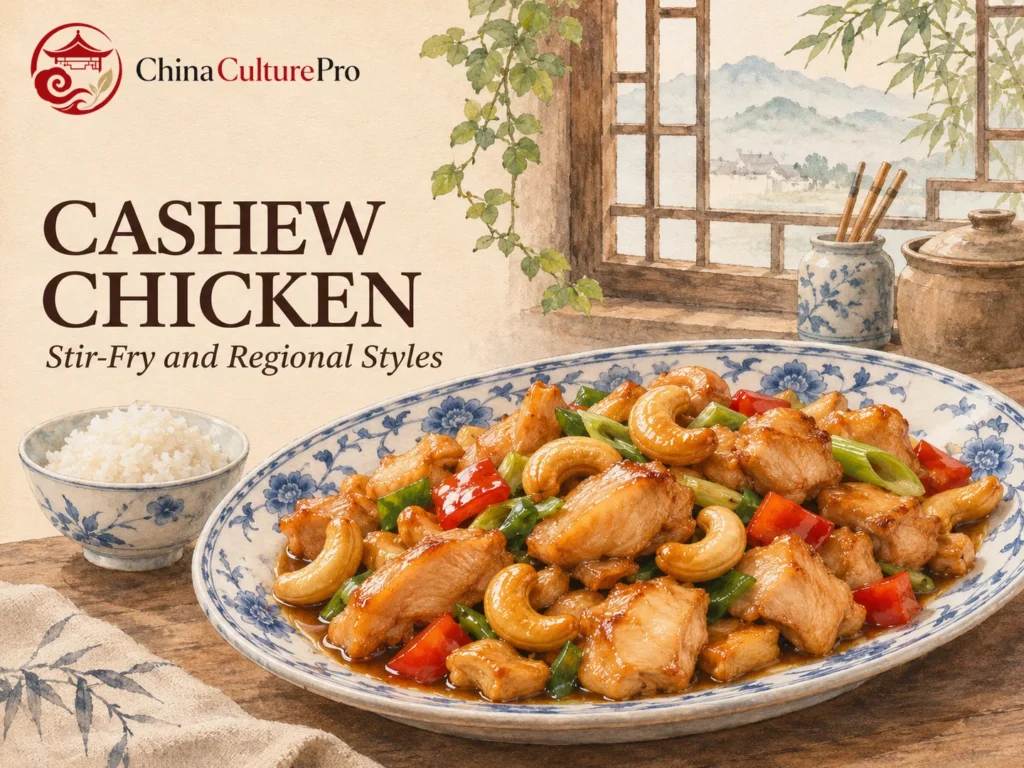

Quick Answer: What Is Cashew Chicken?
Cashew chicken (腰果鸡丁, yāoguǒ jīdīng) pairs bite-sized chicken with roasted cashews and a savory, lightly sweet sauce. The stir-fried version is a familiar Chinese-American takeout dish.[1]
- Stir-fry: Chicken, vegetables and sauce cook together near the end.
- Springfield style: Fried chicken pieces receive sauce, cashews and scallions.[4]
- Texture: Roasted nuts go in late rather than simmering throughout the cooking.[3]
The home recipe below makes a chicken-and-pepper stir-fry, without a breaded coating.

“Cashew chicken” does not identify one fixed preparation. Check whether a menu means a glossy stir-fry or a plate of crispy fried chicken with gravy before deciding what to order or cook. For the stir-fry, prepare the components first so the chicken can finish quickly and the nuts keep their contrast.
Stir-Fried and Springfield-Style Cashew Chicken
Two widely encountered versions have different textures:
- Stir-fried cashew chicken: Small chicken pieces and vegetables are coated in brown sauce, with roasted cashews folded through near the finish.[1][3]
- Springfield-style cashew chicken: Fried chicken chunks are topped with an oyster-sauce-based sauce, cashews and chopped scallions.[4]
The Springfield, Missouri, version is associated with Chinese immigrant chef David Leong and dates to 1963. That regional story should not be treated as the invention of every chicken-and-cashew stir-fry.[4] It is a useful example of Chinese-American food adaptation.
Stir-fry sauces vary: some combine honey and hoisin with soy sauce. Our oyster sauce (蚝油, háoyóu) and hoisin sauce comparison explains these different ingredients.[1]
Ingredients for a Chicken and Pepper Stir-Fry
For about four shared portions, prepare this home version. Tablespoons are 15 ml, teaspoons are 5 ml, and ½ cup is about 120 ml by volume.
- Main ingredients: 450 g boneless, skinless chicken breast or thigh, 1 diced bell pepper, ½ cup roasted unsalted cashews, 4 sliced garlic cloves, 2 teaspoons minced ginger, 2 chopped scallions and 2 tablespoons neutral oil.[2]
- Chicken coating: 1 tablespoon Shaoxing cooking wine (绍兴料酒, Shàoxīng liàojiǔ), ¼ teaspoon salt and 2 teaspoons cornstarch.[2]
- Sauce: 3 tablespoons oyster sauce, 1 tablespoon cooking wine, ½ tablespoon light soy sauce (生抽, shēngchōu), 1 tablespoon Chinkiang vinegar (镇江香醋, Zhènjiāng xiāngcù), 80 ml chicken stock, 2 teaspoons sugar, 1 teaspoon cornstarch, 2 teaspoons sesame oil and a pinch of white pepper.[2]
Cashews are part of the dish, not an optional invisible seasoning. If cooking for someone with food allergies, check every ingredient label and avoid their trigger foods; do not assume a different bottled sauce or another nut is a safe replacement.[6]
How to Make Cashew Chicken
Use a wide skillet or wok, mixing bowls, a clean plate and a food thermometer. Cut the chicken into even, bite-sized pieces.
- Prepare the components: Mix chicken with its coating ingredients. In a separate bowl, combine the sauce. Have the chopped vegetables and roasted cashews ready before heating the pan.[2]
- Sear the chicken: Heat 1 tablespoon oil over medium-high heat. Brown chicken in uncrowded batches; transfer to the clean plate to finish cooking later.[1][2]
- Cook vegetables and sauce: Add the remaining oil, ginger, scallions and pepper. Stir-fry until the pepper begins to soften, then add garlic briefly. Restir the sauce, pour it in and bring to a simmer.[3]
- Finish and add nuts: Return chicken and its juices. Stir until the sauce coats the ingredients and chicken reaches 165°F/74°C in its thickest pieces. Fold in cashews, toss briefly and serve immediately with rice.[3][5]
A thermometer gives the safe endpoint; surface browning alone does not. Keep raw chicken and its utensils separate from cooked food, and do not wash raw chicken before cooking.[5]
Keeping the Chicken Tender and the Cashews Crisp
The light starch coating is part of the preparation used in velveting meat. It is a thin coating, not a thick flour-and-crumb crust.[1]
- Give chicken room: An uncrowded layer makes browning easier. Remove it while preparing the other ingredients, then finish it in the sauce instead of extending the first sear.[2]
- Restir before pouring: The cornstarch in the mixed sauce can settle. Bring it back into suspension so the liquid thickens evenly when heated.[2]
- Add cashews late: A brief final toss gives a different result from leaving the nuts in the simmering sauce while the chicken cooks.[3]
FAQs About Cashew Chicken
Is cashew chicken the same as kung pao chicken?
No. Kung pao chicken (宫保鸡丁, gōngbǎo jīdīng) commonly combines chilies and peanuts; this cashew version uses cashews and a milder sauce.[1]
Should I use raw or roasted cashews?
Use roasted unsalted cashews for the recipe above. Raw nuts need a separate roasting step before their brief final toss.[1]
Do I need a wok?
No. A wide skillet works; leave room between chicken pieces.[2]
Can I prepare it ahead?
Prepare components ahead and keep the nuts separate until finishing. Refrigerate cooked chicken promptly, within two hours or one hour above 90°F/32°C, and use refrigerated leftovers within three to four days at 40°F/4°C or below.[5][7]
資料來源
[1] Bill / The Woks of Life. Cashew chicken
[2] Maggie Zhu / Omnivore’s Cookbook. Cashew chicken: Chicken and pepper stir-fry
[3] SBS Food / The Cook Up. Cashew nut chicken
[4] Springfield Convention & Visitors Bureau. Springfield’s cashew chicken trail and regional history
[5] Centers for Disease Control and Prevention. Chicken and food poisoning
[6] US Food and Drug Administration. Food allergies
[7] USDA Food Safety and Inspection Service. Suggested refrigerator storage times for chicken