
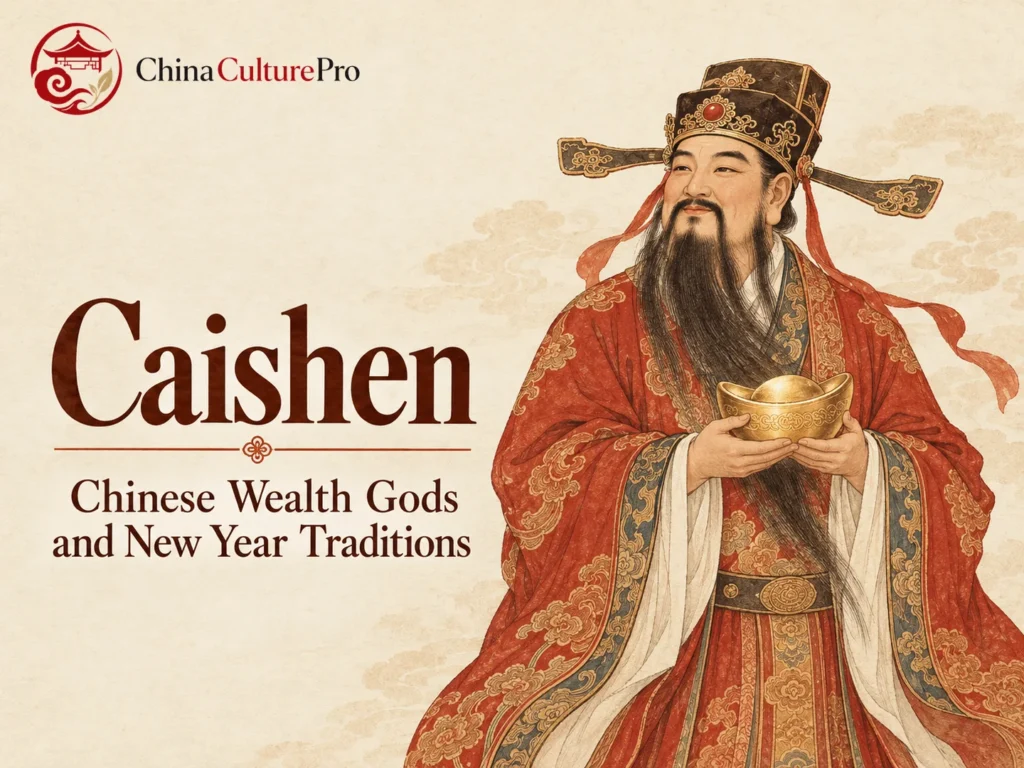

Quick Answer: Who Is Caishen?
Caishen(财神,Cáishén)means a god of wealth, but the name does not always identify one fixed person. Chinese wealth-god traditions include several historical and legendary figures, represented in temples, domestic shrines and auspicious images.
- Civil and martial: Official-looking and warrior-looking wealth gods form two familiar categories.
- Named figures: Zhao Gongming(赵公明,Zhào Gōngmíng), Bi Gan(比干,Bǐ Gàn), Fan Li(范蠡,Fàn Lǐ)and Guan Yu(关羽,Guān Yǔ)are important examples.
- Five Roads: A directional grouping expresses the wish for prosperity from every quarter.
- New Year: Welcoming the wealth god is especially associated with Lunar New Year, including fifth-day customs in several communities.
These are religious and cultural expressions of hoped-for prosperity. Neither a deity image nor a festival observance guarantees financial success, and local traditions need not follow the same list of gods. [1][2][8][9]
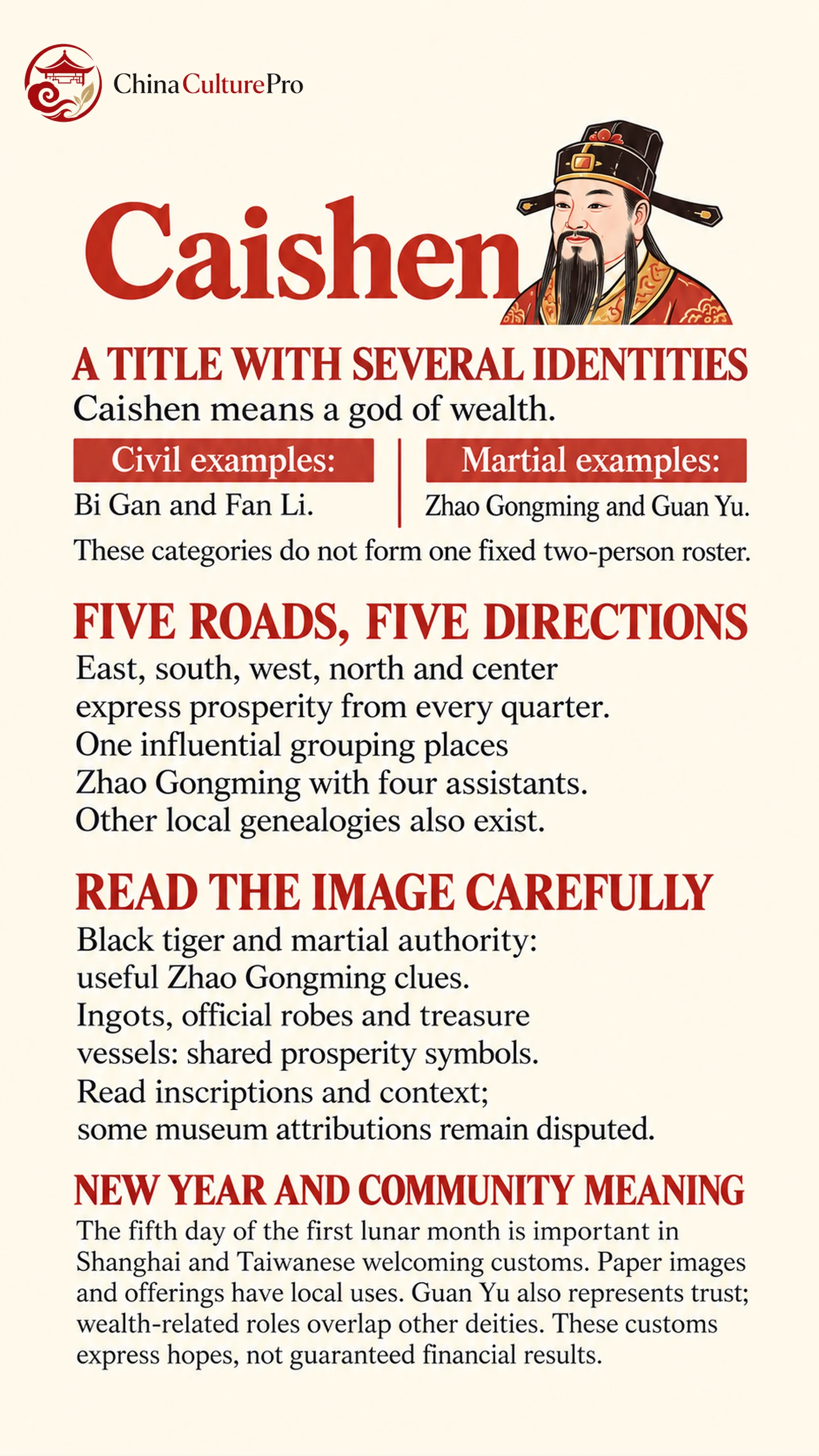
A bearded warrior on a tiger and an official holding an ingot can both belong to wealth-god traditions. To read a Caishen image, separate three questions: who the figure is, what its attributes mean, and how a particular community uses it.
One Name, Several Wealth Gods
The literal meaning of Caishen combines wealth or money with deity. It functions as a religious role as well as a familiar singular English name, “God of Wealth.” Translating it in the singular is convenient, but it can hide a much broader collection of identities. [1][8]
A temple may favor one named god, while a print presents a group or a less individually identified prosperity figure. That is why a modern smiling red-robed character should not automatically be treated as an accurate portrait of every wealth deity. The category developed through local worship, storytelling and visual conventions rather than one fixed biography. [8][9]
Civil and Martial Wealth Gods: Main Identities
“Civil” and “martial” describe familiar types of wealth deity. Civil figures are commonly shown in official dress; martial figures emphasize commanding or protective authority. They are useful distinctions, but not a universal two-person roster. [2][9]
| 人物 | Place in wealth-god traditions |
|---|---|
| Bi Gan | A civil wealth god associated in tradition with the upright Shang minister. A familiar legend links his missing heart with impartiality: an ethical symbol in his later divine identity, not a clinical or historical claim. [2] |
| Fan Li | A civil wealth god associated with the ancient Yue statesman and later stories of commercial success. [2][9] |
| Zhao Gongming | A martial wealth god commonly represented as a forceful, bearded figure riding a black tiger. His religious stories should not be mistaken for a securely documented ancient career. [1][3] |
| Guan Yu | The historical general later honored as Guan Gong or Guandi, with a wealth-related role linked to merchants and trust. This is one aspect of a much wider devotional identity. [5] |
What Are the Five Roads Wealth Gods?
The Five Roads Wealth Gods(五路财神,Wǔlù Cáishén)refer to a grouping associated with east, south, west, north and center. The idea is prosperity coming from all directions, rather than five literal streets that visitors must locate. [2][9]
In a well-attested grouping, Zhao Gongming stands at the center with four assistants: Xiao Sheng(萧升,Xiāo Shēng), Cao Bao(曹宝,Cáo Bǎo), Chen Jiugong(陈九公,Chén Jiǔgōng)and Yao Shaosi(姚少司,Yáo Shàosī). Their titles concern inviting treasure, receiving valuables, attracting wealth and favorable trade. The group appears in religious and popular-print traditions associated with the later novel Investiture of the Gods(封神演义,Fēngshén yǎnyì). This is evidence for an influential narrative arrangement, not proof of five contemporaneous historical officials. [3][9]
Other accounts of the Five Roads connect them with different local figures and road-head deities. Identify the tradition being described before assigning every five-figure image the same genealogy. [2]
Reading Caishen Images and Prosperity Symbols
An ingot signals prosperity; official robes suggest status; a fierce face, armor or tiger may point toward a martial figure. Zhao Gongming’s black tiger is a particularly useful clue when combined with his commanding appearance. These features should be read together with an inscription or catalogue identification. [1][3]
A late nineteenth- or early twentieth-century woodblock print places Guandi above two fortune gods. Gold bars, a ceremonial scepter and a treasure urn communicate wealth and recognition within that composition. The shared symbols do not make every figure in it the same god. [5]
Some identifications remain disputed even for museum objects. A Dehua porcelain figure dated 1610 has been called Caishen and also identified as Guandi. Its official clothing and wealth symbols do not settle the question on their own. This is a useful reminder to preserve an uncertain attribution rather than confidently rename an image. [6]
Welcoming Caishen at Lunar New Year
The fifth day of the first lunar month is an important wealth-god observance in documented Shanghai and Taiwanese customs. It is not a fixed Gregorian date, and the welcoming occasion should not be confused with a single birthday accepted for every named wealth god. [2][7]
A Shanghai account describes merchants preparing on the fourth evening and welcoming the wealth god around the turn into the fifth day. Lanterns, deity papers and offerings expressed hopes for a favorable trading year. The association with “roads” connects prosperity to movement and exchange, rather than to an instruction about modern shop placement. [7]
New Year paper images also brought wealth deities into the home. Some were displayed at the family altar; other ritual papers had shorter ceremonial uses. An image’s purpose therefore matters as much as its appearance. Compare the different placements and protective roles of Chinese door gods. [3][4]
Wealth, Trust and Living Religious Practice
Prosperity is not the only meaning carried by these figures. Guan Yu’s links to merchants also invoke loyalty and trustworthy relationships; the fuller story of Guan Yu and Guan Gong reaches far beyond money. Similarly, Tu Di Gong may have prosperity-related functions while remaining a local earth deity. [2][5]
The auspicious trio Fu, Lu and Shou belongs to a neighboring symbolic world, but blessing, official emolument and longevity are not simply three alternative names for Caishen. Avoid identifying figures solely because they appear on the same festive display. [10]
Within religion in China, wealth-god devotion can cross institutional and domestic settings. Read a shrine through its named deity and community history. Respect local directions about ritual objects and photography; describing the tradition does not require turning it into a universal worship manual. [1][8]
FAQs About Caishen
Is Caishen One God or Several?
Caishen is often translated as one God of Wealth, but the title can cover several figures. A particular temple or image may identify one deity or a group. [8][9]
Is Guan Yu a Wealth God?
Yes, in some traditions. His association with merchants gives him a wealth-related role alongside his wider martial, moral and protective identities. [5]
Why Is Caishen Welcomed on the Fifth Day?
Fifth-day customs connect welcoming wealth gods with an auspicious return to trading and business. They are documented local traditions rather than one identical birthday rule for all wealth deities. [2][7]
Does Every Smiling Figure with an Ingot Represent Caishen?
No. Ingots are shared prosperity symbols. Read the figure’s other attributes, inscription and setting before giving it a specific name. [5][6]
資料來源
[1] National Museum of Finland. Caishen, god of wealth, collection sculpture VK6494:613
[2] Taiwan Historica. Taiwan Folk Artifacts Dictionary: civil and martial wealth gods
[3] Taiwan Historica. Taiwan Folk Artifacts Dictionary: paper offerings for the Five Roads Wealth Gods
[4] Columbia University Libraries. Chinese Paper Gods: Reading the Images
[5] Nelson-Atkins Museum of Art. Guandi and Two Fortune Gods, F88-44/339
[6] British Museum. Dehua deity figure dated 1610, identification discussion, 1930,1113.1
[7] Shanghai Hongkou District Government. Fifth-day wealth-god customs in Shanghai, 2024 cultural account
[8] Memor Museum. The Path to Wealth: Traditional Chinese Fortune Culture Exhibition
[9] Beijing Municipal Culture and Tourism publishing service. Cai Shen: identities and Five Directions grouping
[10] Los Angeles County Museum of Art. Lidded ewer in the form of Happiness with Prosperity and Longevity deities