

Quick Answer: Who Are the Eight Immortals?
The Eight Immortals(八仙,Bāxiān)are a familiar group of legendary and partly historical figures associated with Daoism and Chinese popular religion. Their individual stories differ, but together they became a widely recognized subject in painting, theatre, ceramics and other decorative arts.
- Membership: The familiar group has eight named members, listed below with their common attributes.
- Recognition: A gourd, fan, sword, drum, lotus, basket, flute and clappers or tablet can identify the group.
- Stories: Crossing the sea is their best-known collective adventure.
- Meaning: Images often express wishes for auspiciousness and long life.
They are not eight verified contemporaries whose shared adventure is documented history. Their symbolic powers belong to stories and belief, and an artist need not follow one unchanging object list. [1][2][3]
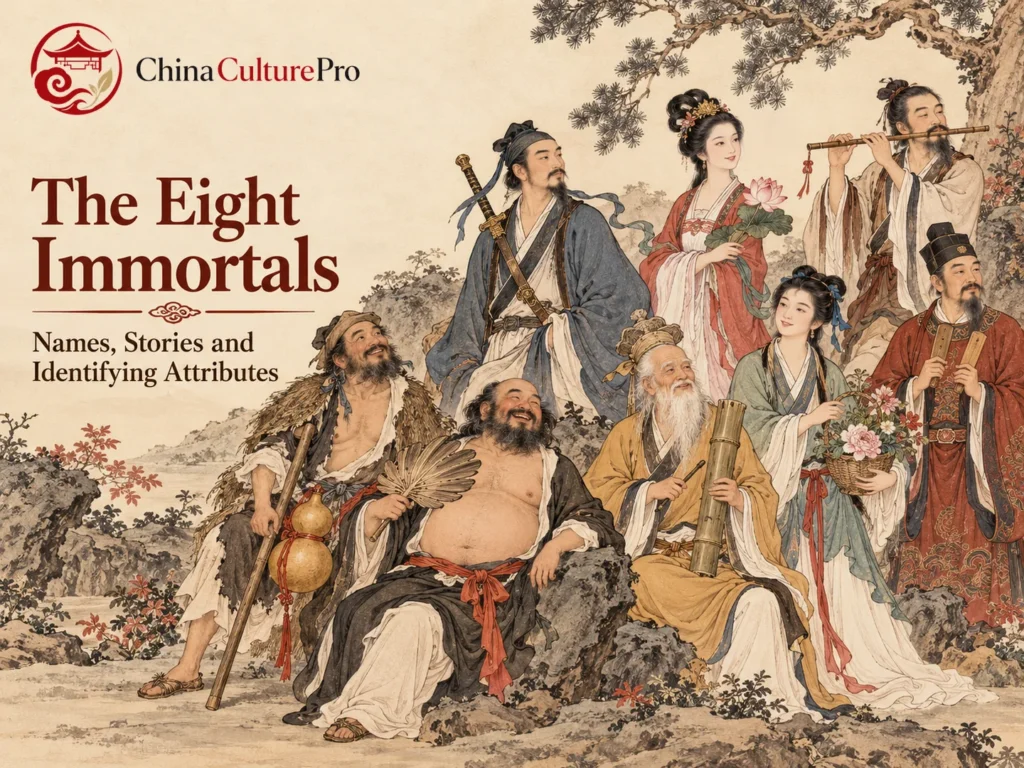
A sword, a flute and a flower basket can make a crowded immortal scene easier to read. Start with the familiar name-and-object associations, then look more closely: a sea-crossing story, a birthday gathering and an object-only design each use the group differently.
The Eight Immortals: Names and Common Attributes
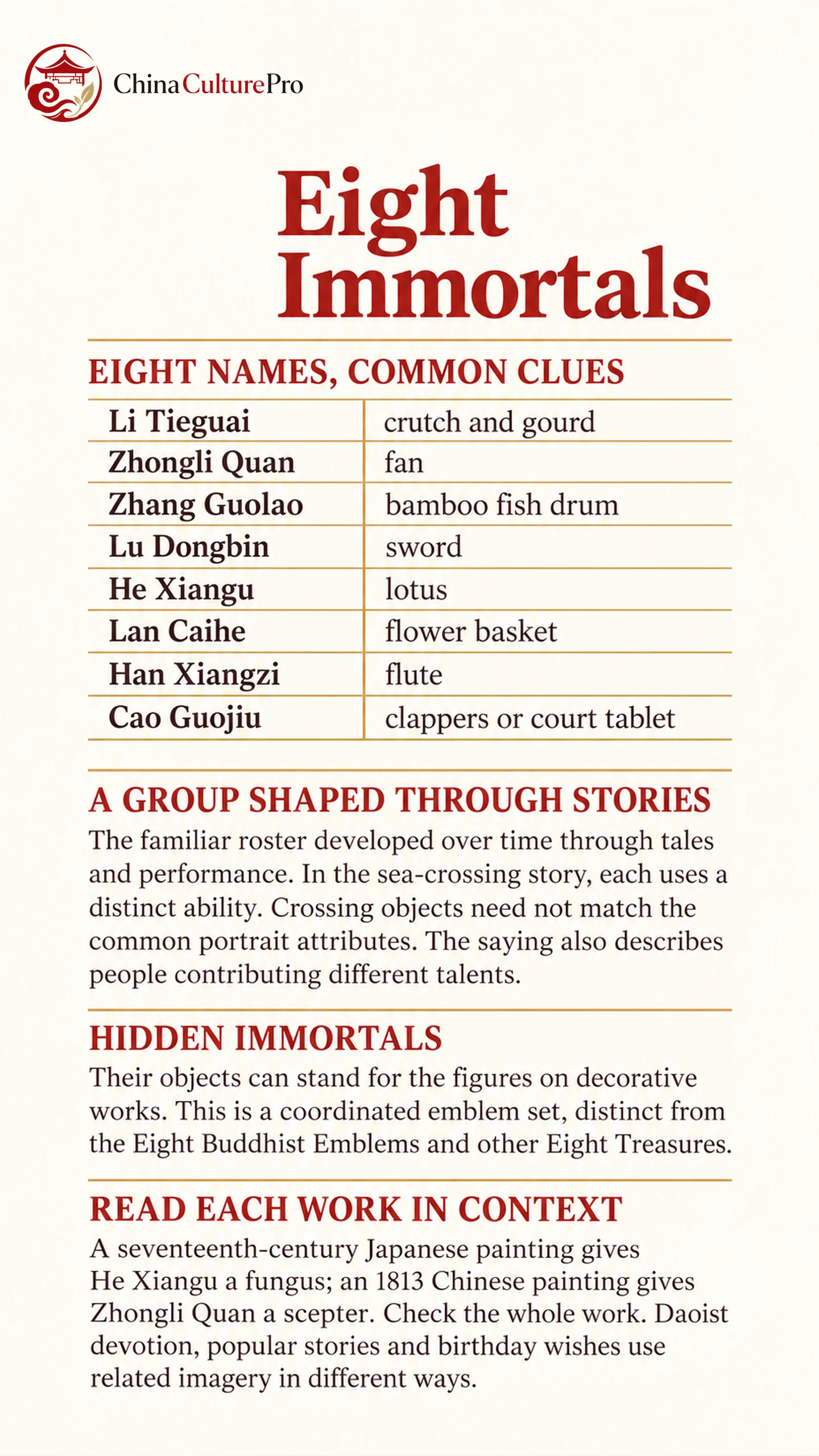
These are the eight members most readers mean today. The table gives common starting clues, not compulsory attributes for every century or medium. Older English spellings and shortened names can look different while referring to the same figure. [2][3][8]
| 名稱 | Common attribute | Recognition note |
|---|---|---|
| 李鐵拐(李铁拐,Lǐ Tiěguǎi) | Iron crutch and double gourd | Also called Tieguai Li; commonly shown as a wandering figure supported by his crutch. |
| Zhongli Quan(钟离权,Zhōnglí Quán) | 扇 | Also called Han Zhongli; Zhongli is the compound surname and Quan the personal name. A fan and exposed belly are familiar clues. |
| 張果老(张果老,Zhāng Guǒlǎo) | Bamboo fish drum | An elderly figure also associated in stories with a donkey; Zhang Guo is another form of the name. |
| Lü Dongbin(吕洞宾,Lǚ Dòngbīn) | 寶劍 | A familiar scholar-like immortal, sometimes also carrying a fly whisk. |
| 何仙姑(何仙姑,Hé Xiāngū) | 蓮花 | The clearly female member in the familiar roster; particular artworks may show another plant. |
| Lan Caihe(蓝采和,Lán Cǎihé) | 花籃 | A wandering performer whose gender presentation is not consistent across traditions. |
| 韓湘子(韩湘子,Hán Xiāngzǐ) | 笛 | Strongly associated with music and flower-related wonders in storytelling. |
| 曹國舅(曹国舅,Cáo Guójiù) | Clappers or a court tablet | Usually shown in official dress; different objects appear in different artistic conventions. |
How the Familiar Group Took Shape
The word xian(仙,xiān)is conventionally translated as “immortal” and names an ideal of extraordinary attainment in Daoist religion and legend. Stories describe people of varied backgrounds attaining extraordinary status. The group’s appeal lies partly in that diversity, rather than a single uniform appearance. [1][8]
The familiar roster emerged through a longer history of tales and performance. Song- and Yuan-period material did not always use the same members. The Ming novel commonly called Journey to the East(东游记,Dōngyóu jì)helped establish and circulate the recognized eight. Earlier references to another group of “eight immortals” should not automatically be read as references to these same individuals. [3]
Some figures connect with historical names or religious lineages, while their later biographies contain miraculous episodes. That mixed background is why “all imaginary” and “all verified historical people” are both poor summaries. The individual traditions of 呂洞賓 及 He Xiangu require their own closer examination. [1][8]
Crossing the Sea: A Story and an Idiom
Eight Immortals Crossing the Sea(八仙过海,Bāxiān guò hǎi)is a traditional tale in which the companions use their extraordinary resources to make the crossing. Instead of simply traveling together by cloud, each demonstrates a distinct ability. In a Ming literary account, the crossing involves such varied supports as a crutch, a paper donkey, musical implements and a tablet. [4]
The familiar saying continues with words meaning “each displays their powers.” In ordinary use, it describes different people contributing their own talents to a shared challenge. It need not imply that the speaker believes the miraculous journey literally occurred. [3][4]
Do not force every crossing object to match the decorative attribute table. Story versions and established portrait conventions have different histories. A musical implement used by one figure in a narrative can differ from the object most often used to identify that figure in art. [2][4]
The Hidden Eight Immortals: Objects Without Figures
The Hidden Eight Immortals(暗八仙,Àn Bāxiān)are an object-based design: the figures disappear, while their familiar implements stand for them. A gourd or fan is therefore more than a still-life detail when it belongs to this coordinated eight-object set. “Hidden” means implied through attributes, not a secret ninth member. [5]
Look for the set on ceramics, textiles and other decorative surfaces. Ribbons or a repeated arrangement can organize the objects without showing any human figures. The motif carries auspicious associations while allowing a compact design to suggest the whole group. [2][5]
It should be distinguished from the Eight Buddhist Emblems and from other sets called Eight Treasures. Those collections can share a lotus or another individual object, but have different membership and religious histories. For example, the Buddhist set includes a Dharma wheel and paired fish, while the immortal set includes a sword and a gourd. Read the collection as a whole. [2]
Why Attributes Vary Between Artworks
A seventeenth-century Japanese diptych provides a useful example. He Xiangu holds a fungus rather than a lotus; Lan Caihe appears with clappers; and a flower basket is associated with Han Xiangzi. These are features of that work, not errors that should be corrected to fit a modern checklist. [6]
An 1813 Chinese painting offers another variation: Zhongli Quan has a scepter, while Zhang Guolao holds a bamboo tube and Li Tieguai his crutch. Date, region, source imagery and an artist’s chosen episode can all affect the result. [7]
Use several clues together: name inscriptions, companions, costume, carried objects and the episode represented. In a difficult case, preserve the catalogue’s uncertainty rather than identifying the figure from one small shape alone.
Daoist Traditions and Birthday Imagery
The Eight Immortals belong to both religious Daoism and popular storytelling. Individual worship and the group’s appearance in stories need not have the same purpose. A temple image, a stage performance and a decorative vessel can all use recognizable identities without being interchangeable religious documents. [1][8]
Birthday scenes often show the immortals bringing auspicious wishes, sometimes in an assembly connected with Xi Wangmu, the Queen Mother of the West. In Taiwanese traditions, embroidered immortal hangings and auspicious performance openings also connect the group with celebration. These are culturally situated examples, not proof of one mandatory ceremony. [3]
A miniature porcelain group on a boat shows how the subject also entered decorative objects. Longevity and good-fortune associations help explain that appeal. They express celebratory wishes for long life and good fortune. The broader setting is religion in China, while the group should be distinguished from enlightened figures in Chinese Buddhism. [9][10]
關於八仙的常見問題
八仙是誰?
The familiar group consists of Li Tieguai, Zhongli Quan, Zhang Guolao, Lü Dongbin, He Xiangu, Lan Caihe, Han Xiangzi and Cao Guojiu. Some have alternative names or English spellings. [3]
八仙屬於佛教還是道教?
They are associated with Daoism and Chinese popular religion. Sharing an auspicious object with a Buddhist design does not make the two groups identical. [1][2]
Is He Xiangu the Only Female Immortal?
She is the clearly female figure in the familiar roster. Lan Caihe’s gender presentation varies, so an absolute “seven men and one woman” formula can obscure the tradition’s complexity. [8][9]
What Does “Each Displays Their Powers” Mean?
It comes from the sea-crossing tale and describes each person bringing a distinct ability to a common challenge. The phrase is also used figuratively. [3][4]
資料來源
[1] Art Institute of Chicago. Taoism and the Arts of China: Eight Immortals glossary
[2] USC Pacific Asia Museum. Rank and Style: Eight Immortals’ attributes and other auspicious sets
[3] Ministry of Education and National Academy for Educational Research, Taiwan. Education Encyclopedia: Eight Immortals, entry by Li Feng-mao
[4] Palace Museum, Beijing. Eight Immortals Crossing the Sea: traditional narrative
[5] Palace Museum, Beijing. Hidden Eight Immortals: the object-emblem motif
[6] The Metropolitan Museum of Art. Eight Daoist Immortals Welcoming Jurojin, seventeenth-century Japanese diptych, 14.76.52
[7] The Walters Art Museum. Zhu Wenxin, The Eight Immortals, 1813, 35.70
[8] Academy of Chinese Studies. Eight Immortals: names, individual traditions and worship
[9] University of Michigan Museum of Art. Eight Immortals on a Boat, PG2020.2.24A&B
[10] The Metropolitan Museum of Art. Cup with Eight Daoist Immortals, 08.212.7