

Quick Answer: Why Do Birds Make This Scene Feel Quiet?
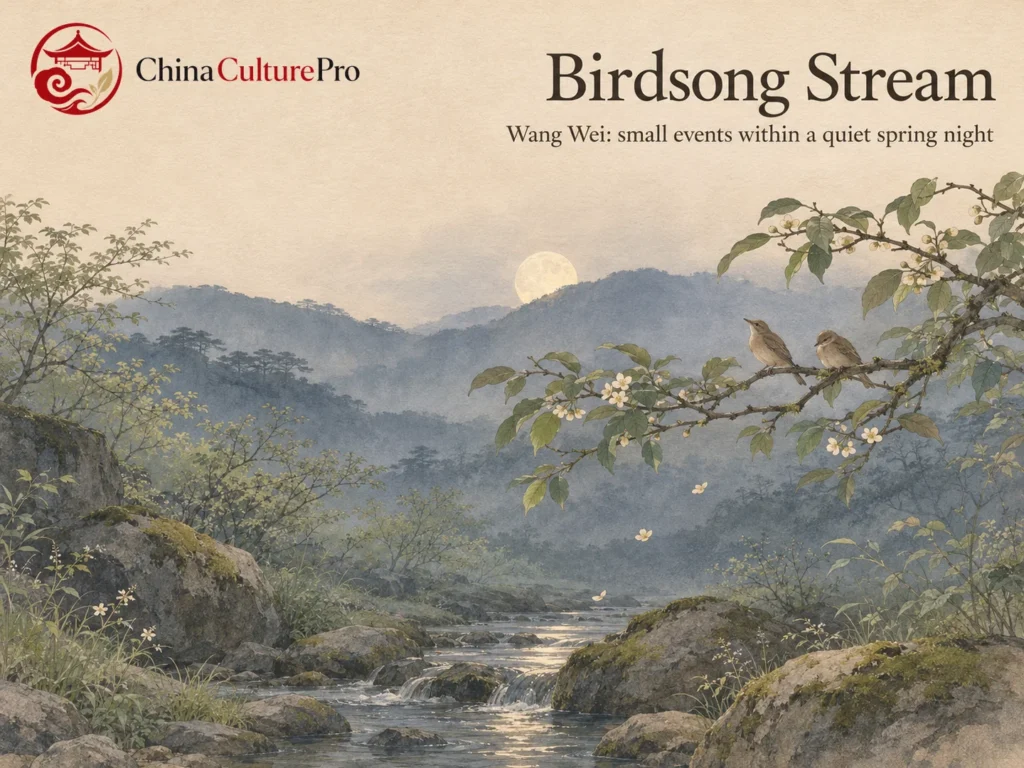
Birdsong Stream (鸟鸣涧, Niǎo Míng Jiàn) by Wang Wei (王维, Wáng Wéi) presents a quiet spring night through small events: falling blossoms, moonrise and occasional bird calls. The sounds stand out because the surrounding scene remains so still.
- Keep the season: The Chinese explicitly names spring in both the mountain and the ravine.
- Notice human attention: The opening places a person at leisure beside falling flowers.
- Listen for intervals: The birds call from time to time, rather than filling the scene with continuous noise.
The poem does not name a bird species, record an exact location or explain how the blossoms are perceived. Its precision lies in the sequence of attention.

A poem called Birdsong Stream might seem likely to describe an abundance of singing. Instead, three lines prepare the conditions in which a few calls become significant. The title’s sound arrives only after the scene has established leisure, darkness and quiet.
Read the Four Lines as a Spring Night Scene
The poem opens a five-piece group associated with Huangfu Yue (皇甫岳, Huáng Fǔ Yuè) and Yunxi (云溪, Yún Xī). It is a four-line, five-character quatrain; its complete text contains twenty characters. [1]
Gui blossoms (桂花, Guì Huā) are often translated as osmanthus flowers. The plant name raises a historical interpretation question, discussed below; retaining “gui” in this original English rendering avoids pretending that the poem establishes a modern botanical identity.
| Chinese line | Plain English rendering |
|---|---|
| 人闲桂花落 | A person at ease; gui blossoms fall. [1] |
| 夜静春山空 | Night is still; the spring mountain is empty. [1] |
| 月出惊山鸟 | The moon rises, startling mountain birds. [1] |
| 时鸣春涧中 | Now and then they call within the spring ravine. [1] |
The Wang Wei guide places this small landscape beside his wider work. The verse itself gives no date or journey narrative that needs to be supplied before its imagery can make sense.
Keep Human Leisure and Falling Blossoms in View
The first line sets a person’s unhurried state beside the falling blossoms. It does not describe a mountain entirely without human presence. The emptiness of the next line therefore works as a felt quality of the night, rather than a census of who is there. [1]
The word for leisure should not be casually changed into “the human world.” Likewise, the spring setting need not be rewritten as autumn to fit a familiar flowering season. Scholarship has challenged the argument that spring-flowering gui was necessarily impossible in the relevant historical setting. That does not establish a particular modern cultivar. [2]
The fall of a blossom is a small enough event to suggest sustained attention. Yet the Chinese does not expressly say “I hear,” “I see” or “I smell” it. An English translation may supply an act of watching for fluency; a reader should recognize that choice as an interpretation.
Let the person’s leisure and the landscape’s quiet support each other. There is no need to make the blossoms physically fall because someone meditates, or to turn every natural detail into a fixed religious symbol.
Hear the Bird Calls without Losing the Quiet
Moonrise brings a change in the scene’s light, and the verse connects it with the birds being startled. Their calls then occur “now and then.” The spaces between sounds remain part of what the reader imagines. [1]
That intermittent movement keeps the empty scene from becoming lifeless. Something responds within the landscape, but the response is small enough to make the surrounding stillness perceptible. The poem does not need the birds to leave the valley or gather into a large flock.
The sequence also joins sight and hearing. Blossoms fall, light appears, birds react, calls emerge. Read the movement through those events rather than treating the final line as a contradiction of the quiet night.
Compare Bamboo Lodge, where human music inhabits seclusion, and Deer Enclosure, where voices reach an apparently empty place. The nature poetry guide offers a wider reading path.
FAQs About Birdsong Stream
Is Birdsong Stream set in spring or autumn?
Spring. Both “spring mountain” and “spring ravine” appear in the Chinese, regardless of questions about the flower name.
Does the poem say the speaker hears the blossoms fall?
No act of hearing is explicitly stated there. Their fall invites attention, but the exact means of perception remains open.
Are the birds singing continuously?
No. The final line presents calls occurring from time to time, leaving intervals of quiet between them.
資料來源
[1] Wang Wei and Zhao Diancheng, via Wikisource. Annotated Collection of Wang Wei, Volume 13: Birdsong Stream
[2] Wang Shaohua, Fudan University Center for Research on Chinese Excavated Classics and Paleography. On Interpreting Ren Xian Gui Hua Luo in Birdsong Stream