


Quick Answer: What Happens in Bamboo Lodge?
In Bamboo Lodge (竹里馆, Zhú Lǐ Guǎn), Wang Wei (王维, Wáng Wéi) sits alone among secluded bamboo, plays a stringed instrument and whistles at length. No other person knows he is there, but the bright moon comes to shine on him.
- Read quiet as a setting: The speaker still makes music and a human sound.
- Keep the instrument clear: It is a zither, not a flute or a European lute.
- Notice the final change: Moonlight answers the preceding absence of human awareness.
The four lines leave the speaker’s mood unstated. Their solitude need not become either a diagnosis of loneliness or proof of perfect contentment.
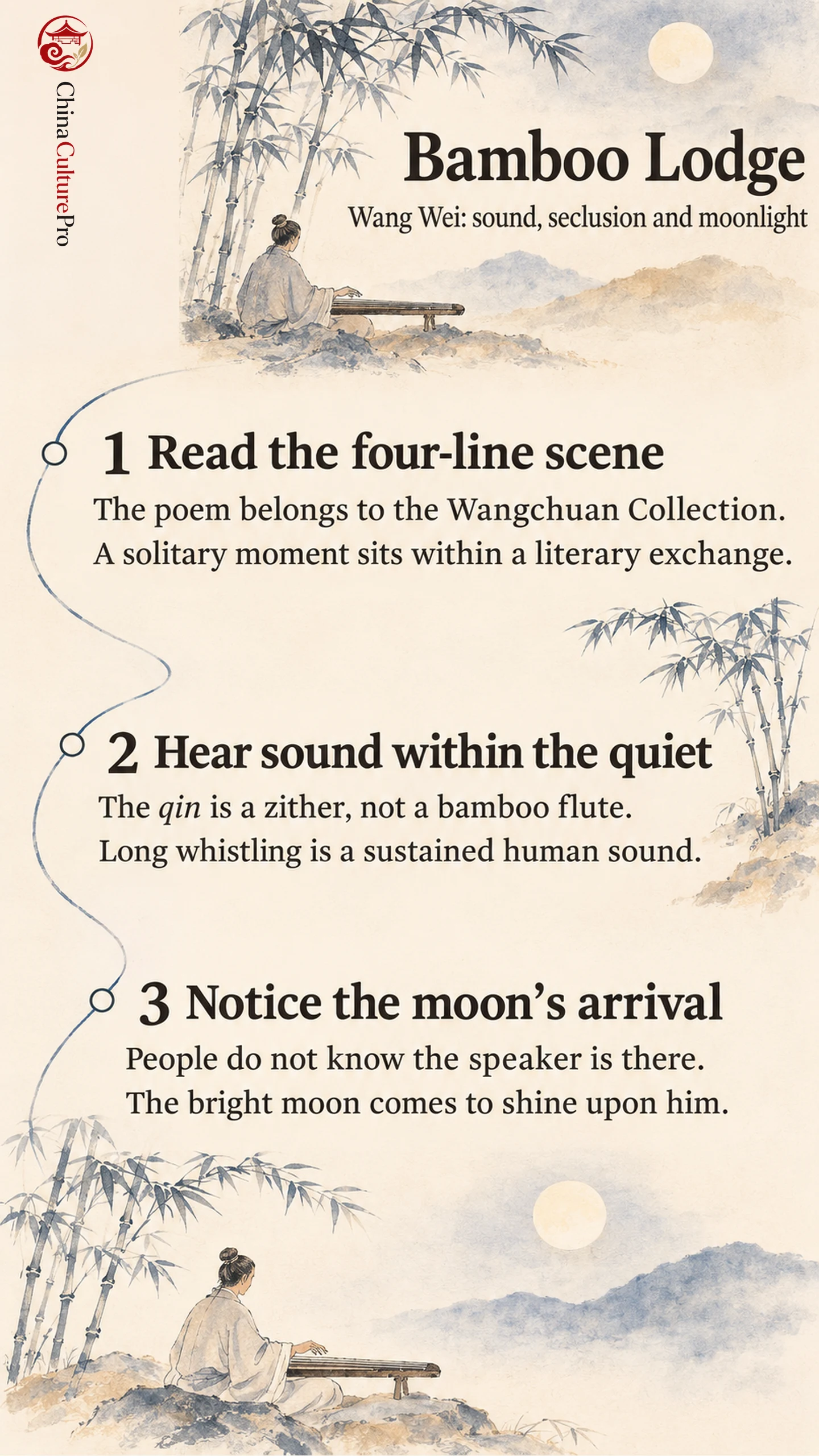
The poem gives very little visual detail about the lodge itself. Its attention rests on a person’s actions and on the relation between a hidden place, sound and light. That small sequence gives the twenty characters their movement.
Read the Four Lines in Their Wangchuan Setting
The poem belongs to the Wangchuan Collection (辋川集, Wǎng Chuān Jí). Its preface describes sites around Wang Wei’s estate and the quatrains he and Pei Di (裴迪, Péi Dí) wrote about them. A poem of solitude thus sits within a literary exchange. [1]
The instrument named qin (琴, Qín) is the zither now commonly called guqin (古琴, Gǔ Qín). Here is the complete text with an original English rendering. [2]
| Chinese line | Plain English rendering |
|---|---|
| 独坐幽篁里 | Alone I sit within secluded bamboo. [1] |
| 弹琴复长啸 | plucking the qin and whistling long. [1] |
| 深林人不知 | Deep in the woods, people do not know I am here. [1] |
| 明月来相照 | the bright moon comes to shine upon me. [1] |
The title points to a lodge, but the verse does not describe its roof, furniture or exact dimensions. Let the bamboo enclosure remain the immediate setting rather than inventing a fully furnished room.
The Wang Wei guide offers wider context for his poetry.
Hear the Qin and the Long Whistle within the Quiet
The guqin is a long, horizontally played seven-string zither. Unlike the larger guzheng, it has no row of movable bridges. Its comparatively soft sound and association with literati cultivation help explain why a solitary performance makes sense here. [2]
The next action, long whistling (长啸, Cháng Xiào), is a sustained human sound. The word can involve pursed-lip whistling or an extended ringing call; it does not name a bamboo wind instrument. [3]
These sounds keep the secluded scene active. Quiet does not mean that absolutely nothing can be heard. The music and whistle belong to the person sitting there, without requiring a public concert setting or requiring an audience. The verse supplies no tune or detailed performance technique. [1]
For the instrument’s wider culture, see the guqin guide. The guzheng and guqin comparison clarifies their different constructions.
Watch Moonlight Change the Feeling of Being Alone
The third line removes ordinary human recognition: people do not know about the speaker’s presence in the deep woods. The fourth then gives the scene a different kind of relation. The moon “comes,” giving the moonlight the force of an arrival. [1]
The effect is gently companionable without declaring that the moon literally thinks or understands. An English translation may emphasize companionship, but the underlying action is still illumination. The poem lets that action carry more feeling than a direct announcement of happiness would.
Read the third and fourth lines together. Stopping at the third produces isolation; including the fourth changes its quality. Yet neither line tells us to resolve every possible undertone into one fixed emotion or a documented episode of political withdrawal.
Compare Deer Enclosure, where voices and light also shape an apparently empty scene. The wider moon poetry guide shows how illumination can suggest quite different relationships.
FAQs About Bamboo Lodge
Is the qin in the poem a guzheng?
No. It is the instrument now commonly called guqin, a seven-string zither with a different construction from the guzheng.
Does long whistling mean playing a bamboo flute?
No. It describes a sustained sound made by the person. The bamboo in the poem is the surrounding grove.
Does being alone mean the speaker is unhappy?
The poem does not state that. Music, whistling and the moon’s arrival complicate a simple reading of the scene as loneliness.
資料來源
[1] Wang Wei and Zhao Diancheng, via Wikisource. Annotated Collection of Wang Wei, Volume 13: Wangchuan Preface and Bamboo Lodge
[2] Music Office, Leisure and Cultural Services Department, Hong Kong. A Rendezvous with the Guqin: Structure and Musical Uses
[3] Ministry of Education, Taiwan. Revised Mandarin Chinese Dictionary: Xiao