


Quick Answer: What Is Climbing High About?
Climbing High (登高, Dēng Gāo) by Du Fu (杜甫, Dù Fǔ) brings an immense autumn landscape into contact with one aging, ill traveler. Wind, birds, falling leaves and a rolling river lead toward distance from home, solitude and a wine cup recently set aside.
- Hear the opening: The scene begins with urgent wind and sorrowful animal cries.
- Compare the middle: Falling leaves and continuing water give vastness different directions.
- Keep the last verb: The speaker has stopped drinking; the poem offers no final toast.
The poem’s compressed language should not be turned into literal measurements of the speaker’s age or distance traveled.
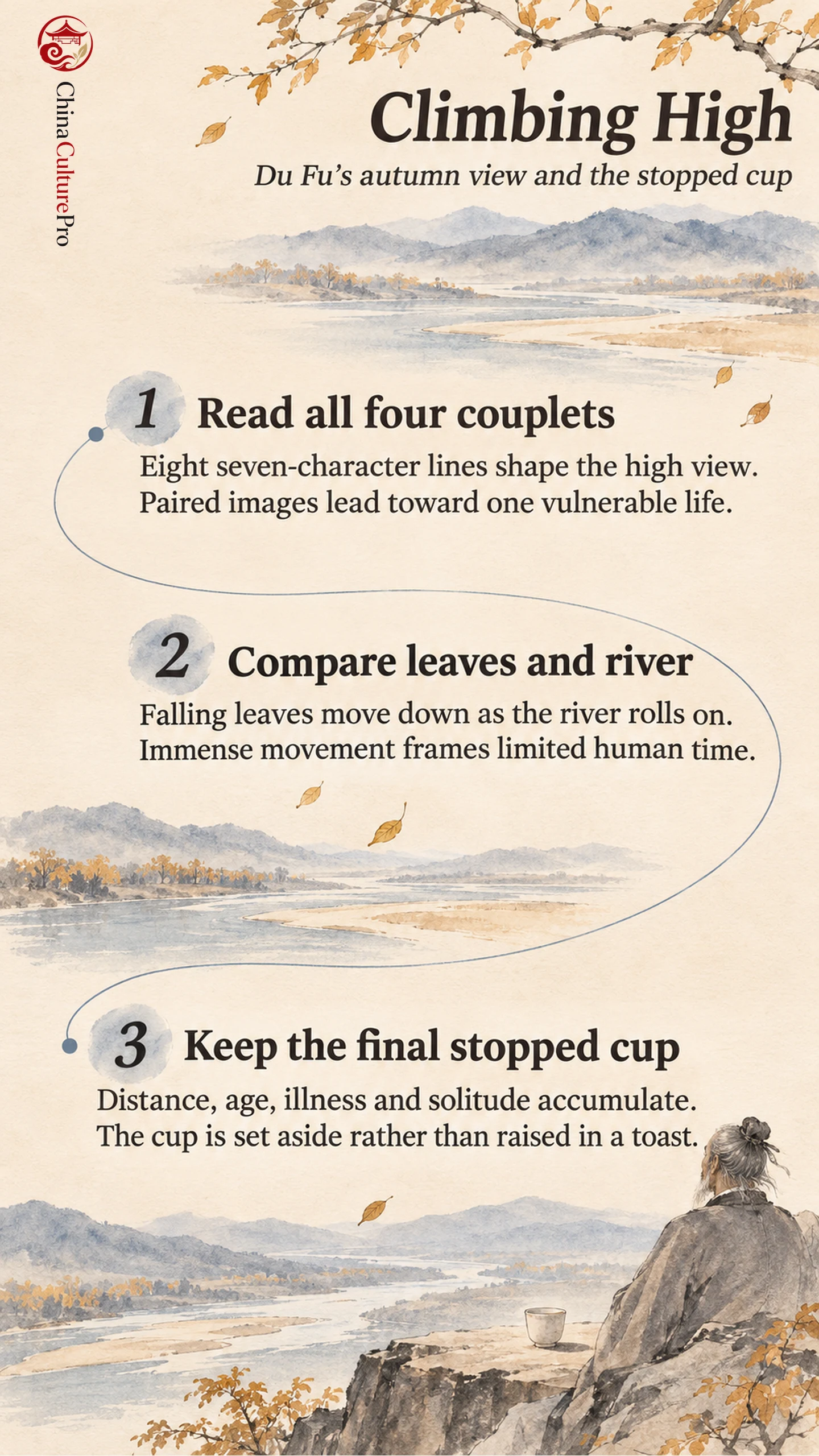
The title suggests an expansive view. The ending gives that view a painful limit: a human body cannot continue indefinitely like the river, and even a familiar comfort has become unavailable.
Read the Complete Poem and Its Four Couplets
The poem is traditionally placed in Du Fu’s autumn writing at Kuizhou (夔州, Kuí Zhōu), usually dated to 767. It is lushi (律诗, Lǜ Shī), regulated verse: eight lines of seven characters, arranged as four couplets. [1][2]
The Yangtze River (长江, Cháng Jiāng) is the great river named in the second couplet. Here is the complete poem with an original English rendering. [1]
| Chinese text | Original English rendering |
|---|---|
| 风急天高猿啸哀,渚清沙白鸟飞回。 | The wind is sharp, the sky high; gibbons cry mournfully. The islet is clear, the sand white; birds wheel in flight. [1] |
| 无边落木萧萧下,不尽长江滚滚来。 | Boundless falling leaves rustle downward; the endless Yangtze rolls on toward me. [1] |
| 万里悲秋常作客,百年多病独登台。 | Far from home, grieving at autumn, forever a sojourner; in an aging lifetime, often ill, I climb this terrace alone. [1] |
| 艰难苦恨繁霜鬓,潦倒新停浊酒杯。 | Hardship and bitter regret have thickened the frost at my temples; worn down, I have lately set aside the cup of cloudy wine. [1] |
The pairs are more than containers for separate observations. Parallel arrangements make the images answer each other, then make distance and a vulnerable lifespan answer each other in turn. [3]
For that craft, see the regulated verse guide; the Du Fu guide gives a broader introduction to his writing.
Set Falling Leaves against the Rolling River
The first couplet holds several perceptions together: wind, height, cries, pale sand and moving birds. The scene is sharply perceived without becoming comfortable. Its sound and movement prevent the high view from becoming a static picture. [1]
The next pair enlarges the field. “Boundless” faces “endless,” while falling downward faces water rolling toward the observer. The repeated sounds in the Chinese reinforce the contrast between rustling leaves and continuing flow.
“Falling wood” is the compact expression behind the leaves in English. It does not require whole trees toppling into the river. The landscape suggests seasonal loss without needing an invented flood or logging scene.
Nor is the river simply a reassuring symbol that life always improves. Its persistence can sharpen the speaker’s sense of limited time. What continues outside him does not cancel what is being lost within his own life.
Read the two lines together before assigning a fixed symbolic meaning to either image. Their force comes partly from the relation between them: two kinds of immense movement perceived from one exposed position.
Follow the Turn from Distance to the Stopped Cup
The fifth and sixth lines bring the observer into focus. Distance, autumn grief, repeated wandering, age, illness and being alone accumulate within one paired construction. Traditional commentary draws attention to these compressed layers. [2]
“A hundred years” evokes a human lifespan and approaching old age; it does not make Du Fu a centenarian. Likewise, the great distance is expressive rather than a route measurement to convert into modern miles.
The final couplet narrows the scale again. The landscape’s autumn has a bodily counterpart in the hair whitening at the temples. Then the cup brings the poem into the immediate present. The key word is “stopped,” not “filled” or “raised.” [1]
Traditional commentary connects that new interruption of drinking with illness. That is a reading of the historical poem, not enough evidence for a precise modern medical diagnosis. [2]
The restrained ending does not undo the vast opening. It makes its pressure felt in a small object and an interrupted action. Being alone here also does not prove that every relative and friend had died; the poem gives the speaker’s situation on the height.
Compare the seasonal pressure of Du Fu’s Autumn Meditations, then return to the Chinese poetry guide for other forms and periods.
FAQs About Climbing High
Does a hundred years mean Du Fu was one hundred years old?
No. It evokes a human lifespan and, in this context, the speaker’s sense of age and bodily decline.
Does the poem end with Du Fu drinking wine?
No. The final line says he has lately stopped the cup. Traditional commentary associates this with illness.
Does the title prove he climbed a mountain summit?
No. It means ascending to a high place. The poem names a terrace or elevated platform, without specifying a mountain summit or a particular surviving tower.
資料來源
[1] Du Fu, via Wikisource. Climbing High: Complete Text and Variants
[2] Qiu Zhaoao, via Wikisource. Detailed Annotations to Du Fu’s Poetry, Volume 20: Climbing High
[3] Yang Lian. The Poetics of Space, and More: Aesthetic Pressures on Classical Chinese Poetry and a Contemporary Solution