

Quick Answer: What Is Chinese Regulated Verse?
Chinese regulated verse, commonly called jintishi (近体诗, jìntǐshī), organizes poems through rules for line length, rhyme, historical tone patterns and, in key positions, paired wording.
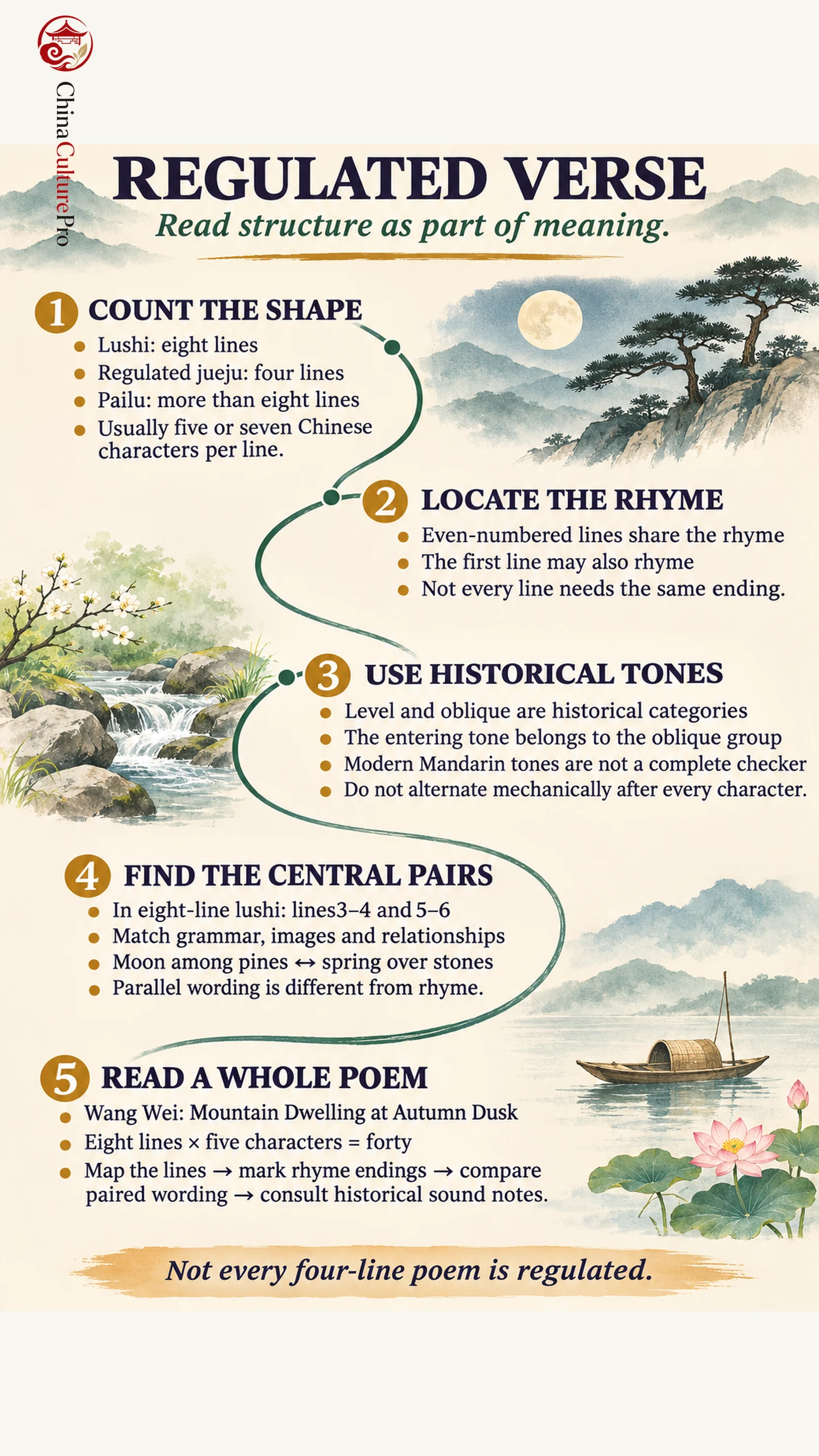
- Eight lines: Lüshi (律诗, lǜshī) normally consists of four couplets, with five or seven characters in each line.
- Four lines: Jueju (绝句, juéjù) includes regulated quatrains, but the wider label also covers older-style examples.
- Extended form: Pailü (排律, páilǜ) continues beyond eight lines, extending the sequence of regulated couplets.[1][2]
Line count gives you a starting point. Understanding a poem’s form also requires its Chinese text and the sound conventions appropriate to it.
A regulated poem makes relationships audible and visible: between repeated rhyme words, between corresponding phrases and between a scene and the thought it prompts. It is a major branch of Chinese poetry, not a rulebook followed by every classical poem.
Four Lines, Eight Lines and Extended Verse
The label “recent-style” reflects a historical distinction from gushi (古诗, gǔshī), older-style verse. Sound regulation developed before reaching a mature form in the early Tang period. Later poets continued to write both kinds; “old” and “recent” do not simply mean the date when a particular surviving poem was written.[1]
Two line-length labels are useful: wuyan (五言, wǔyán) means five characters per line, and qiyan (七言, qīyán) means seven. Punctuation does not count toward either total.
| 形式 | 常見形狀 | What else to check |
|---|---|---|
| Five-character lüshi | Eight lines, forty characters | Rhyme, tone pattern and the two central parallel couplets |
| Seven-character lüshi | Eight lines, fifty-six characters | The same kinds of regulation, with longer lines |
| Regulated jueju | Four lines of five or seven characters | Tonal and rhyme requirements; four lines alone are insufficient |
| Pailü | More than eight lines | Extended regulation and parallelism through the intervening couplets |
These shapes are standard reference points, rather than a claim that the poetic tradition has no variants. In particular, older-style quatrains do not become regulated merely because they contain twenty or twenty-eight characters. Start with the edition’s classification and then examine its evidence.[2][3]
For the historical setting, see Tang poetry. For comparison with tune-based lyrics and songs, use the comparison of poetry forms.
How Rhyme and Historical Tones Work
In the usual regulated pattern, even-numbered lines share a rhyme category, normally a level-tone rhyme. The first line may also rhyme; the other odd-numbered lines normally do not. Rhyming concerns the line endings, while parallelism concerns corresponding wording within paired lines. They are separate relationships.[1][2]
The tonal contrast is between ping (平, píng), the historical level category, and ze (仄, zè), the oblique group containing the other historical categories. One of these is ru (入, rù), the entering tone. The pattern governs relationships within a line, between the two lines of a couplet, and across neighboring couplets. It is not a demand that every successive character simply switch between two labels.[3]
Modern Mandarin pronunciation cannot serve as a complete checker. For example, 石, “stone,” is pronounced shí with a second tone today, but belongs historically to the entering category. Classifying it automatically as level because it has Mandarin tone two would give the wrong historical result.[6]
Chinese characters preserve the written text; pinyin (拼音, pīnyīn) represents modern Mandarin pronunciation. Neither the printed shape nor a modern tone mark by itself settles an ancient poem’s full sound pattern. Annotated editions and historical rhyme references supply the missing context.[3]
Reading an Eight-Line Poem
Wang Wei (王维, Wáng Wéi) provides a clear example in Mountain Dwelling at Autumn Dusk (山居秋暝, Shānjū Qiū Míng). Below are its four couplets, each containing two five-character lines. The English gives a brief sense of each pair rather than a matching English meter.[4]
| Lines | Chinese couplet | Sense of the pair |
|---|---|---|
| 1–2泡 | 空山新雨后,天气晚来秋。 | After fresh mountain rain, evening brings autumn’s coolness. |
| 3–4 | 明月松间照,清泉石上流。 | Bright moonlight shines among pines; clear spring water flows over stones. |
| 5–6 | 竹喧归浣女,莲动下渔舟。 | Noisy bamboo reveals returning laundry women; moving lotus plants reveal a passing fishing boat. |
| 7–8 | 随意春芳歇,王孙自可留。 | Spring’s fragrant growth may fade; the addressed figure can still remain here. |
The even-line endings are 秋, 流, 舟 and 留: qiū, liú, zhōu and liú in modern Mandarin. Their written sequence lets you locate the rhyme positions before studying the historical category. Do not require their modern spellings to look identical.[4]
Lines three and four show duizhang (对仗, duìzhàng), parallel arrangement. “Bright moon” corresponds to “clear spring”; “among pines” to “over stones”; shining to flowing. Lines five and six then pair bamboo with lotus, sound with movement, and human activity on land with a boat on water. Correspondence can combine similarity and contrast; it does not require two opposing opinions.[4][5]
For a small tonal example, the third line reads level–oblique–level–level–oblique, while the fourth reads level–level–oblique–oblique–level, using historical categories. Notice the contrast at important positions and the fact that the first characters need not be opposite. This pair also shows why “alternate after every character” is misleading.[3][4][6]
The formal pairs help the scene unfold. Quietness contains human presence, and the ending makes remaining in the mountain setting a meaningful possibility. The Wang Wei profile explains his wider writing; the guide to parallel couplets follows the related craft beyond this poem.[5]
Check Structure Without Losing Meaning
Use a few deliberate passes rather than trying to diagnose every tonal variation immediately.
- Establish the text: Use a reliable Chinese edition, preserving its characters and punctuation rather than counting an English translation.
- Map lines and rhyme: Count characters in each line, pair the lines and mark the rhyme words at the ends of even-numbered lines.
- Examine the central couplets: In an eight-line lüshi, compare lines three and four, then five and six, for grammatical and semantic correspondences.
- Check historical sound with notes: Consult an annotated edition or historical rhyme reference before judging tones, variant readings or apparent exceptions.
For a shorter comparison, Ascending Stork Tower (登鹳雀楼, Dēng Guànquè Lóu), usually attributed to Wang Zhihuan (王之涣, Wáng Zhīhuàn), has four five-character lines. Its first pair presents sun, mountains, river and sea; the second turns toward the wish for a farther view through another ascent. A compact shape still allows a change of thought.[7]
Return finally to meaning. Notes on literary allusions can explain a difficult inherited phrase, while nature poetry offers further examples of how scenery supports feeling and reflection. Formal checking should make those choices easier to notice.
FAQs About Chinese Regulated Verse
Does regulated verse always have eight lines?
No. Eight-line lüshi is a central form, but regulated quatrains have four lines and extended regulated verse has more than eight. The wider term jueju also includes older-style quatrains.[1][2]
Does every line rhyme?
Usually the even-numbered lines carry the shared rhyme. The opening line may join them, depending on the pattern. This is different from requiring both lines of every couplet to rhyme with one another.[1][2]
Must every couplet use parallelism?
The standard eight-line lüshi requires it in the two central couplets, lines three–four and five–six. The opening and closing pairs have greater freedom; quatrains do not inherit a requirement for two middle pairs.[1][2]
Can modern Mandarin tones verify an old poem’s rules?
They help you pronounce a modern reading but do not reproduce the historical system. Some characters now pronounced with Mandarin tones one or two belonged to the entering category and counted as oblique in traditional prosody.[3][6]
資料來源
[1] Key Concepts in Chinese Thought and Culture. Lüshi
[2] Radio Television Hong Kong. Classifying and reading classical poetry
[3] Yanwen Wu, University of Wisconsin–Madison. Tonal Prosody in Recent-style Verse of the Early Tang: From a Statistical Perspective
[4] Wang Wei, primary text via Wikisource. Mountain Dwelling at Autumn Dusk
[5] Hong Kong Education Bureau, Cheng Chung-shan. Rereading the classics: Wang Wei, Li Bai, Du Fu and Liu Zongyuan
[6] Taiwan Ministry of Education. Stone: historical character dictionary record
[7] Wang Zhihuan, primary text via Wikisource. Ascending Stork Tower