


Quick Answer: What Is Tang Poetry?
Tang poetry is poetry from China’s Tang (唐, Táng) dynasty, conventionally dated 618–907. It includes short lyrics and longer poems about landscape, separation, public life, military service and many other occasions.[1]
- Begin with a complete poem: A famous pair of lines may change meaning when you read what follows.
- Look at form and occasion: Line length, paired structures and the speaker’s situation work together.
- Read more than one voice: Different poets—and different poems by the same poet—handle similar images in contrasting ways.
The celebrated short anthology is a later selection, not the whole Tang poetic tradition.
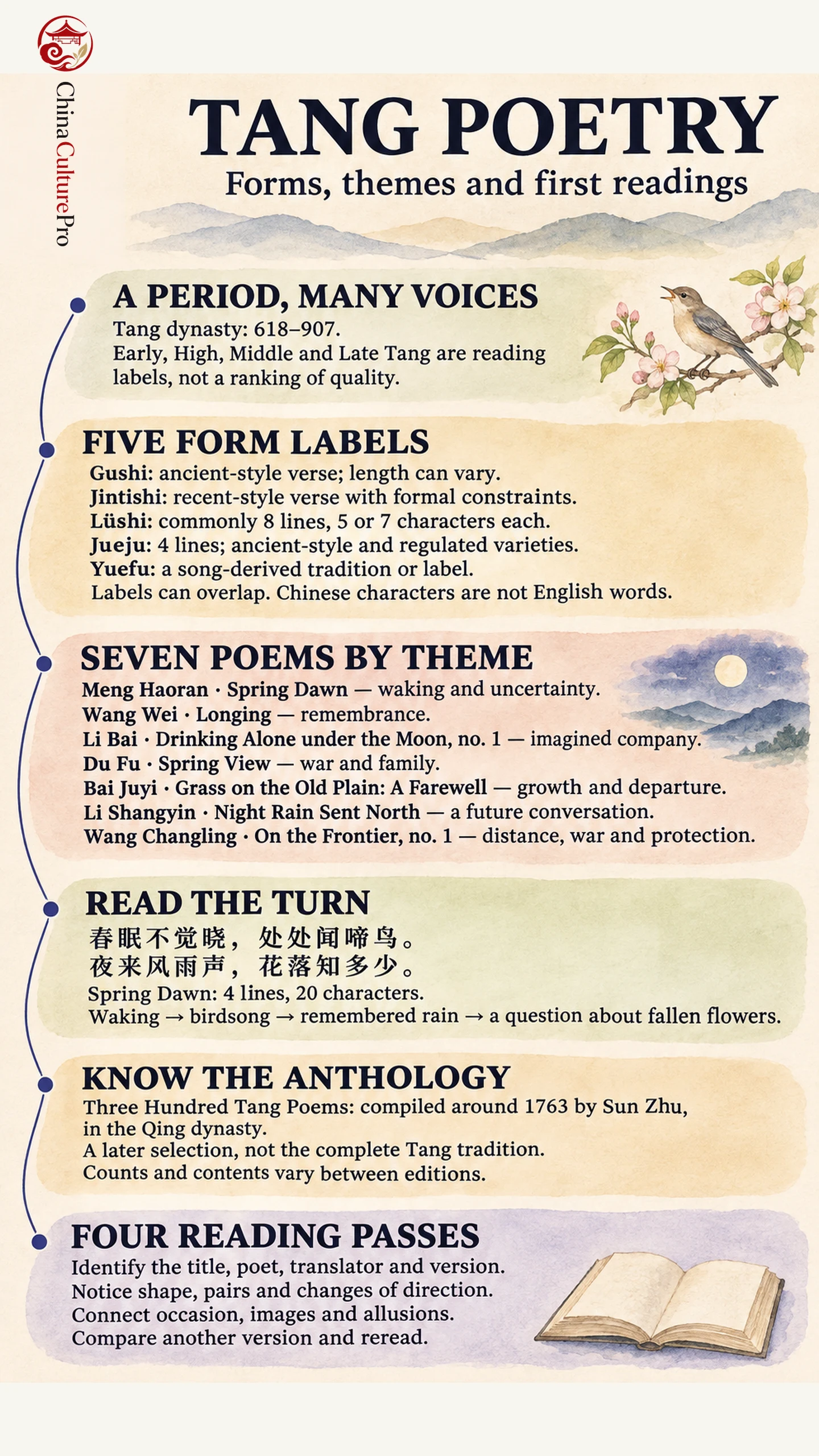
A reader can enter Tang poetry through a spring morning, a farewell or a letter that cannot promise a return date. These situations are approachable, but the writing rewards attention to what is said indirectly. Start with one poem, notice its shape, and let notes explain references that the first reading cannot supply. The broader Chinese poetry guide connects this period with earlier and later traditions.
A Dynasty of Poetry, Not One Uniform Style
Poetry occupied courtly, educational and social settings during the Tang dynasty. Literary skill could matter in official careers; poems also participated in relationships, travel, religious practice and exchanges between friends. A personal voice on the page need not imply that a poem was composed only for private reflection.[14]
Literary histories commonly use four period labels: Early Tang (初唐, Chū Táng), High Tang (盛唐, Shèng Táng), Middle Tang (中唐, Zhōng Táng) and Late Tang (晚唐, Wǎn Táng). One conventional scheme places their boundaries at 618–712, 713–765, 766–835 and 836–907. These labels help organize reading; they should not be mistaken for four uniform styles or an automatic ranking of quality.[1]
The early period helped consolidate formal possibilities, while later poets continued to reshape them. The military and political upheavals of the eighth century changed the circumstances of writing, but did not create a simple division between cheerful poems before a crisis and sorrowful ones afterward. Read a period label alongside the actual poem and its occasion.
The Main Forms: Line Length Is Only the Beginning
Five- and seven-character lines are common. Count Chinese characters in the verse, excluding punctuation; an English translation may need a different number of words or lines. The following names answer different questions about structure and tradition, so they are not five mutually exclusive boxes.[3][4]
| 標籤 | What it tells you |
|---|---|
| gushi (古诗, gǔshī) | Ancient-style verse that does not follow the full pattern of regulated verse; its length and structure can vary.[3] |
| jintishi (近体诗, jìntǐshī) | Recent-style verse organized through formal constraints such as line length, tone patterns and rhyme.[3] |
| lüshi (律诗, lǜshī) | In its common narrow sense, an eight-line regulated poem with five or seven characters in each line.[3] |
| jueju (绝句, juéjù) | A four-line poem, usually with five or seven characters per line; quatrains include ancient-style and regulated varieties.[4] |
| yuefu (乐府, yuèfǔ) | A song-derived poetic tradition or label that can overlap with descriptions of a poem’s line length and form.[2][12] |
Regulated verse involves more than counting. Tonal organization, rhyme and parallel relationships between paired lines contribute to its construction; the middle pairs of an eight-line poem are especially important for parallelism. Modern Mandarin readings can help you hear a poem, but they do not reproduce the historical sound system on which these rules depended.[3]
The regulated-verse guide develops those details. For the wider relationship between major verse families, use the comparison of major Chinese verse families. A convenient English word such as “lyric” does not remove the distinctions between Chinese formal labels.
Seven Poems and the Themes They Open
These are reading choices, not a ranking of the “best” poems. The English titles are identifying labels; editions may use different translations.
| Poet and poem | What to read for |
|---|---|
| Meng Haoran (孟浩然, Mèng Hàorán), Spring Dawn (春晓, Chūn Xiǎo) | Four five-character lines move from waking and birdsong to remembered wind and rain, then a question about fallen flowers.[5] |
| Wang Wei (王维, Wáng Wéi), Longing (相思, Xiāng Sī) | A four-line, five-character poem makes red seeds a focus for remembrance. The emotional relationship need not be reduced to one confidently identified romantic recipient.[6] |
| Li Bai (李白, Lǐ Bái), Drinking Alone under the Moon (月下独酌, Yuè Xià Dú Zhuó), no. 1 | Fourteen five-character lines imagine the moon and a shadow as companions. The attempt at company does not erase solitude.[7] |
| Du Fu (杜甫, Dù Fǔ), Spring View (春望, Chūn Wàng) | Eight five-character lines connect a damaged public world, family separation and the speaker’s body.[8] |
| Bai Juyi (白居易, Bái Jūyì), Grass on the Old Plain: A Farewell (赋得古原草送别, Fù Dé Gǔyuán Cǎo Sòngbié) | The complete poem has eight five-character lines. Its resilient grass leads onward to a landscape of departure and the feeling of seeing someone off.[9] |
| Li Shangyin (李商隐, Lǐ Shāngyǐn), Night Rain Sent North (夜雨寄北, Yè Yǔ Jì Běi) | Four seven-character lines move from an uncertain return date to an imagined future conversation about the rainy present.[10] |
| Wang Changling (王昌龄, Wáng Chānglíng), On the Frontier (出塞, Chū Sài), no. 1 | Four seven-character lines bring historical distance, soldiers’ nonreturn and the wish for capable military protection into a frontier setting.[11] |
Read the Wang Wei, Li Bai, Du Fu 及 Bai Juyi profiles for more works by those poets. The examples already show why one theme does not imply one mood: spring can bring pleasure, uncertainty, renewed growth or anxiety.
Other recurring themes include frustrated ambition, friendship, family news and the tension between official service and withdrawal. Frontier poetry can express military hopes as well as the costs of prolonged separation; it should not be flattened into one uniformly celebratory voice. A poem’s military rhetoric also belongs to its historical setting, rather than serving as a description of present-day peoples.[11][14]
Follow a theme into nature poetry, love poems, friendship and farewell poetry or moon poetry. Compare what changes between authors instead of assuming that an image always carries the same message.
Reading a Short Poem Without Flattening It
Spring Dawn offers a useful first close reading. Here is a received version in simplified characters:[5]
春眠不觉晓,处处闻啼鸟。夜来风雨声,花落知多少。
An English sense-gloss written for this guide is: Sleeping in spring, the speaker does not notice dawn, then hears birds all around; remembering the night’s wind and rain, the speaker wonders how many flowers have fallen. The four lines contain twenty characters, excluding punctuation.
The poem moves between times and kinds of awareness. First comes waking without having noticed dawn, then sound in the present, memory of the night and a question about what may have happened outside. That sequence makes a small morning scene more than a list of pleasant spring images.
Its ending does not provide a counted answer or announce a single moral. Reading it as “spring is beautiful” loses the remembered disturbance and the uncertainty about the flowers. A translator may emphasize the question differently, but the turn toward what has been lost or remains unseen deserves attention.[5]
The same habit helps with longer poems: read beyond a famous statement about grass surviving fire, or a memorable description of the moon, to see what the next lines do. Literary allusions need notes when an earlier text or historical figure matters, but not every image needs to become a hidden code.
Starting With an Anthology and Reading Further
Three Hundred Tang Poems (唐诗三百首, Táng Shī Sānbǎi Shǒu) was compiled around 1763 by Sun Zhu (孙洙, Sūn Zhū), during the Qing dynasty (清, Qīng), long after the Tang. It became an influential teaching selection. The title does not guarantee exactly three hundred poems in every edition; contents and counts vary.[12]
An English edition edited by Peter Harris provides one route through that selection and arranges poems by poet rather than reproducing the original organization by form. How to Read Chinese Poetry: A Guided Anthology, edited by Zong-qi Cai, serves a different purpose: guided explanations of forms and poems across a much wider historical range. Check the contents and notes for the reading job you want.[2][13]
Try four passes through a poem:
- Identify the poem: Record its Chinese title, poet, translator and any stated textual version.
- Read the shape: Look at line length, paired structures, repetitions and where the poem changes direction.
- Connect the occasion and images: Use notes to clarify the speaker’s situation and allusions, while allowing more than one plausible reading.
- Compare and reread: Read a second translation or listen to a reliable reading, then return to what changes between opening and ending.
Pinyin (拼音, pīnyīn) can connect characters with modern Mandarin pronunciation. Our pinyin guide explains the notation. Audio is useful for rhythm and recall, while translation notes remain important for historical pronunciation, references and ambiguities that a recording alone cannot settle.
FAQs About Tang Poetry
Are all Tang poems four lines long?
No. Quatrains are a familiar entry point, but eight-line regulated poems and longer ancient-style poems also belong to the tradition. The fourteen-line moon poem in this guide is one counterexample.[2][7]
Does five-character verse mean five English words?
No. It describes the number of Chinese characters in each verse line, not the word count of a translation. English versions may alter line arrangement to express the poem.[3][4]
Was Three Hundred Tang Poems compiled during the Tang?
No. It is an eighteenth-century selection of earlier poetry, assembled roughly eight and a half centuries after the dynasty ended. It should not be confused with a complete collection of Tang verse.[12]
Do I need Chinese to start reading Tang poetry?
You can begin with translations. Chinese text, notes and comparisons between versions provide additional ways to notice form and interpretive choices; a guided anthology can help you use them without already reading fluently.[2]
資料來源
[1] Academy of Chinese Studies. Tang Poetry
[2] Columbia University Press. How to Read Chinese Poetry: A Guided Anthology
[3] Key Concepts in Chinese Thought and Culture. Lüshi: regulated verse
[4] Key Concepts in Chinese Thought and Culture. Jueju: quatrain
[5] Meng Haoran, Chinese primary text via Wikisource. Spring Dawn
[6] Wang Wei, Chinese primary text via Wikisource. Longing
[7] Li Bai, Chinese primary text via Wikisource. Drinking Alone under the Moon, first poem
[8] Du Fu, Chinese primary text via Wikisource. Spring View
[9] Bai Juyi, Chinese primary text via Wikisource. Grass on the Old Plain: A Farewell
[10] Li Shangyin, Chinese primary text via Wikisource. Night Rain Sent North
[11] Wang Changling, Chinese primary text via Chinese Text Project. On the Frontier: first of two poems
[12] University of Virginia Library. Three Hundred Tang Poems
[13] Penguin Random House. Three Hundred Tang Poems, edited by Peter Harris
[14] Columbia University Press. How to Read Chinese Poetry in Context