

Quick Answer: What Is Chinese Folk Painting?
Chinese folk painting covers several picture-making traditions connected to local communities and popular audiences. New Year pictures (年画, niánhuà) are a major example. Their subjects include guardians, scenes from plays and wishes for abundance. Modern farmer painting (农民画, nóngmín huà) often depicts rural work, landscapes and everyday life. [1][2][4][6][7]
- Use: A New Year image may have a place on a door, near the stove or on a wall. [1][2]
- Making: Workshops may print an image from blocks, add brush color over printed lines or paint it by hand. [1][2][3]
- Modern work: Artists in places such as Huxian and Jinshan developed locally recognizable ways of picturing rural life. [6][7]
The subjects can overlap. The picture’s occasion, materials and production history tell you more than bright color alone. [1][7]
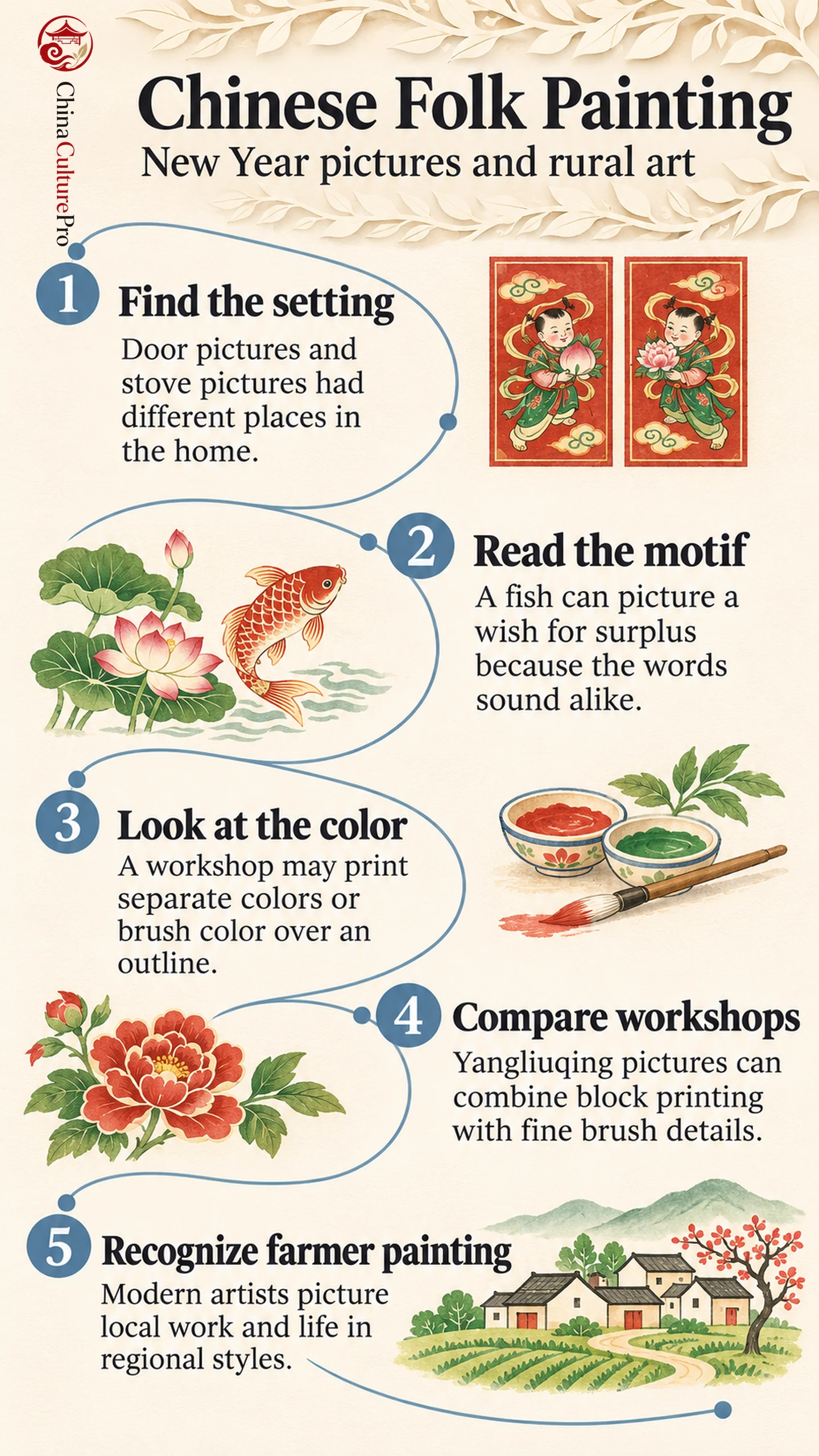
A pair of painted guardians at a doorway has a different job from a picture of village life in a gallery. Both can sit within the larger history of Chinese art. To understand how each works, begin with where it was meant to be seen and how its maker put color on the sheet.
New Year Pictures and Where They Go
Paired door gods (门神, ménshén) guard the threshold. On a double door, each leaf can hold one member of the pair. A print of the Kitchen God belongs to a different place in the home, near the stove. [1][2]
Other pictures feature historical tales, theater or auspicious subjects. In Yangliuqing’s Abundance Year After Year (连年有余, liánnián yǒuyú), a child holds a large fish alongside a lotus motif. The words for fish (鱼, yú) and surplus (余, yú) sound alike in Mandarin. Lotus (莲, lián) echoes the word for successive or continuous (连, lián). The image makes a seasonal wish visible through familiar objects. [4][5]
How Regional Workshops Print and Paint
Several techniques can put color on a New Year picture. A line block can establish the outlines. Other blocks can print separate colors in alignment, or a painter can apply color by brush. In a picture made by both methods, blocks can carry larger areas of clothing or background color while the brush adds faces or fine garment details. These shared processes also help explain similarities to modern Chinese woodcuts despite different uses. [1][2][3]
| 傳統 | 地點 | How color can be made |
|---|---|---|
| Yangliuqing | Tianjin | Printed lines and colors can be finished by brush, especially in the face, hands or decorative details. [1][2] |
| Taohuawu | Suzhou, Jiangsu | Workshops used separate color blocks and sometimes added hand coloring. [2] |
| Mianzhu | 四川 | In a characteristic colored picture, a printed dark outline is filled with brush color. The tradition also includes monochrome impressions. [1][3] |
| Wuqiang | Hebei | Workshops register different blocks to build the picture in successive colors. The tradition includes door pictures, stove pictures and other formats. [2] |
A work made in the same town may use a different process from the next. A catalog entry can tell you which stages were printed and which were painted. [1][2][3]
Modern Farmer Painting in Huxian and Jinshan
Huxian, the former county now within Xi’an’s Huyi District, is known for modern paintings of rural work and village life in the Guanzhong region. The local exhibition hall was founded in 1976 and holds works dating back to 1958. When you see the older name Huxian on a label, it refers to the same local tradition that the Huyi exhibition hall collects today. [6]
Jinshan painting developed in the Shanghai area. Artists have drawn on embroidery and paper cutting, as well as the landscape and life of water towns. A picture may organize plants, people and houses into flattened areas of color that resemble a decorative pattern. Jinshan was among the places recognized as centers of modern folk painting in 1988. A 2025 exhibition placed Jinshan work alongside paintings by fishers from Zhoushan in Zhejiang and artists from Shuicheng in Guizhou. Marine subjects in the former and echoes of batik in the latter show how differently artists can use a local visual vocabulary. [7]
FAQs About Chinese Folk Painting
Are All New Year Pictures Woodblock Prints?
Many were printed from carved blocks. Others were painted by hand or combine a printed outline with brush color. The name describes a category of pictures associated with the New Year. [1][2][3]
Why Does a Child Hold a Fish in New Year Pictures?
Fish can picture a wish for surplus because the words sound alike in Mandarin. In the Yangliuqing example, the lotus adds a second sound association, reinforcing a wish for abundance year after year. [5]
Is Farmer Painting the Same as New Year Painting?
Farmer painting is a modern field with identifiable regional centers and artists. New Year painting is defined chiefly by its connection to a festival. A painting of harvest work can belong to a local farmer-painting tradition even if it was made for exhibition and has no seasonal use. [1][6][7]
資料來源
[1] China Intangible Cultural Heritage Network. Guide to Recognizing New Year Pictures
[2] China Intangible Cultural Heritage Network. Representative Projects: Woodblock New Year Pictures
[3] China Intangible Cultural Heritage Network. Mianzhu Woodblock New Year Pictures
[4] The Metropolitan Museum of Art. The Printed Image in China, 8th–21st Century
[5] China Intangible Cultural Heritage Network. Yangliuqing New Year Pictures and Cultural Life
[6] Xi’an Municipal Government. Huyi District Cultural Institutions
[7] Shanghai Municipal Government. Farmer Paintings at the China Art Museum