


Quick Answer: What Is a Futou?
A futou (幞头, fútóu) is a Chinese head covering that took forms ranging from tied cloth to a shaped cap with stiff extensions.[1]
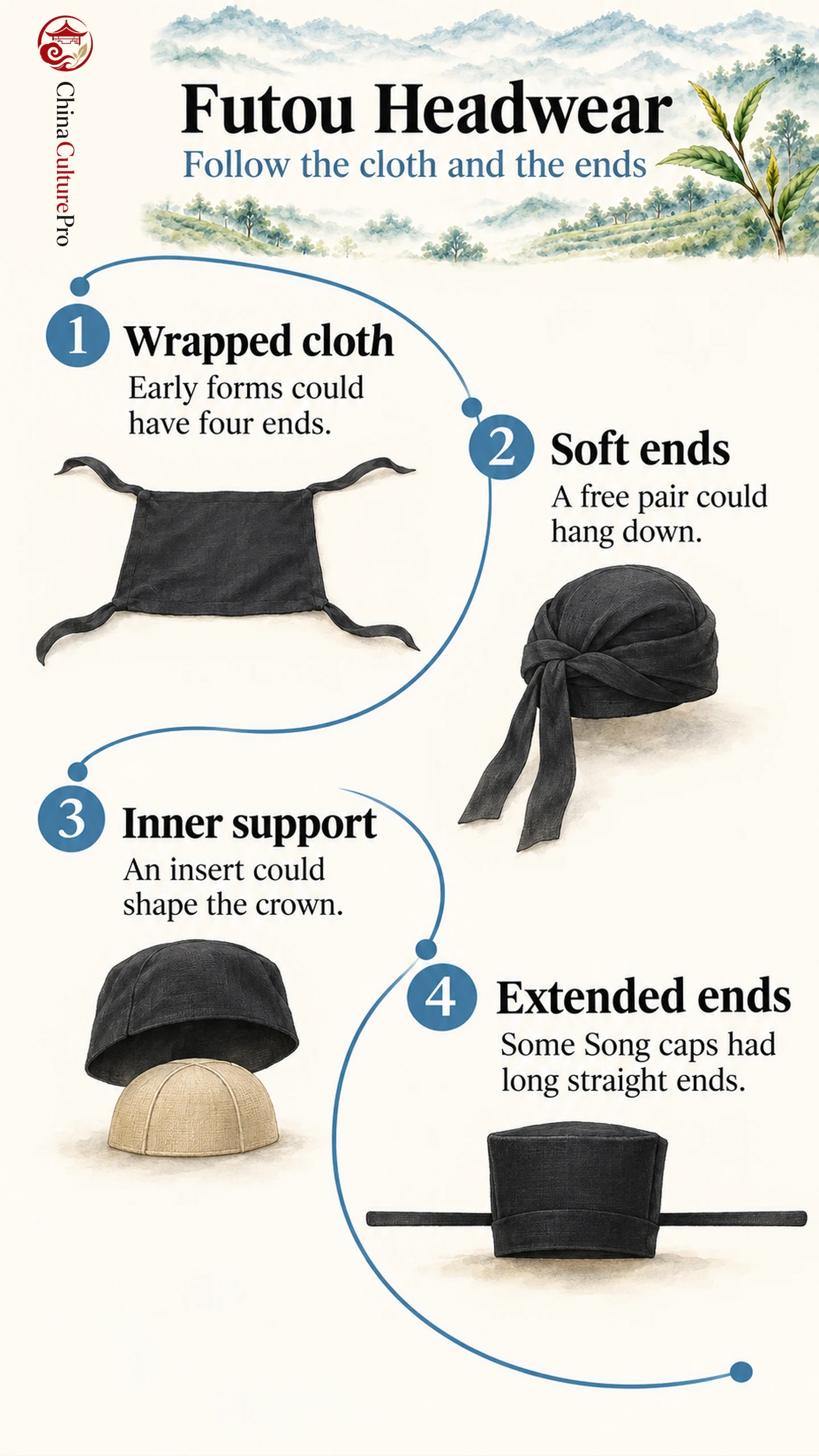
- Early construction: A wrapped cloth could have four ends, with one pair used for tying and another left visible.[1]
- Support: A shaped insert could help the head covering hold its form.[2]
- Silhouette: Song examples include caps with long, horizontal ends.[3][4]
Identify the cap body and the ends together. The word covers more than one style.[1]
From Soft Ends to Stiff Extensions
The free ends of the cloth are often called its feet. Soft ends could hang down, while stiffening allowed some versions to lift or project away from the head.[1]
A shaped inner support, the jinzi (巾子, jīnzǐ), could give the cloth a more defined crown. The National Museum of China’s Tang figure leading a horse shows a futou worn with a narrow-sleeved, turned-collar robe and belt.[2]
Song Portraits With Extended Ends
The seated portrait of Emperor Taizu depicts a stiff, squared black cap with wide horizontal extensions. The hat appears alongside a pale round-collar robe and jade-mounted red court belt.[3]
A portrait of Southern Song Emperor Gaozong shows an extended-foot futou, or zhanjiao futou (展脚幞头, zhǎnjiǎo fútóu), above a red robe. These images document a court presentation of the silhouette.[4]
Wearing a Futou Reproduction
Choose a dated example with a similar occasion and outfit. A front view shows the spread of the extensions, while a side view shows the crown and where the ends attach. Try the cap over the intended hair arrangement and check doorway clearance with long extensions. Compare Ming official hats or the Dongpo jin when the shapes look similar.
FAQs About Futou Headwear
Were All Futou Stiff?
Some were tied from soft cloth. Other forms used inner supports or stiffened ends. The cap body and the ends could have different structures.[1][2]
Did Song Futou Always Have Straight Ends?
Straight extended ends appear in court portraits. Other descriptions include curved, curled or crossed ends.[1][3][4]
Is a Ming Winged Hat the Same as a Song Futou?
Compare the crown, how the extensions meet it and the dress context. Similar outlines alone offer limited evidence for identifying a headpiece.[1][3]
資料來源
[1] The Palace Museum. Futou
[2] National Museum of China. Tang Sancai Figure Leading a Horse
[3] National Palace Museum. Seated Portrait of Emperor Taizu of Song
[4] National Palace Museum. Seated Portrait of Emperor Gaozong of Song