
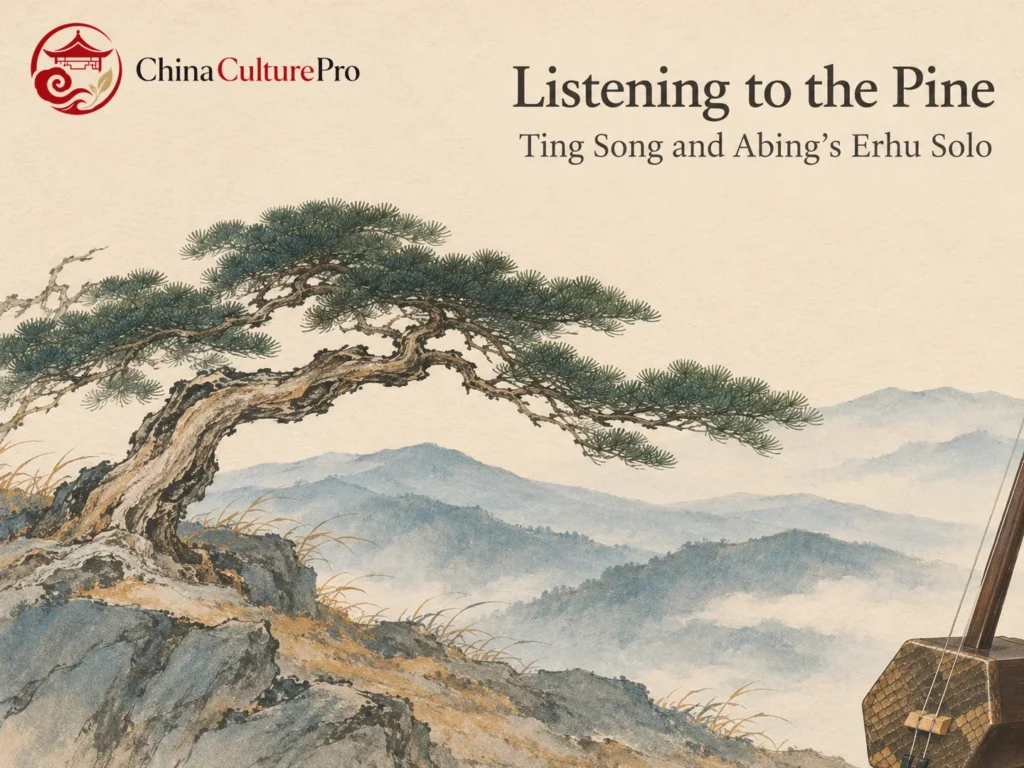

Quick Answer: What Is Listening to the Pine?
Listening to the Pine (Ting Song, 听松, Tīngsōng) is an erhu (二胡, èrhú) solo associated with the Wuxi musician Abing (阿炳, Ābǐng). His recorded performance survives from a 1950 wire recording session.[1][2]
- Instrument: The archive identifies the track as a solo for the two-string erhu.[1]
- Title: Research discusses both the pine tree and a wordplay association with the Song dynasty.[3]
- Later rendition: The Chinese Music Archive lists Song Fei’s Listening to the Pines.[4]
Begin with Abing’s archive track, then compare how a later player starts and ends a phrase.

The title evokes a pine tree, but the sound can also suggest strength and resolve. Listen for the edge of the bow stroke, the time the player gives a sustained note and the way a phrase pushes forward again. Listen for those details in both the wire transfer and a newer recording.
The Wuxi Wire Recording
The fieldwork account names Yang Yinliu and Cao Anhe. They recorded three erhu pieces in Wuxi in 1950, including Ting Song 及 Moon Reflected on Erquan. The group also recorded three pipa pieces, among them Big Waves Wash the Sand.[2]
The Chinese National Academy of Arts describes a later digital transfer from the original wire. Its booklet records a 1951 release that included Ting Song and a 1952 publication of transcribed music and commentary. The audio and printed score document different aspects of Abing’s performance.[1][5]
What the Title Can Suggest
The written title uses the character 松, meaning pine. A research review also discusses 宋, the homophone used for the Song dynasty, and an association with the historical figure Yue Fei. Scholars connect both readings with the music’s firm, resolute character.[3]
The title gives you an image to bring to the performance. Hear whether the long notes feel poised or tense, then listen to how a sharper onset changes the mood. Notice whether the tree image still feels apt as the bowing changes.
Read the Performer Credit
The Chinese National Academy of Arts lists Ting Song among Abing’s surviving recordings. The Chinese Music Archive lists a later solo by Song Fei as Listening to the Pines, under archive identifier A4002-00120. Search by performer and the Chinese title when an English catalog uses a different translation.[1][4]
A transfer of the same 1950 performance can sound different across releases. Background texture and recording level can change during remastering. Check the performer and date first so you know whether you have two performances or two transfers.[1]
Hear the Bow in Two Renditions
Play one phrase twice. The first time, follow the rise and fall of the notes. The second time, listen for how strongly each note begins and whether the end of the phrase is abrupt or sustained. Compare the same details in another erhu rendition.
For a piece with more overt rhythmic motion, try Horse Racing and compare the beginnings of its repeated notes.
FAQs About Listening to the Pine
Is Listening to the Pines the same piece?
It is an English title used for Ting Song. The Chinese Music Archive uses the plural form for Song Fei’s recording.[4]
What instrument did Abing play on the recording?
The Chinese National Academy of Arts lists it as an erhu solo.[1]
When was Abing’s recording made?
His surviving rendition was recorded in Wuxi in 1950 during the sessions that preserved six pieces.[2]
資料來源
[1] Chinese National Academy of Arts. The Six Surviving Recordings of Abing
[2] China Intangible Cultural Heritage. Building a Chinese Traditional Music Recording Archive
[3] China Intangible Cultural Heritage. Review of Research on Abing and Erquan Yingyue
[4] Chinese Music Archive. Erhu Audio Music Archive
[5] Chinese National Academy of Arts. Abing Recording Booklet