


Quick Answer: What Is Horse Racing for Erhu?
Horse Racing (Sai Ma, 赛马, Sàimǎ) is a modern piece for erhu (二胡, èrhú) by Huang Haihuai (黄海怀, Huáng Hǎihuái). Its quick bow strokes and sharply defined plucked notes evoke a race on the grasslands.[1][2][4]
- Early performance: Huang played the solo in Guangzhou in 1962.[1]
- Melody: The work incorporates a melody drawn from Mongolian musical material.[1][2]
- Credits: The title appears in programs for soloist, trio and larger ensemble versions.[3][4][5]
Read the composer and arranger lines before comparing two recordings.
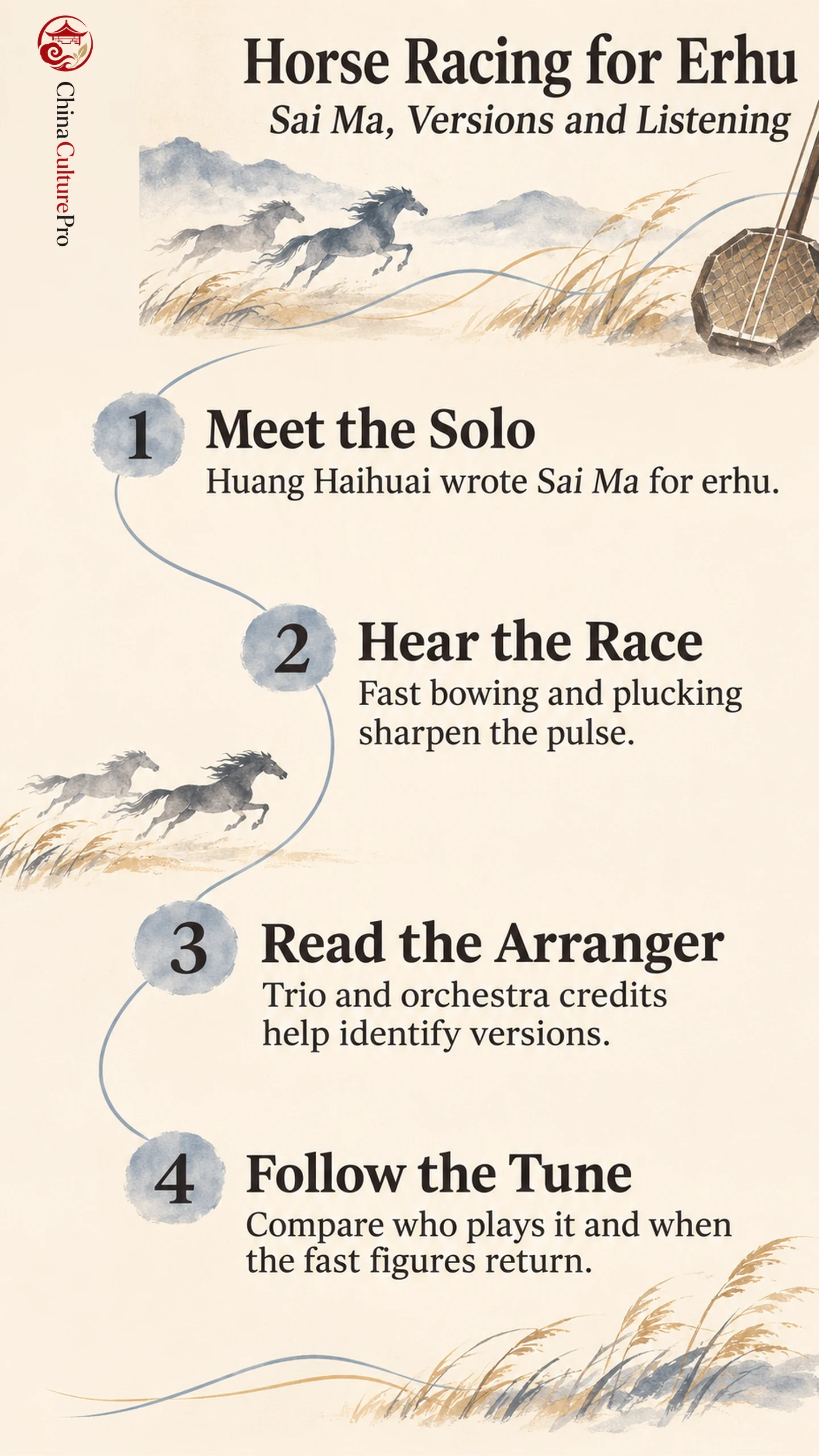
The opening can feel like a burst of motion, but the tune that follows gives the ear something to hold on to. On a first hearing, listen for the change from clipped rhythmic figures to a longer melodic line. That contrast makes the return of the fast playing easier to recognize.
From an Erhu Solo to the Concert Stage
A Guangzhou account dates Huang’s composition to 1959 and its completion to 1960. It records his solo performance at a Guangzhou music festival in 1962. A Macau program archive also associates the piece with the Shanghai Spring erhu competition in 1963. These dates describe different events in the work’s early life.[1][6]
The central tune draws on Mongolian material. The grassland setting also invites comparison with the morin khuur, a bowed instrument in its own tradition. The solo Huang wrote uses the two strings of the erhu.[1][2][4]
How Two Strings Suggest a Race
Quick bow changes give the opening figures their urgency. During a variation, the erhu player can pluck the notes with a finger. That dry attack makes the repeated pulse easier to separate from the singing tone of the bowed melody.[2]
Tap the pulse while the articulation changes to hear how the rhythm carries across bowed and plucked notes. Short notes can suggest hooves without a percussion sound. In a fuller arrangement, listen for whether a drum or another instrument takes over the emphasis and changes the feel of the pulse.[2][4][6]
Three Versions to Compare
Each program credits Huang and identifies a different arranger. The instruments and ensemble credits are useful when looking up a recording or performance.
| Program | Arranger | Performance setting |
|---|---|---|
| Hong Kong LCSD’s Variations in Chinese Music | Johnny Yim | Erhu, piano and yangqin |
| Singapore Chinese Orchestra Chinese Classics | Qu Chunquan | Orchestra program |
| Hong Kong Chinese Orchestra Tuen Mun concert | Ng Cheuk-yin | Orchestra and Yat Po Singers |
The LCSD trio also programmed Autumn Moon Over a Calm Lake. The Tuen Mun concert featured a separate Ng arrangement of 《金蛇狂舞》.[3][4][5]
Listen for the Tune Under the Motion
Find the longer tune in two versions and note who plays it. Then hear how the performer or arranger brings back the racing figures. You may hear an individual player change attack or several players hand the rhythm to one another.
For a different way to hear how an erhu shapes a melody over time, compare Moon Reflected on Erquan. There, let your attention follow the length and inflection of each note.
FAQs About Horse Racing for Erhu
Who composed Horse Racing for erhu?
Huang Haihuai composed the erhu solo. Later programs may add a separate arranger credit.[1][3][4][5]
What makes the galloping sound in Horse Racing?
Fast bowing and plucked passages give the repeated rhythms sharp attacks that suggest a horse’s motion.[2][4]
Are Horse Race and Horse Racing the same work?
Both English titles appear in programs for Huang Haihuai’s Sai Ma. Check the composer and arranger to identify the version.[3][5]
資料來源
[1] Guangzhou Municipal Cyberspace Administration. The Story Behind Horse Racing
[2] Jingchu Network. Huang Haihuai’s Horse Racing
[3] Hong Kong Leisure and Cultural Services Department. Variations in Chinese Music
[4] Singapore Chinese Orchestra. SCO E-Programme Booklet
[5] Hong Kong Chinese Orchestra. Music Integrates Community Concert: Tuen Mun
[6] Macau Public Library. Macau Performing Arts Programme Archive