


Quick Answer
The Ziwei Emperor (紫微大帝, Zǐwēi Dàdì) is a Daoist sovereign associated with the north celestial pole and the stars. His title links him to the Purple Palace Enclosure (紫微垣, Zǐwēi Yuán), a region of the sky likened to an imperial court in traditional Chinese astronomy.[1][2][3]
- Celestial domain: One of his titles is Ziwei Great Emperor of the Northern Pole in the Central Heaven (中天紫微北極大帝, Zhōngtiān Zǐwēi Běijí Dàdì).[2]
- Daoist rank: He belongs to the Four Sovereigns (四御, Sìyù), although the names grouped with him vary by source.[2][3]
- In ritual art: A Qing hanging scroll shows him as a court ruler in purple, holding a tablet before his chest.[2]
Polaris marks the north celestial pole for modern observers. The older religious title refers to the authority associated with that part of the sky, whose pole star has changed over time.[2][4]
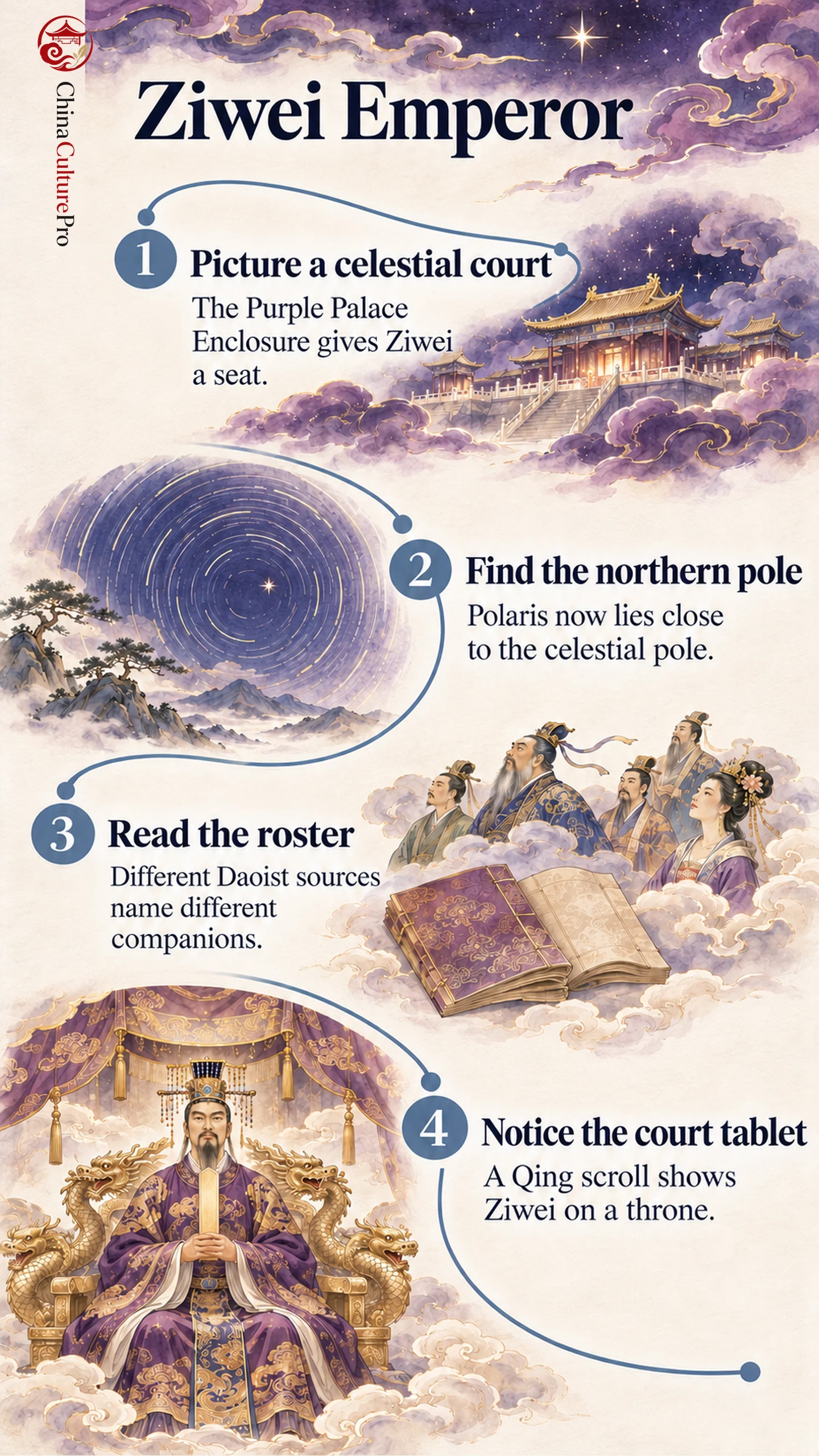
The old star map gives the heavenly ruler a seat and attendants. In a Qing ritual scroll, the same court imagery takes a form worshippers could recognize: a throne, a canopy, and an emperor holding a court tablet.[1][2]
Why the northern sky was pictured as a palace
The astronomy treatise in the *Book of Jin* (晉書, Jìn Shū) describes an enclosure north of the Northern Dipper (北斗, Běidǒu) bounded by fifteen stars. It calls the region a regular dwelling of the Son of Heaven and identifies a seat of the Ziwei Emperor. Nearby star groups are assigned to attendants and offices. The arrangement maps the structure of an imperial court onto the northern sky.[1]
The apparent rotation of the stars around a nearly fixed point gives that image its physical setting. Polaris now lies close to the north celestial pole. Over long periods, the slow change in the direction of Earth’s axis shifts the pole’s position among the stars. The pole remains the organizing point even as nearby stars change.[4]
Where Ziwei fits among the Four Sovereigns
The National Museum of Taiwan History groups the Ziwei Emperor with the Jade Emperor (玉皇大帝, Yùhuáng Dàdì), the Southern Pole Emperor of Longevity (南極長生大帝, Nánjí Chángshēng Dàdì), and the Earth Sovereign (后土皇地祇, Hòutǔ Huángdìqí). Taiwan’s Sanqing Temple (三清宮, Sānqīng Gōng) gives a different roster. It retains Ziwei and the Southern Pole Emperor and names the Celestial Emperor of the Great Ultimate (太極天皇大帝, Tàijí Tiānhuáng Dàdì) and the Azure Splendor Emperor of the Eastern Pole (東極青華大帝, Dōngjí Qīnghuá Dàdì) as the other two.[2][3]
The museum’s account associates Ziwei with the sun, moon, stars, and seasonal order. When he appears in the same group as the Нефритовый император, the two names identify distinct figures within that grouping.[2]
What the Qing hanging scroll shows
In the National Museum of Taiwan History scroll numbered 2003.001.0994, Ziwei sits upright on a dragon throne beneath a canopy. He wears a ceremonial crown and a purple robe, holds a court tablet in both hands, and has a round halo behind his head. The painting gives a celestial ruler the visual form of an imperial audience.[2]
The museum describes such scrolls as ritual altar images and places this type to the right of the images of the Three Pure Ones (三清, Sānqīng). Its place within the altar group shows how the portrait presented Ziwei alongside other deities during ritual. The scroll’s maker and place of production are recorded as unknown.[2]
FAQs About the Ziwei Emperor
Is Ziwei another name for Polaris?
Polaris is the bright star that now serves as the North Star because it lies close to the north celestial pole. In Daoist contexts, Ziwei can name a deity associated with the polar region and its stars.[2][3][4]
Is the Ziwei Emperor the Jade Emperor?
The museum’s Four Sovereigns list includes both as distinct figures. Ziwei’s particular association is with the polar sky and celestial bodies.[2]
What is the Purple Palace Enclosure?
It is a region of traditional Chinese astronomy near the north celestial pole. Its stars were described through the offices, attendants, and protected spaces of an imperial court.[1]
Источники
[1] Wikisource. Book of Jin, astronomy treatise
[2] National Museum of Taiwan History. Portrait scroll of the Ziwei Emperor, 2003.001.0994
[3] Sanqing Temple. The Ziwei Emperor of the Northern Pole
[4] NASA Science. What is the North Star and how do you find it?