
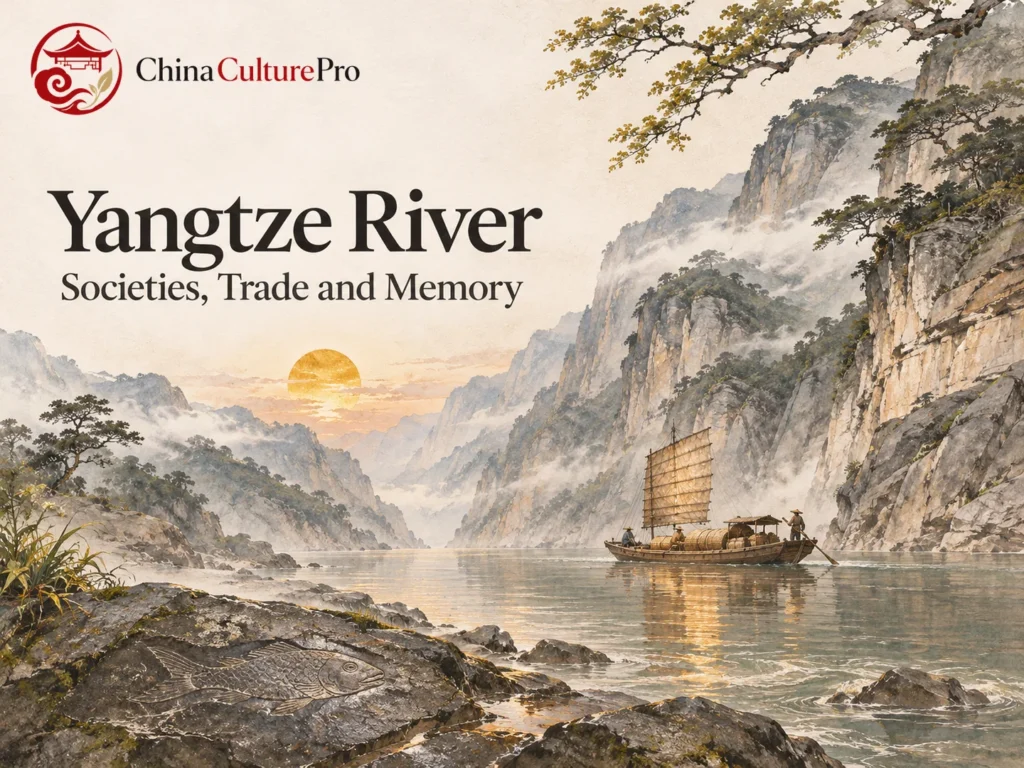

Quick Answer: Why Does the Yangtze Matter to Chinese History?
The Yangtze, or Chang Jiang (长江, Cháng Jiāng), connects regions with different histories. Its basin supported early rice-growing societies, brought neighboring states and markets into contact and provided a waterway that later governments connected to the Grand Canal.[1][2][3]
- Early societies: Liangzhu’s city ruins preserve evidence of rice farming, water management and distinctive jade burial goods.[1]
- Trade: The Grand Canal linked the Yangtze to other river systems and carried grain for imperial governments.[3]
- River memory: At Baiheliang (白鹤梁, Báihèliáng) in Chongqing, carvings recorded low water levels when the rock emerged in dry seasons.[4]
The clearest evidence comes from specific places and periods. A jade burial object, a bronze bell and an inscription on a river rock each answer a different question.

The Yangtze links mountain gorges and broad floodplains to the sea. A river journey also joins places whose people built distinct settlements, maintained different political ties and lived with water on different terms.
Four Places and Objects in Yangtze History
| Свидетельство | Part of the basin or network | Что это показывает |
|---|---|---|
| Liangzhu city ruins | Lower basin, near present-day Hangzhou | Rice cultivation, waterworks, a walled center and differences in burial wealth.[1] |
| Marquis Yi’s bells | Present-day Hubei, in the middle basin | Music and ritual at the court of Zeng, including a gift from the king of Chu.[2] |
| Grand Canal | Connected the Yangtze and other basins | Grain and other supplies moving through an organized imperial network.[3] |
| Baiheliang inscriptions | Fuling, Chongqing, upstream of the Three Gorges Dam | Observers wrote records of seasonal water levels into exposed river stone.[4] |
Rice and Waterworks in the Lower Basin
The ruins of Liangzhu culture date to about 3300–2300 BCE. The city stood in a lowland network of rivers and wetlands. Dam sites outside the city show that inhabitants managed water beyond the boundaries of individual farms. Rice supported the settlement’s economy while the surrounding waterworks show the scale at which labor could be organized.[1]
Burials also reveal differences among people in the settlement. Some contained finely worked jade objects, including the cong (琮, cóng), a form with a square exterior and a round central opening. These finds are evidence about status and ritual in one society. Rice cultivation elsewhere in the basin has its own chronology.[1]
A Bell Connects Chu and Zeng
Bronze bells from the tomb of Marquis Yi of Zeng speak to relationships among states in what is now Hubei. One bell carries an inscription recording a gift from King Hui of Chu dated to 433 BCE. It was found among the instruments buried with the marquis, whose own state was Zeng (曾, Zēng).[2]
The bell lets historians see a specific encounter between courts. They can read the donor, recipient and date together with the instrument’s ritual purpose. That context is part of the wider history of Jingchu culture and the region associated with Chu (楚, Chǔ).[2]
The region’s association with Chu also appears in commemorations of Qu Yuan around the Dragon Boat Festival. In Zigui, Hubei, traditions associated with the poet include dragon boat racing and eating leaf-wrapped zongzi. A comparison of zongzi and onigiri explains where that festival food fits among other rice preparations.[6]
Canal Traffic and the River’s Water Marks
Canals made a connection between an east-flowing river and northbound imperial supply routes. Earlier canal sections were brought together into a larger system in the Sui dynasty. The network expanded and changed in later periods. By the Yuan dynasty it linked five major basins, including those of the Yangtze and the Yellow River. The system called caoyun (漕运, cáoyùn) organized government grain shipments along waterways. Follow the Grand Canal’s history to see how the routes shifted.[3]
Further upstream, Baiheliang shows how river users observed the water itself. For generations, the ridge reappeared at particularly low water, and observers left inscriptions on its face. Fish carvings served as reference marks in some of those observations. The Three Gorges reservoir submerged the ridge, and a protection project preserved the inscriptions underwater. Their nomination remains on China’s UNESCO World Heritage Tentative List.[4]
FAQs About Yangtze River History
Are Chang Jiang and Yangtze the Same River?
Chang Jiang is the Mandarin name for the river called the Yangtze in English. Historical spellings and references vary, including Changjiang in modern institutional sources.[4][5]
How Are the Yangtze’s Main Reaches Divided?
One standard division puts the end of the upper reach at Yichang and the boundary between the middle and lower reaches at Hukou. Cultural and political regions have boundaries of their own and can extend across that scheme.[5]
What Did the Grand Canal Carry From the Yangtze Basin?
Grain, including rice, was a major cargo. The canal’s administration also moved supplies through a network that linked the Yangtze with other river basins.[3]
Источники
[1] UNESCO World Heritage Centre. Archaeological Ruins of Liangzhu City
[2] Hubei Provincial Museum. Introduction to the Tomb of Marquis Yi of Zeng
[3] UNESCO World Heritage Centre. The Grand Canal
[4] UNESCO World Heritage Centre. Baiheliang Ancient Hydrological Inscription, Tentative List
[5] Hydrological Sciences Journal. Changes in Riverbed Morphology in the Middle Yangtze River
[6] China Daily via China Culture. A Current of Culture