


Quick Answer: What Is Xuan Paper?
Xuan paper (宣纸, xuānzhǐ) is a traditional Chinese paper associated with Jing County in Anhui. Makers use fiber from blue sandalwood bark and rice straw. The paper is used for brush writing and painting. Its finish affects how readily ink spreads through the surface. [1][2][3]
- Place and materials: Jing County papermaking combines local craft knowledge with suitable fibers and water. [1][2]
- Finish: Unsized, sized and partly sized sheets absorb ink differently. [3][4]
- Use: A spreading wash and a fine, contained line make different demands on the sheet. [3][4]
The English label “rice paper” can refer to several materials. Check the fibers and the finish when those details matter. [1][4][5]
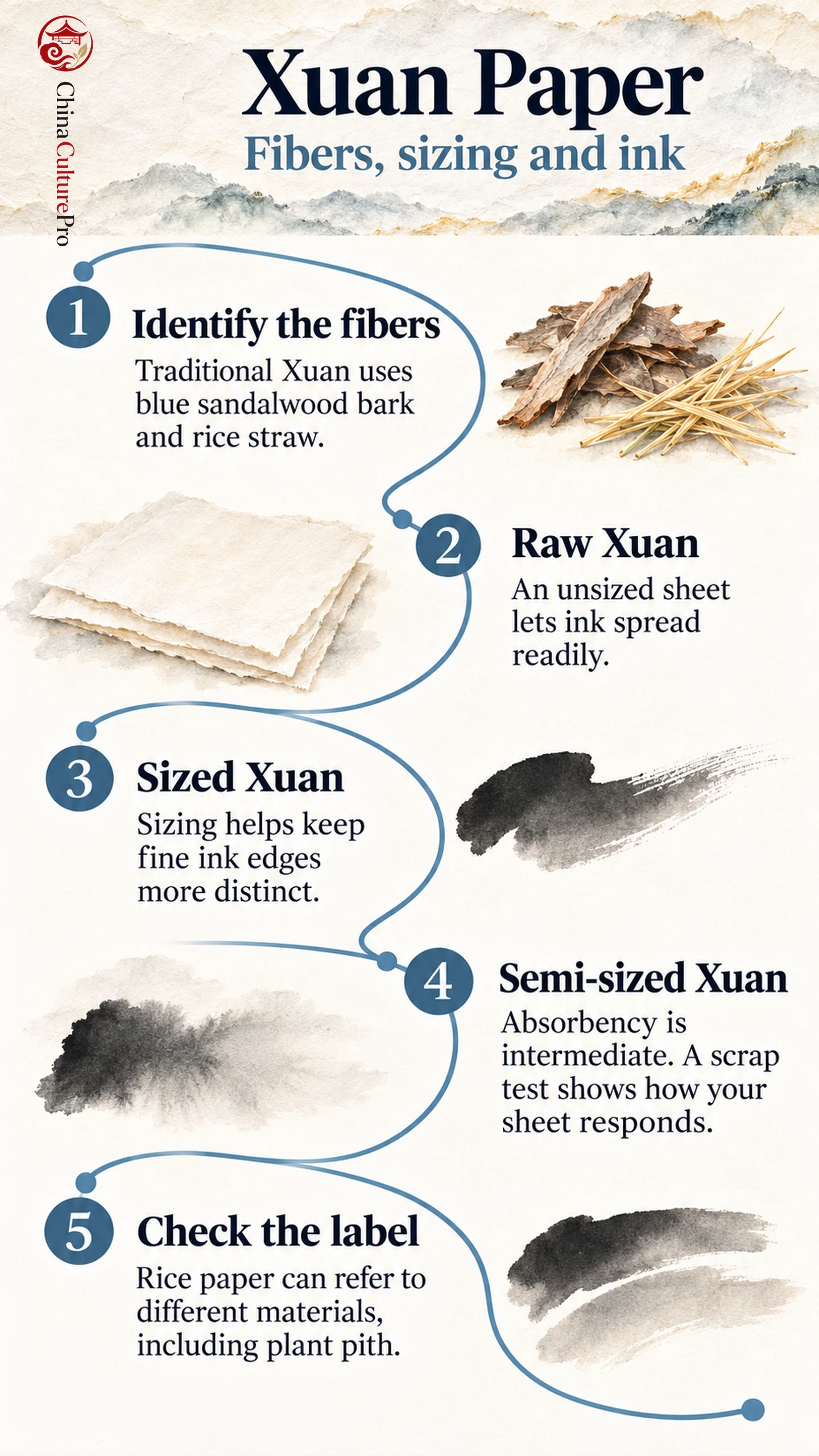
A brushstroke can stay crisp on one sheet and develop a soft edge on another. The difference can come from how the paper was finished. For a useful comparison, start with the sheet itself and keep the brush and ink as similar as possible.
Where Xuan Paper Comes From
The traditional craft centers on Jing County in southern Anhui. Papermakers process blue sandalwood bark (Pteroceltis tatarinowii) and rice straw into usable fibers. Long fibers from the inner bark combine with shorter straw fibers in the finished sheet. [7] They bring the fibers together in a pulp, lift a wet layer onto a screen and dry the resulting sheet. The water used in processing the pulp is one part of the local craft, along with the preparation of the fibers and skill of forming a sheet. [1][2]
The traditional handicraft was inscribed on the Representative List of the Intangible Cultural Heritage of Humanity in 2009. This recognition concerns the making practice. Xuan paper is one example of the paper category among the Four Treasures of the Study. [1][3]
Raw, Sized and Semi-Sized Xuan Paper
Sizing is a treatment that changes how readily liquid enters a sheet. Traditional sizing can involve glue and alum. Even with a similar fiber base, different finishing treatments can make ink behave differently. [3][4]
| Послевкусие | Typical response | When it can help |
|---|---|---|
| Raw Xuan (生宣, shēngxuān) | Unsized and readily absorbent | Useful when you want a wash to spread or a stroke to produce a soft edge. [3][4] |
| Sized Xuan (熟宣, shúxuān) | Treated to reduce absorption | Useful for keeping fine outlines or carefully placed color within clearer edges. [3][4] |
| Semi-sized Xuan (半熟宣, bànshúxuān) | Intermediate absorption | Useful for some ink movement while retaining more control of the edge. [3][4] |
The finish is one feature of a sheet. Fiber mix and thickness are separate variables. A thicker sheet can still be unsized. The finish name describes a treatment, while a small test shows how the paper actually responds to your brush. [3][4]
How to Compare Ink on Different Sheets
Compare a narrow line and a wet patch of wash on scraps from two sheets. Use the same brush and a similar ink load. Look at how far the edge moves outward and whether the fine line stays distinct after it dries. A change in load, pressure or speed can affect the result, so keep the comparison simple. The guide to Chinese calligraphy brushes explains the tool side of that comparison. [3][4]
A more absorbent sheet can emphasize the transitions in a loose wash. A more controlled edge is useful when a painting depends on fine contours. See gongbi and xieyi painting for the different kinds of mark those approaches can use. [3][4]
Xuan Paper and the Name Rice Paper
In English, rice paper is a broad label for materials made in different ways. Some painting suppliers use it broadly for East Asian brush papers. In historic collections it can also refer to a support made from the pith of the Tetrapanax plant. The pith was cut into thin sheets from the stem, while Xuan paper is formed from prepared fibers. [1][4][5]
FAQs About Xuan Paper
Is Xuan Paper Made From Rice?
Rice straw contributes fiber to traditional Xuan paper alongside bark from the blue sandalwood tree. The straw is a fibrous part of the rice plant; it is the straw that goes into the pulp. [1][2][5]
Does Raw Mean the Sheet Is Unfinished?
Raw refers to the absence of sizing treatment. The sheet has already been formed and dried. Its higher absorbency is part of how it works. [2][3][4]
Do Beginners Need Xuan Paper?
You can learn basic brush control on simple practice paper. Keep the surface consistent while you learn what changes with pressure and ink load. Try Xuan when you want to explore the differences among finishes. [3][4][6]
Источники
[1] UNESCO. Traditional Handicrafts of Making Xuan Paper
[2] Xuancheng Municipal Government. Xuan Papermaking
[3] Tsinghua University Press. Basic Knowledge of Chinese Calligraphy
[4] Chinese Brush Painters Society. Paper
[5] Royal Botanic Gardens, Kew. Conserving Chinese Pith Paintings
[6] Columbia University, Asia for Educators. Classroom Exercise: Introduction to Chinese Calligraphy
[7] Hilary Mullock. Xuan Paper