

Quick Answer: Who Was Xin Qiji?
Xin Qiji(辛弃疾,xīn qìjí; 1140–1207)was a Southern Song writer especially celebrated for ci lyrics(词,cí).[1]
- Background: Born in Shandong, he participated in resistance against the Jin dynasty(金,jīn)and later held Song official posts.[1]
- Literary range: His work includes military ambition, intimate longing and rural scenes.[2]
- Reading key: Watch how a lyric’s ending changes the meaning of its opening images.
His reputation as a patriotic poet is important, but it does not describe every mood or subject in his writing.[1]
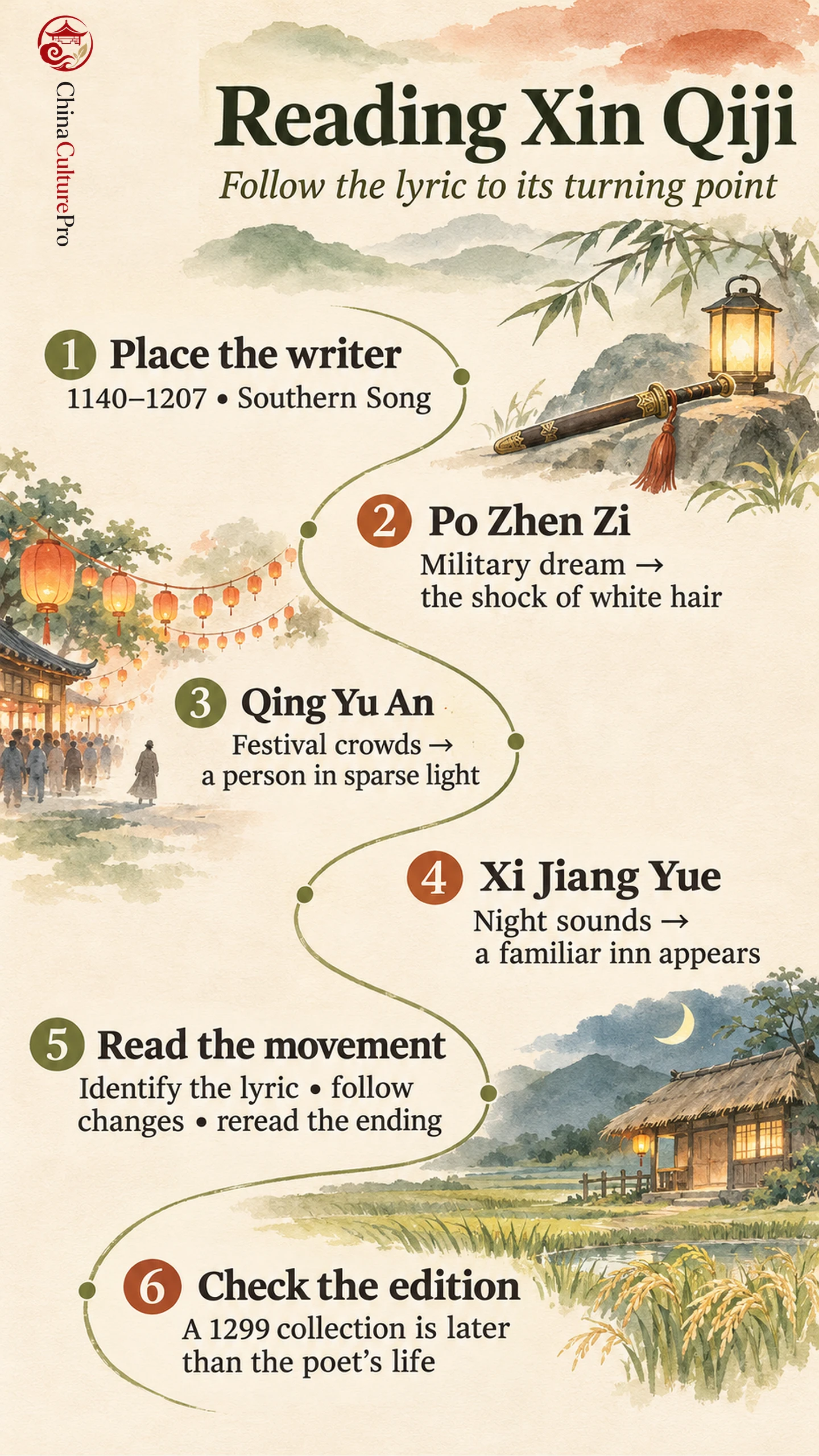
A sword seen by lamplight, a figure beyond the brightest lanterns, frogs heard among rice fields: three lyrics offer different entrances to his work. Read them together to follow changes in scale, sound and expectation.
Southern Song Context: Ambition and Interrupted Service
Xin participated in resistance as a young man and later held official posts, retiring in 1181. Yet biographical background should frame a reading rather than settle it in advance: a military dream need not describe a battle he fought.[1]
He is associated with haofang(豪放,háofàng), often translated as a bold or unrestrained style.[6] The Library of Congress describes both heroic and gentler qualities in his work, alongside frustration at unfulfilled ambitions. The contrast is useful: scale, sound and emotional reversal tell us more about an individual lyric than assigning it a single label.[2]
Three Ci Lyrics to Begin With
| Tune and identifying subtitle | Opening situation | Reading focus |
|---|---|---|
| Po Zhen Zi(破阵子,pò zhèn zǐ), sent to Chen Tongfu | A sword by lamplight and a military dream | The abrupt return from imagined achievement to aging.[3] |
| Qing Yu An(青玉案,qīng yù àn): Yuanxi(元夕,yuán xī), or Lantern Festival | A brilliant, crowded festive night | The movement from public spectacle to a particular person.[3][5] |
| Xi Jiang Yue(西江月,xī jiāng yuè): Night Walk on Huangsha Road(夜行黄沙道中,yè xíng huángshā dào zhōng) | A countryside walk under moonlight | Sounds, changing weather and the recognition of a familiar inn.[3] |
From Military Dream to Quiet Recognition
In Po Zhen Zi, “醉里挑灯看剑,梦回吹角连营” can be rendered: “In drunkenness I trim the lamp and look at my sword; in dream, horns sound through linked camps.” The lyric moves through marching, horses and the imagined completion of a ruler’s great undertaking. Then “可怜白发生”—“Alas, white hair has grown”—cuts across the vision. On this reading, the ending transforms triumph into a measure of time and frustrated possibility.[3]
Qing Yu An fills its opening with light, music, decorated vehicles and passing crowds. Its final discovery takes a different direction: “蓦然回首,那人却在,灯火阑珊处。” Here rendered: “Suddenly I turn: that person is there, where the lantern light grows sparse.” The contrast makes attention move away from the spectacle. A reader may explore symbolic interpretations, but the text itself does not name the person or establish a particular real-life romance.[3]
In Xi Jiang Yue, “稻花香里说丰年,听取蛙声一片” becomes “Amid the scent of rice blossoms, talk of a plentiful year; listen to the chorus of frogs.” A few stars and drops of rain then lead toward a remembered inn, suddenly visible as the path turns. Rather than a grand declaration, the close offers recognition within a changing landscape. These brief English renderings are working translations of the original Chinese.[3]
How to Read a Xin Qiji Lyric
- Identify the work: Record its tune name together with a subtitle or opening line, so that you can distinguish lyrics sharing a tune.
- Follow the movement: Mark changes in place, sound, viewpoint or dream state without explaining every image through biography.
- Reread the ending: Compare white hair, sparse lantern light or the reappearing inn with the opening scene.
- Add context selectively: Consult notes for an unfamiliar historical reference, then test how it affects the lyric as a whole.
Ci follow established tune patterns rather than a uniform line length. Research on Xin’s lyrics to another tune examines how sentence patterns and rhyme remain connected to that formal framework.[4]
Editions, Names and Reading Context
Jiaxuan(稼轩,jiàxuān)is Xin’s literary name. The Library of Congress catalogs a 1299 edition of his collected lyrics containing 573 works in twelve juan, or book divisions. That is the contents of a particular edition, not a date in his lifetime or a definitive count of everything he wrote.[2]
For a Northern Song comparison, read Huang Tingjian(黄庭坚,huáng tíngjiān)and notice another writer’s use of friendship, landscape and allusion.
FAQs About Xin Qiji
Was Xin Qiji Only a Patriotic Poet?
No. Public ambition is central to his reputation, but his lyrics also explore quieter scenes and varied personal moods.[1][2]
Why Do Some Books Call Him Hsin Ch’i-chi?
That is an older romanized spelling of Xin Qiji, used in English-language scholarship. It identifies the same writer.[1]
Are the Tune Names the Subjects of the Poems?
Not necessarily. A tune name identifies a formal pattern; subtitles and opening lines help identify the particular lyric and its subject.[3][4]
Источники
[1] Chinese University of Hong Kong, Renditions. Xin Qiji
[2] Library of Congress. Jiaxuan chang duan ju: Shi er juan
[3] Xin Qiji, Project Gutenberg. 辛棄疾詞選
[4] Zhu Huiguo. The Style of Xin Qiji’s 24 Ci Poems to the Tune of Lin Jiang Xian and Its Significance for Studies of the Tunes of Ci Poems
[5] Lingnan University, Chinese Language Education and Assessment Centre. 青玉案 · 元夕
[6] Academy of Chinese Studies. Song Ci