
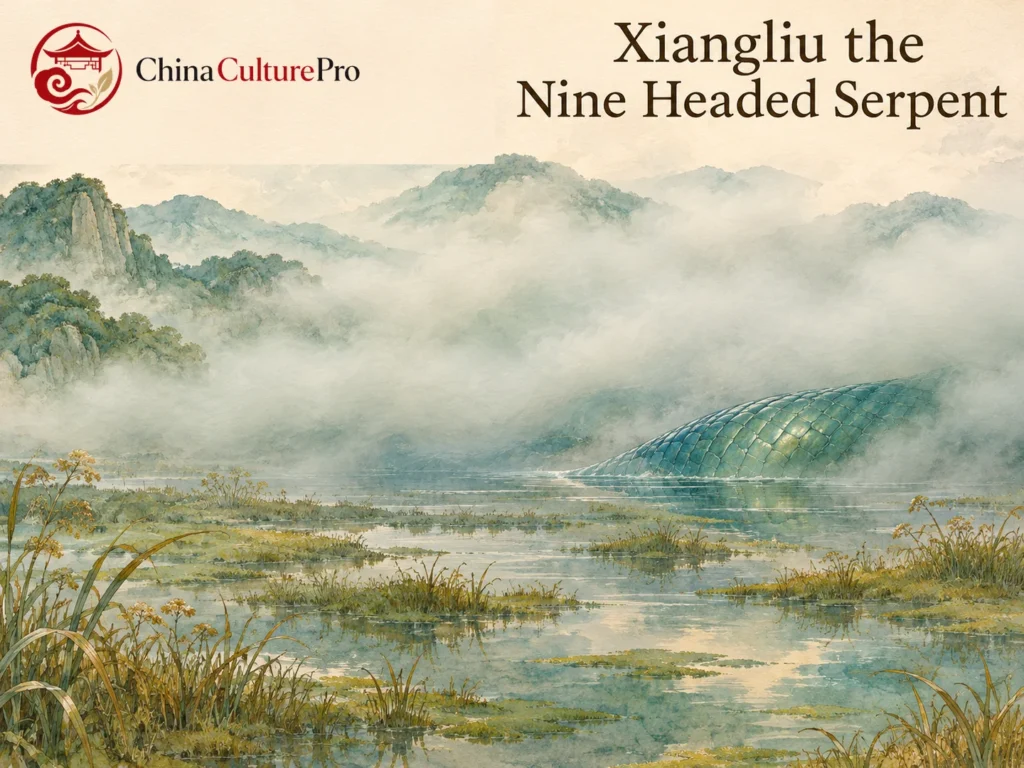

Quick Answer: What Is Xiangliu?
Xiangliu (相柳, Xiàngliǔ) is a nine-headed serpent and a servant of Gonggong in the Classic of Mountains and Seas. One passage describes nine human-faced heads on a blue-green serpent body. Another calls the figure Xiangyao (相繇, Xiàngyáo). Both accounts connect the serpent’s defeat by Yu with a landscape that remains difficult to use.[1][2][3]
- The creature: Nine heads and a serpent body identify it in the northern accounts.
- The names: Guo Pu treats Xiangliu and Xiangyao as variants.
- The land: The encounter leaves waterlogged or infertile ground in the story.
What happens to the land after the serpent falls is as important as the defeat itself.[1][2]

A nine-headed serpent can make for a striking picture. In the stories of Xiangliu, the harder question is what Yu can do with the land after the creature is gone.
The Nine Heads in Beyond the Northern Seas
The Beyond the Northern Seas chapter names Xiangliu as a servant of Gonggong. It says the creature feeds at nine mountains and turns the places it reaches into marshes or streams. Later in the passage, it gives the serpent a qing body and nine human-faced heads. Qing can be translated as blue-green in this description.[1]
The passage uses nine to describe both the serpent and the landscape it ranges across. The number describes both the heads and the extent of the creature’s feeding. The waterways and marshes then become a clue to the consequences of its presence.[1]
Xiangyao in the Great Wilderness of the North
The Great Wilderness of the North chapter uses the name Xiangyao. Its description also gives nine heads and a serpent body, and connects the figure’s activity with pools that animals cannot inhabit. Guo Pu’s commentary reads Xiangyao as a variant of Xiangliu.[2][3]
The two passages have overlapping details, but the northern wilderness account gives its own sequence of actions and descriptions. Read the names as related when comparing these entries, and keep each passage’s wording about the landscape in its own account.[1][2][3]
Why Yu’s Flood Story Ends With a Platform
Both accounts give Yu the role of defeating the serpent. The Beyond the Northern Seas passage says the ground can no longer grow grain. It describes repeated efforts to fill the site and ends with a platform of the divine rulers. The Great Wilderness adds a pool before mentioning the platform.[1][2]
The stories place the site north of Kunlun in their imagined geography. The episode makes the damaged land a problem even after the creature is defeated. The platform gives the site a new use in the story, after it can no longer support grain.[1][2][3]
Xiangliu, Jiufeng and Tengshe
The Great Wilderness of the North also describes Jiufeng, a deity with nine human-faced heads and a bird body. The number and the faces can invite comparison. The body and story identify the figures: Xiangliu’s serpent body goes with Gonggong and Yu.[1][2]
A serpent shape alone can also recall Tengshe. The Xunzi’s Tengshe is a flying serpent in an example about learning. The land and water left by Xiangliu give this serpent a distinct place in the flood stories.[1][2][4]
FAQs About Xiangliu
How many heads does Xiangliu have?
The two northern accounts give Xiangliu or Xiangyao nine heads. The Beyond the Northern Seas chapter specifies human faces.[1][2]
Are Xiangliu and Xiangyao the same figure?
Guo Pu explains Xiangyao as a variant of Xiangliu. Each name appears in a different version of the story in the Classic of Mountains and Seas.[1][2][3]
Who defeats Xiangliu?
Yu defeats the serpent in both accounts. The stories then describe the difficulties of using the affected land.[1][2]
Источники
[1] Chinese Wikisource. Classic of Mountains and Seas, Beyond the Northern Seas
[2] Chinese Wikisource. Classic of Mountains and Seas, Great Wilderness of the North
[3] Guoxue Dashi. Yuan Ke’s Annotated Classic of Mountains and Seas, volume 17
[4] Chinese Wikisource. Xunzi, Encouraging Learning