

Quick Answer
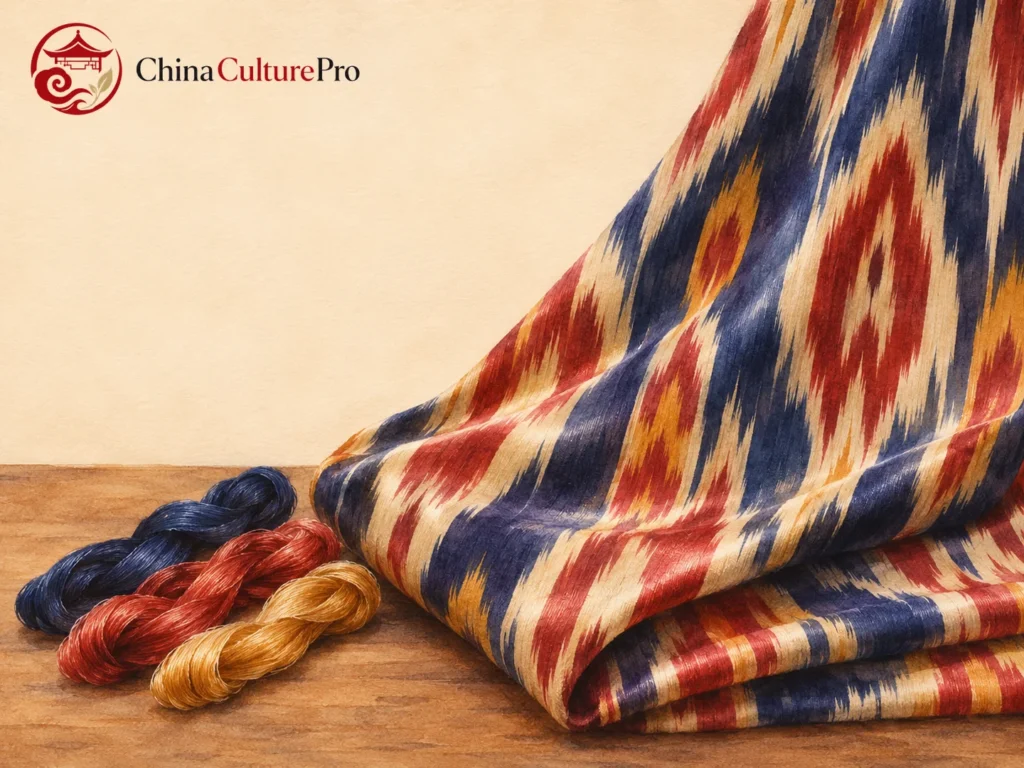
Uyghur atlas silk (艾德莱斯绸, Àidéláisī chóu) is a patterned silk fabric made in Xinjiang, including the Hotan area. Its designs come from colour applied to the warp threads before weaving. By aligning those threads on the loom, a weaver turns bands of dyed colour into motifs with characteristically soft edges.[1][2][3]
- Technique: Selected parts of bundled warp threads resist dye, creating differently coloured sections.[1][2]
- Finished fabric: Plant, geometric and other motifs emerge as the threads come together.[2][3]
- Place: China’s national inventory records a Luopu County submission for the dyeing and weaving technique.[1]
To identify a particular piece, look for the way colour follows the threads and for a maker or workshop record.[1][2]
A soft edge on a silk motif can look like a brushstroke. In atlas silk, the colour can already be present in the long threads before the cloth exists. The woven motif brings those coloured sections side by side. That relationship between colour and structure is the most useful starting point for understanding the fabric.[2][3]
Where Atlas Silk Is Documented
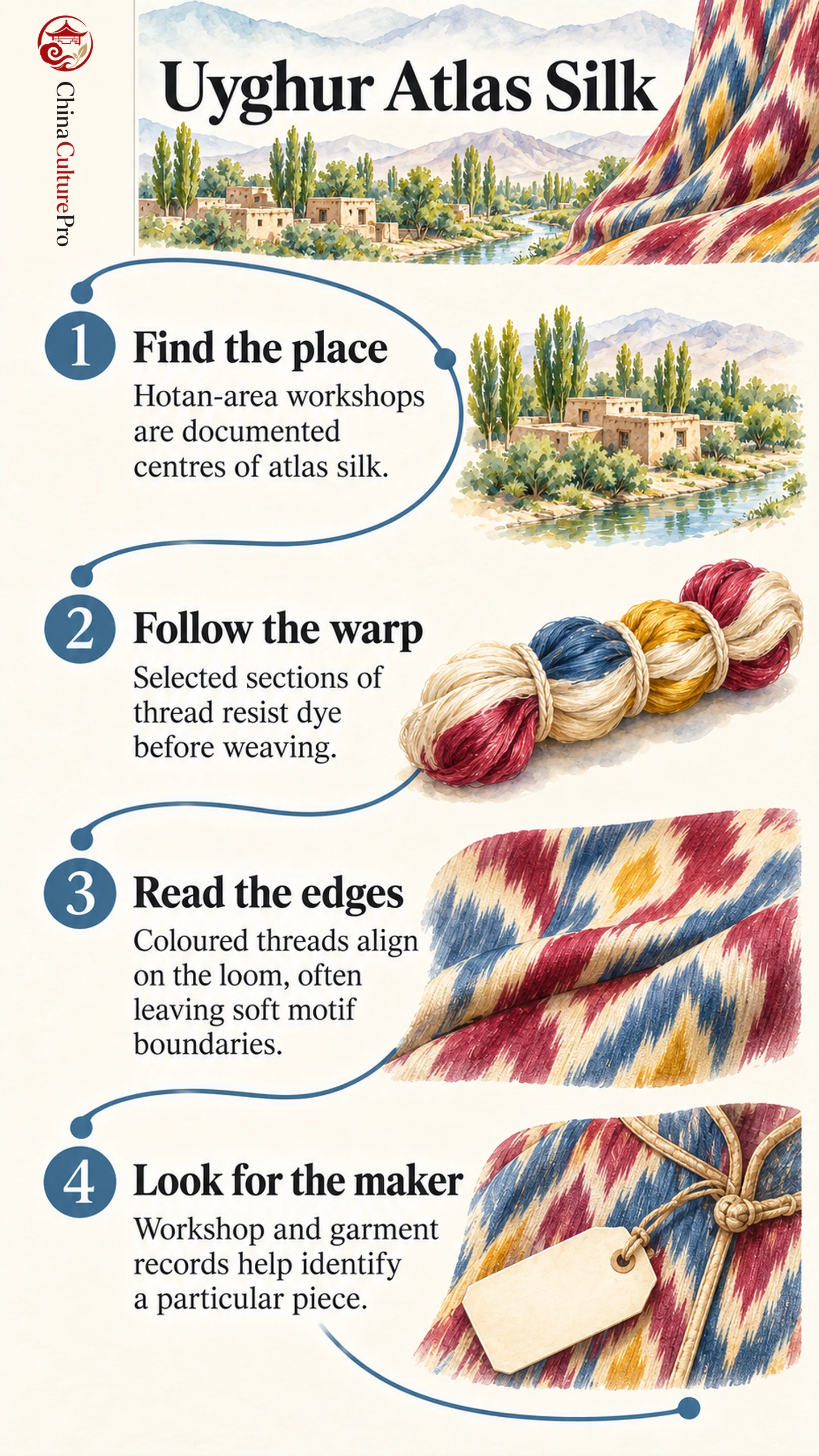
China included the Uyghur atlas silk dyeing and weaving technique in its national intangible cultural heritage list in 2008. The entry identifies Luopu County and names Jiya and Buya as important centres in the craft’s history. Hotan is also the setting of a published workshop account.[1][4]
A label that gives a county, workshop or weaver tells a reader more about an individual piece than a broad regional name alone. The workshop account illustrates one place where visitors could see the dyed threads and woven fabric together.[1][4]
Why the Pattern Starts with the Warp
The warp is the set of threads that run the length of a fabric. In atlas silk, makers tie sections of those threads before dyeing them. The ties restrict dye in selected areas. Colour can be built up through more than one dyeing stage, so the threads have a pattern of coloured sections before they are placed on the loom. This form of resist dyeing is known as warp ikat.[1][2][3]
When the warp is arranged for weaving, the coloured sections of adjacent threads form a larger design. At a boundary, the colours can appear to feather where dye reaches the edge of a tied section or where adjacent threads shift. The softer boundary records something about how the colour was applied and how the threads meet.[2][3]
The guide to Chinese silk weaving explains how other methods use the warp or the crossing weft to form their patterns.
How to Read a Finished Piece
Textile studies describe atlas motifs inspired by plants, musical instruments and geometric figures. The shapes can be repeated along the cloth. A close view can show how the motif spans several neighbouring warp threads, with colour changing along their length. The direction of the coloured threads makes this feature easier to see.[2][3]
The regional study places Xinjiang atlas within a much wider group of ikat textiles. It compares the local work with examples from Central and South Asia and Japan. A soft outline is a reason to look more closely, and the fibre, object type and documented place help identify a particular fabric.[3]
How Workshops Carry the Craft Forward
The national entry describes a training school associated with the craft in Jiya. Teaching has to cover the relationship between preparing the threads and weaving them. A workshop demonstration can show the tied or dyed threads before the finished motif makes that stage harder to see.[1][4]
A garment shows another decision made after the cloth leaves the loom. Its cut can place a repeat along an edge, across a wide panel or around a seam. The guide to Chinese embroidery explains how a separate pattern can be stitched onto an existing fabric.[2]
A Uyghur doppa hat shows how the decoration of a garment can also come from embroidery or beadwork on a finished textile. Look for the weave in atlas silk and for the stitches on an embroidered cap.
FAQs About Uyghur Atlas Silk
Is Atlas Silk Printed?
In the technique described in the inventory, the colour is applied to tied sections of warp before weaving. The dyed threads form the design as the cloth is woven.[1][2]
Is Atlas Silk the Same as All Ikat?
Ikat covers several traditions that resist-dye threads before weaving. Uyghur atlas is a documented warp-ikat fabric associated with particular communities and textile practices in Xinjiang.[2][3]
Источники
[1] China Intangible Cultural Heritage Network. Uyghur atlas silk dyeing and weaving
[2] Qi Chunying, Museum of Minzu University of China. The technique of Uyghur atlas silk
[3] Research Journal of the Costume Culture. Characteristics of traditional Uyghur atlas fabrics in Xinjiang
[4] China Culture. A traditional atlas silk workshop in Hotan