


Quick Answer: What Is the Tiangong Kaiwu?
The Tiangong Kaiwu (天工开物, Tiāngōng Kāiwù), often rendered The Exploitation of the Works of Nature, is an illustrated work on agriculture and crafts by Song Yingxing (宋应星, Sòng Yìngxīng). First printed in 1637, during the Мин (明, Míng) period, it describes how materials become useful products.[1]
- Structure: Three juan (卷, juàn), or traditional divisions, containing eighteen chapters.
- Subjects: Grain, textiles, salt, sugar, ceramics, metals, paper, transport and more.
- Approach: Descriptions of production accompanied by illustrations, connecting materials, equipment and work.[1]
It records techniques rather than claiming that its author invented them all. Read its procedures as historical evidence, with attention to the particular process and edition.
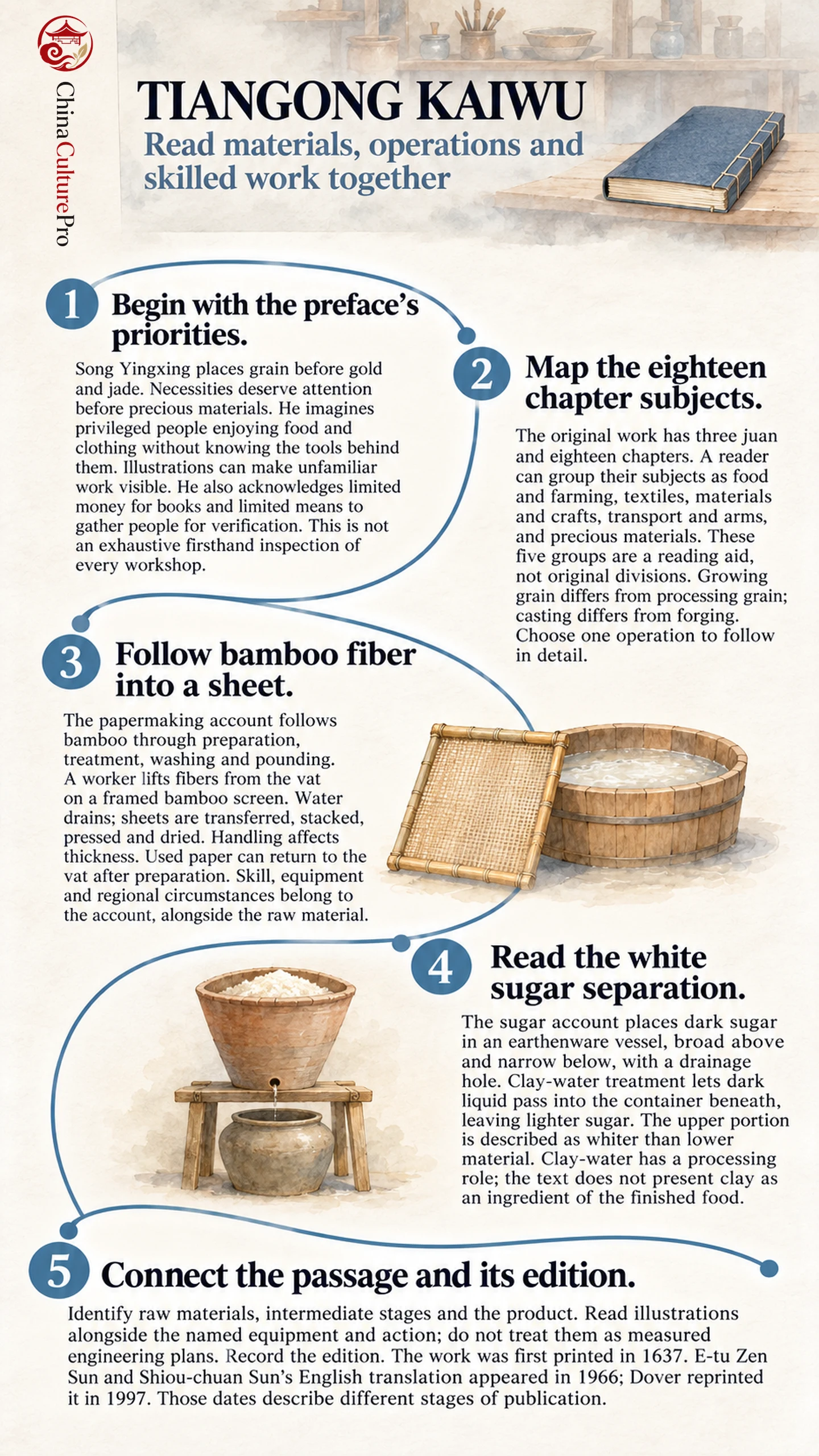
A sheet of paper and white sugar look like finished commodities. The Tiangong Kaiwu directs attention behind them: to fibers, vessels, water and skilled handling. These examples make its account of agriculture and craft easier to read than a list of celebrated inventions.
Why Song Yingxing Put Grain Before Jewels
Song’s preface gives the order of subjects a purpose: grain is valued above gold and jade. Food sustains life, so production of necessities deserves attention before precious materials. This is an explicit editorial priority, not a claim that every chapter has equal weight.[3]
He imagines privileged readers enjoying grain from their kitchens or wearing fine clothing while scarcely knowing the implements behind either. The book’s illustrations can make unfamiliar work visible to them. Its treatment of silk production thus belongs to a wider argument about attending to the labor and materials behind everyday consumption.
The same preface acknowledges constraints: limited money for acquiring books and limited means to gather people for discussion and verification. Song writes from what he has learned and heard. That admission matters when assessing a particular statement; the book should not be presented as an exhaustive firsthand inspection of every workshop in China.
His closing remark that the work is unrelated to advancement through literary achievement sharpens the contrast. Knowledge of useful production, rather than an examination-centered literary performance, is the project’s declared concern.[3]
A Reading Map of Its Eighteen Chapters
These five reader groups map the eighteen subjects; they do not reproduce the book’s original divisions. The opening grain chapter is called Naili (乃粒, Nǎilì). Later chapters extend well beyond farming.[2]
| Reader’s group | Chapter subjects included |
|---|---|
| Food and farming | Grain cultivation; grain processing; salt; sugar and sweeteners; fermentation starters. |
| Textiles | Clothing materials and manufacture; dyeing. |
| Materials and crafts | Ceramics; casting; forging; calcined minerals and related materials; oils; paper; metals; pigments and ink. |
| Transport and arms | Boats and vehicles; military equipment. |
| Precious materials | Pearls, gems and jade. |
The distinction between related chapters is useful. Casting and forging describe different kinds of metalworking; growing grain and processing harvested grain are different operations. Choose a process to follow rather than expecting one uninterrupted story of technological progress.
Bamboo Paper: Following Fiber, Water and the Worker’s Hand
The thirteenth chapter, Shaqing (杀青, Shāqīng), concerns papermaking. Its bamboo-paper account follows raw bamboo through soaking, removal of outer material, treatment with lime and ash preparations, heating, washing and pounding. The resulting fiber suspension can then become a sheet.[2][4]
The worker lifts fibers from the vat using a finely woven bamboo screen supported by a frame. Water drains away; the wet sheet is transferred and stacked, pressed to remove water, then separated and dried. The account links the worker’s handling of the screen with the sheet’s thickness. Skill is part of the process, alongside the material and equipment.
The passage also describes used paper returning to the vat after preparation, saving earlier processing work. It distinguishes uses and regional circumstances rather than presenting every sheet as the same product. This adds a practical dimension to the history of papermaking: production includes reworking existing material, not only starting with a newly gathered plant.
Read these descriptions for their sequence and distinctions. The chapter is a historical account of workshop practice, not a reason to reproduce its chemical treatments or durations as a modern household project.
White Sugar: Reading a Separation Process
The sixth chapter, Ganshi (甘嗜, Gānshì), includes a white-sugar account. After cane juice has been processed into dark sugar, it is placed in an earthenware vessel that is broad above and narrow below, with a small drainage hole. Clay-water treatment allows dark liquid to pass into the container beneath, leaving a lighter sugar mass.[2][5]
The vessel’s form matters: material is held above while liquid can leave below. The account distinguishes the exceptionally white upper portion from lower, more yellow-brown material. A finished product’s color is therefore related to a sequence of treatment and separation, not simply to a different crop.
Do not compress that description into “clay is an ingredient in white sugar.” The passage assigns clay-water a role in processing. Nor does a modern name for a separation method prove that every detail of this historical explanation has been experimentally validated.
Together, the paper and sugar examples offer a useful reading question: what enters the process, what changes, what is removed, and what becomes the saleable product? The same question can organize reading of other chapters.
How to Read the Text, Illustrations and English Translation
- Choose one operation: Identify its raw materials, intermediate stages and finished product.
- Connect words and image: Follow the named equipment and the worker’s action, noting what the description leaves unstated.
- Record the edition: Distinguish the historical witness, a later reproduction and a modern translation.
Read an illustration alongside its passage, rather than as a modern engineering blueprint. Ask what action it makes visible and what information the prose supplies. A depiction of work is not, by itself, a measured plan for reconstructing a machine.[3]
Editions also have histories. The National Library of China’s exhibition identified Song’s 1637 printing alongside a late-Ming or early-Qing edition and a 1771 Osaka printing. Such differences matter when comparing images and wording. They belong to the wider material history of woodblock-printed books.[1]
For English reading, E-tu Zen Sun and Shiou-chuan Sun translated and annotated Chinese Technology in the Seventeenth Century. The 1997 Dover edition reprints the translation originally published by Pennsylvania State University in 1966. Those are two publication dates for the translation’s history, not two dates for Song’s original work.[6]
FAQs About the Tiangong Kaiwu
Did Song Yingxing invent all the techniques he describes?
No. The work describes agricultural and craft techniques. Its importance lies in recording and organizing production knowledge, not in establishing Song as the inventor of every method it includes.
Is it a book only about the Four Great Inventions?
No. Its eighteen chapters cover a much wider range of work, including food, textiles, ceramics and transport. See Chinese inventions for a wider view of invention history.
Can its descriptions be used as modern workshop instructions?
Treat them as historical descriptions. Terminology, omitted steps, workshop context and the accuracy of individual claims require investigation; the text and its illustrations are not a current technical specification.
Источники
[1] National Museum of Classic Books, National Library of China. Tiangong Kaiwu exhibition announcement (2021)
[2] Public-domain Chinese text. Tiangong Kaiwu: received table of contents
[3] Public-domain Chinese text. Tiangong Kaiwu: Song Yingxing’s own preface
[4] Public-domain Chinese text. Tiangong Kaiwu: making bamboo paper
[5] Public-domain Chinese text. Tiangong Kaiwu: making white sugar
[6] CiNii Books catalogue. Chinese Technology in the Seventeenth Century: Sun and Sun translation, Dover reprint (1997)