


Quick Answer: What Is The Waterfall on Mount Lu About?
The Waterfall on Mount Lu (望庐山瀑布, Wàng Lúshān Pùbù) usually refers to the four-line poem by Li Bai (李白, Lǐ Bái) that begins with sunlight on Incense Burner Peak (香炉峰, Xiānglú Fēng). It is the shorter of two poems under that title.[1][2]
- Light: Sunshine makes a purple haze rise around the peak.
- Movement: The distant fall seems to hang before it plunges.
- Scale: The speaker imagines the Milky Way (银河, Yínhé) falling from the highest heavens.[1]
The apparent height expresses the force of the sight rather than measuring the cliff.[1]
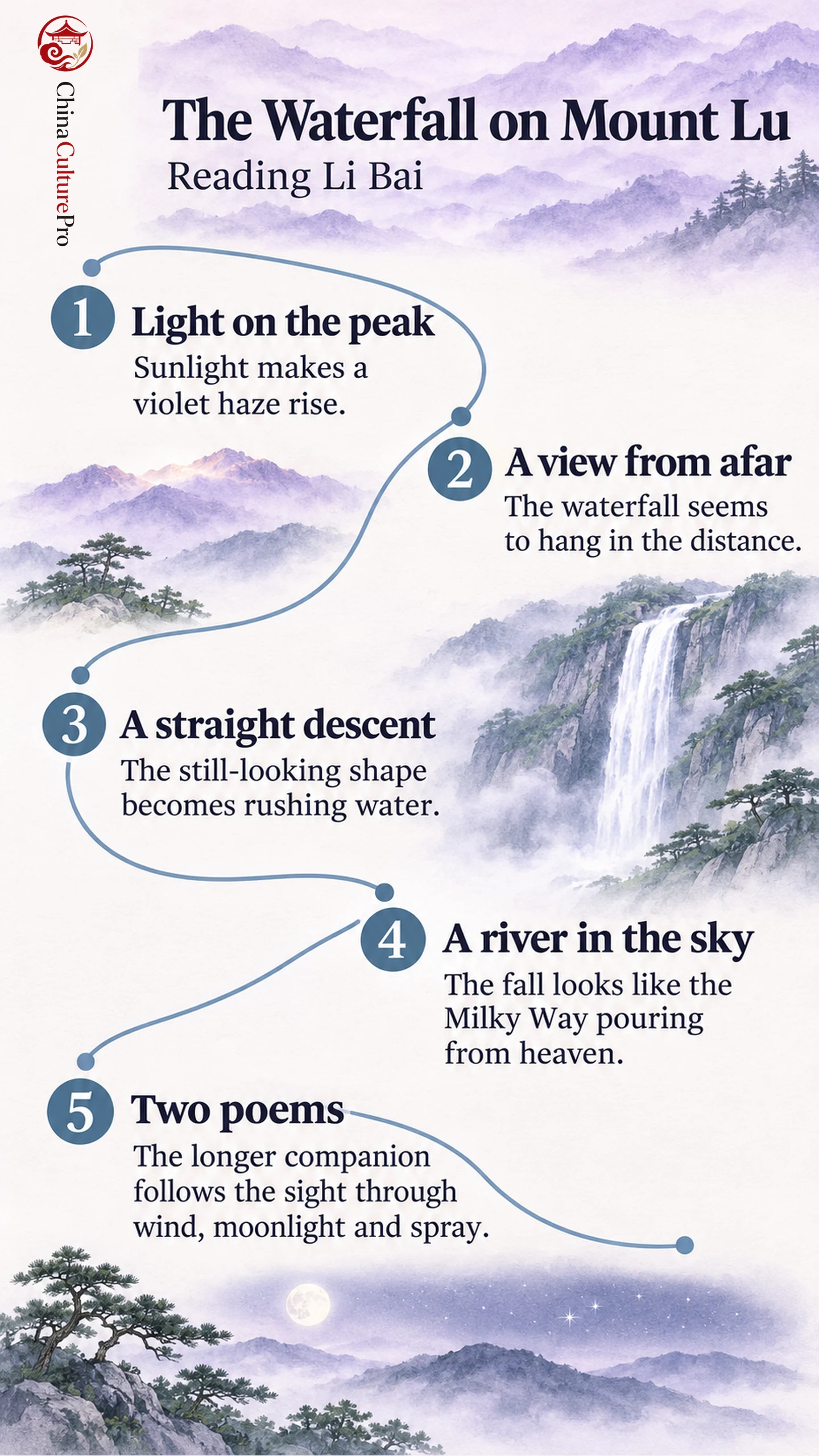
From far away, the fall looks like a strip of white held still. Look again and the water is all motion. Li Bai makes that change of attention happen in the space of two lines, then lets the fall appear to come from farther away than any mountaintop.
The Quatrain in Chinese, Pinyin and English
The four lines have seven characters each. This English rendering follows the base text with 前川 in line two and 九天 in line four. The pinyin gives a modern Mandarin reading.[1][2]
| Китайский | Пиньинь | Смысл |
|---|---|---|
| 日照香炉生紫烟 | Rì zhào Xiānglú shēng zǐyān | Sunlight strikes Incense Burner Peak. A violet haze rises. |
| 遥看瀑布挂前川 | Yáo kàn pùbù guà qiánchuān | Seen from afar, the waterfall hangs above the stream ahead. |
| 飞流直下三千尺 | Fēi liú zhí xià sān qiān chǐ | Flying water plunges straight down three thousand chi. |
| 疑是银河落九天 | Yí shì Yínhé luò jiǔtiān | It could be the Milky Way falling from the highest heavens. |
Some editions give 长 in the second line or 半 in the fourth. The first change makes the line look toward a long stream or river. The second changes how the height of the sky is expressed. The basic turn from viewing the water to imagining a heavenly source remains.[2]
How the View Changes from Mist to Motion
The peak’s name helps carry two images at once. Xianglu means “incense burner.” The haze rising in sunlight can evoke smoke rising from a censer. The poem gives a colour and a movement, without settling which conditions produced the light.[1][2]
The second line supplies the viewer’s distance with 遥看, “look from afar.” At that distance the water appears to hang, 挂. The third line uses another set of verbs. The water flies and goes straight down. The shift can be read as a change in attention rather than a movement to a new position. The waterfall first has an outline, and then that outline fills with speed.[1]
Why the Waterfall Looks Like the Milky Way
The number in line three is a large, round distance in chi, a traditional unit of length. The eye has already been asked to follow a straight drop, and the number lengthens the fall in the reader’s mind. The last line makes the next step possible by taking a river in the sky and giving it the movement of water on earth.[1]
The opening word 疑 keeps the image suspended between looking and imagining. The speaker nearly takes the fall for a celestial river. That instant of uncertainty lets a familiar sight take on impossible scale. In The Hard Road to Shu, the sky also supplies a scale that ordinary human movement cannot meet. Here the comparison follows one clear downward line.[1]
Cao Cao’s Viewing the Sea uses a comparison of similar scale. In that poem the sea seems large enough to contain the stars. Li Bai’s quatrain follows the apparent movement of the celestial river toward earth.
The Longer Companion Poem
The first poem in the pair begins with a climb and a view south toward the falls. It has space for wind, moonlight, spray and foam, and for the speaker’s wish to stay amid the mountain scenery. It already compares the water to a celestial river. The shorter poem keeps that association and makes it the instant on which the ending turns.[1][2]
The two works give a reader different ways to spend time in a landscape. The longer poem follows the water through a succession of sights. The quatrain stops after one sudden recognition. Question and Answer in the Mountains offers another compact view, in which the landscape becomes the speaker’s answer to a question about his retreat.
FAQs About The Waterfall on Mount Lu
Where is Mount Lu?
Mount Lu, also called Lushan, is in Jiujiang, Jiangxi province. The mountain’s landscape has a long association with Chinese art and literature.[3]
Is the waterfall really three thousand chi high?
The poem gives the drop that distance to convey its scale. The following comparison to the Milky Way makes the height part of an imaginative description.[1]
Источники
[1] Li Bai. Two Poems on Viewing the Waterfall at Mount Lu
[2] Li Bai. Viewing the Waterfall at Mount Lu, Annotated Text
[3] UNESCO World Heritage Centre. Lushan National Park