
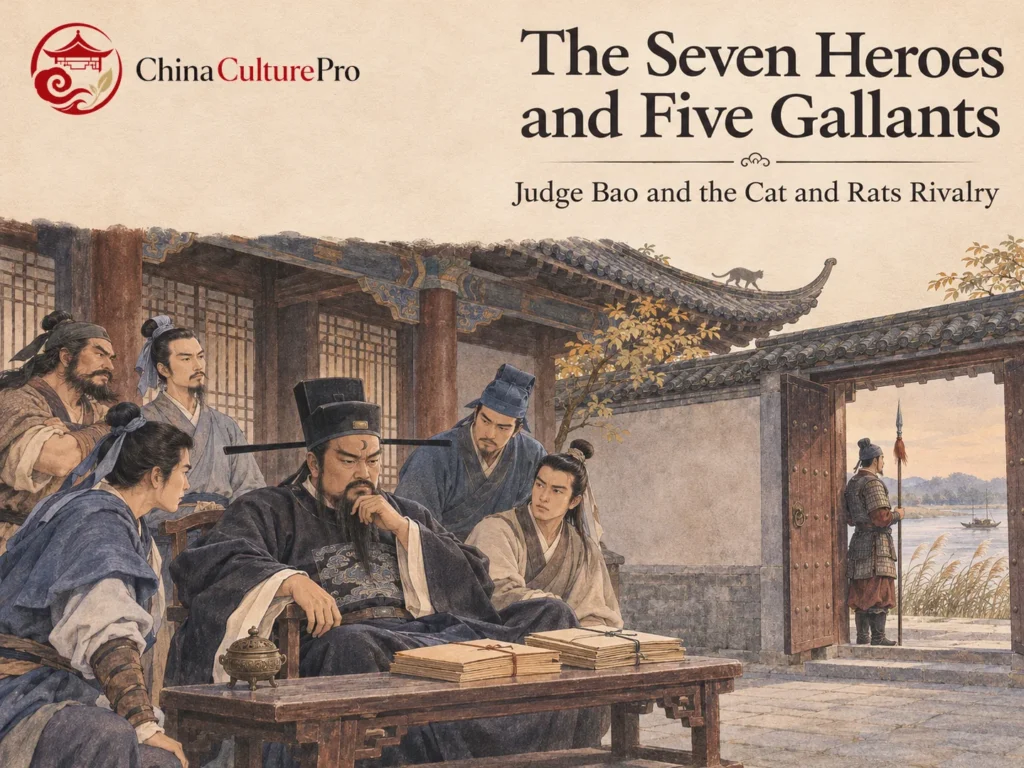

Quick Answer: What Is The Seven Heroes and Five Gallants?
The Seven Heroes and Five Gallants (七侠五义, Qī Xiá Wǔ Yì) is a late Qing novel about the fictional cases of Judge Bao (包公, Bāo Gōng) and the martial heroes who help investigate them. It grew from stories associated with the Qing storyteller Shi Yukun (石玉昆, Shí Yùkūn). Yu Yue (俞樾, Yú Yuè) revised the earlier novel and gave this version its title.[2][3]
- Setting: The fictional action takes place in the Northern Song. Judge Bao is the popular name for the historical official Bao Zheng (包拯, Bāo Zhěng).[1]
- The earlier title: The Three Heroes and Five Gallants (三侠五义, Sān Xiá Wǔ Yì) was first published in 1879. Yu Yue’s revised title appears with his preface dated 1889.[1][4]
- The best-known rivalry: Zhan Zhao (展昭, Zhǎn Zhāo), nicknamed the Imperial Cat (御猫, Yùmāo), draws the attention of the Five Rats (五鼠, Wǔ Shǔ), especially Bai Yutang (白玉堂, Bái Yùtáng).[5]
- Edition check: Catalogues document both a 120-chapter and a 100-chapter book under the Seven Heroes title.[2][3]
The guide explains how the court cases and rivalries fit together. It keeps the fates of the main characters out of the summary.
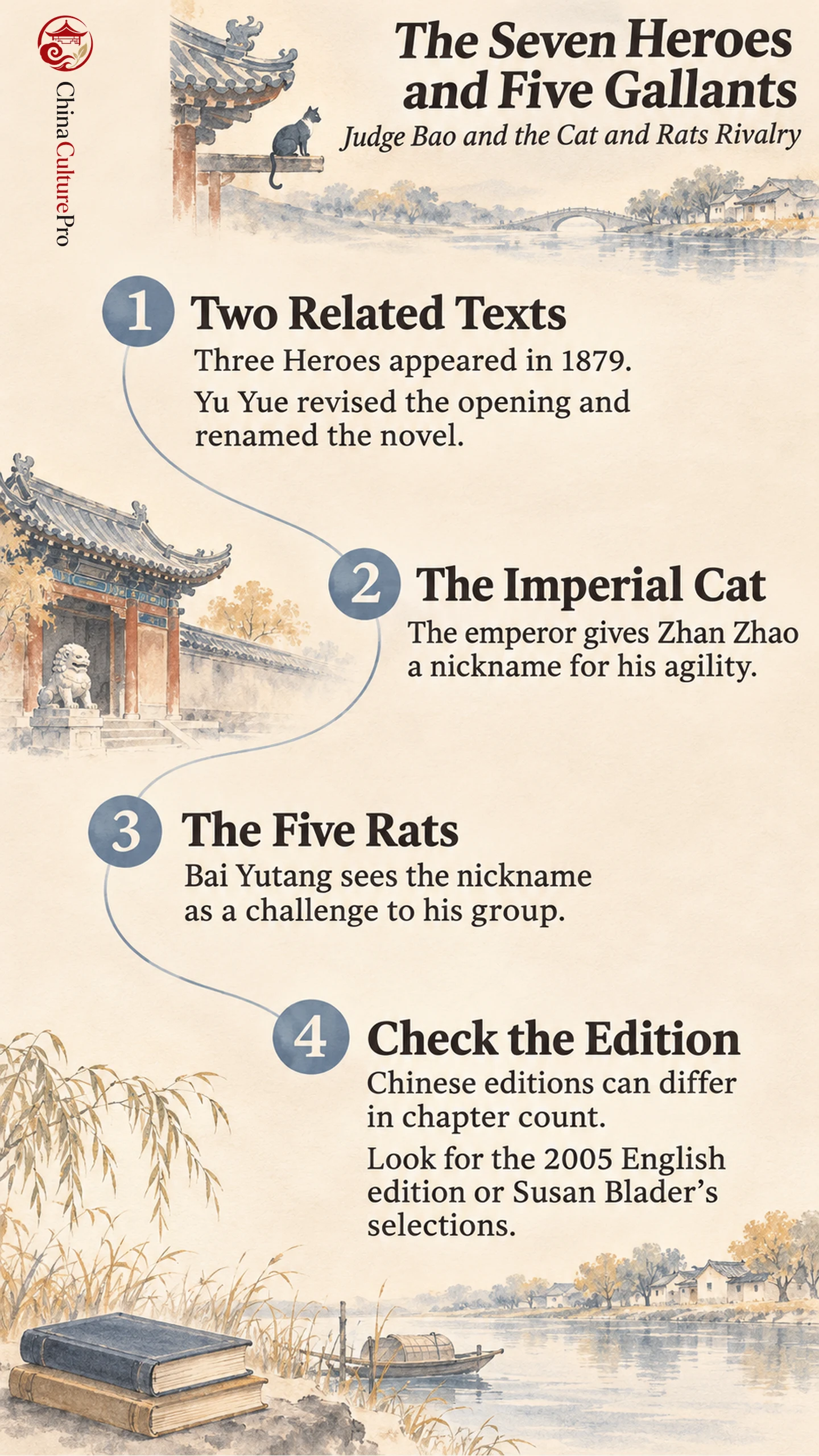
An emperor gives a skilled guard the nickname Imperial Cat. It sounds like harmless praise until a band of sworn brothers known as the Five Rats hears it. Suddenly a court honor matters to men who earned their reputations far from the palace.[5]
That shift in perspective is a good introduction to the novel. Bao’s authority can resolve a case in court. He still needs people who can follow a lead outside it, and those people sometimes have scores of their own to settle.
Why the Novel Has Two Titles
The earlier version, The Three Heroes and Five Gallants, appeared in 1879 and drew on an oral storytelling tradition associated with Shi Yukun.[1]
The medieval setting belongs to the story, while the publication and revision belong to the late Qing. The Song dynasty is useful background for the official Bao. The adventures belong to the later literary tradition built around him.
Yu Yue rewrote the first chapter. Lu Xun’s account of the revision explains that Yu considered the earlier opening, which featured the substitution of an animal for a royal infant, too far removed from the historical record. Yu tried to bring his opening closer to historical biography.[4] That change tells you something about the editor’s preferences. It leaves plenty of room for invention in the rest of the novel.
The story combines gongan (公案, gōng’àn), or crime and courtroom fiction, with the exploits of martial heroes.[5]
If you come from Chinese wuxia fiction, notice what the court adds to a familiar kind of scene. Winning a confrontation may get a person free to tell his story. A hearing gives Bao a chance to question that account and decide what weight to give it.
Who Are the Seven Heroes and the Five Gallants?
The earlier title can be hard to count from the names. Zhan Zhao and Ouyang Chun are the Southern and Northern heroes. Ding Zhaolan and Ding Zhaohui share the designation of twin heroes. That makes four people. Yu Yue’s seven also include Ai Hu, Zhi Hua and Shen Zhongyuan, characters already in the story.[4]
The Five Gallants are the sworn brothers Lu Fang, Han Zhang, Xu Qing, Jiang Ping (蒋平, Jiǎng Píng) and Bai Yutang. Each has a Rat nickname, so a chapter heading may give an alias before the text uses the personal name. Jiang is the River-Turning Rat, and Bai is the Brocade-Furred Rat.[6]
A short cast note helps when you first read a case. Put Bao’s office in one column and the sworn brothers in another. Pencil Zhan beside the office after his court appointment. The columns show where people begin, and the plot shows how readily allegiances can cross between them. The brotherhood in Water Margin offers another way to compare what ties a group together.
How the Cat and Rats Test Loyalty
After a display of swordsmanship and archery, Zhan leaps to a high pavilion and then to its roof. The emperor’s praise gives him the cat nickname. Bai Yutang takes that nickname as a challenge to the Five Rats and repeatedly seeks to match himself against Zhan.[5] The nickname links two scenes with very different stakes. The emperor is praising a guard. Bai hears a judgment on his own group.
Chapter 46 shows how quickly a second obligation can interfere with the rivalry. Jiang Ping gets medicine from Han Zhang by telling Han that their sworn brother Xu Qing has been hit. He uses it to help Ma Han, an officer attached to Bao’s office who was struck by a poisoned bolt.[7] Keep track of what Jiang actually says, then ask what Han assumes from it. The scene depends on the speed with which people act when someone invokes a bond they take for granted.
The book can make room for sympathy on more than one side of such a disagreement. Someone tied to the sworn brothers can see the harm in letting an officer die. Someone deceived in the process can still have grounds to feel betrayed. Those responses make the investigation a test of loyalties as well as a search for answers.
Which Edition Should You Read?
If you want Yu Yue’s version, search 七俠五義 or 七侠五义 together with his name and check the chapter count in the catalogue. Indiana University records a 120-chapter facsimile based on an 1890 Shanghai edition. Taiwan’s Cultural Memory Bank documents a 100-chapter 1964 Dadong Bookstore edition.[2][3] Compare the contents pages first. If the opening is available, check whether it begins with the royal infant substitution or with the revised account.
Foreign Language Press issued an English edition in 2005, ISBN 9787119033549.[8] Susan Blader’s Tales of Magistrate Bao and His Valiant Lieutenants is a separately published set of English selections from the earlier version.[1]
Choose between these by the title and contents. A reader exploring other Chinese classic books in translation can use the same checks when a translator selects episodes from a longer work.
For a first encounter, read one whole case. Then follow one person who moves between Bao’s office and the martial world. That path gives you a manageable start and shows how this work joins two strands of Chinese literature.
FAQs About The Seven Heroes and Five Gallants
Are The Three Heroes and Five Gallants and The Seven Heroes and Five Gallants related?
Yes. Yu Yue revised the earlier novel. He rewrote the first chapter and adjusted the title to account for more of the existing characters.[2][4]
Was Judge Bao a historical person?
Yes. Bao Zheng was a Northern Song official. The novel puts its fictional investigations and martial heroes around the figure of the incorruptible Judge Bao.[3]
Are there English editions of the story?
Yes. Look for the 2005 Foreign Language Press edition of The Seven Heroes and Five Gallants or Susan Blader’s English selections from the earlier version.[1][8]
Источники
[1] Chinese University of Hong Kong Press. Tales of Magistrate Bao and His Valiant Lieutenants
[2] Taiwan Cultural Memory Bank. The Seven Heroes and Five Gallants, Dadong Bookstore Edition
[3] Indiana University Libraries. Qi Xia Wu Yi: One Hundred and Twenty Chapters
[4] Lu Xun. A Brief History of Chinese Fiction, Chapter Twenty-Seven
[5] Hong Kong Public Libraries. Cats in Literature: The Agile Cat
[6] National Museum of Taiwan History. Illustrated Three Heroes and Five Gallants Playing Cards
[7] Tianya Shuku. The Seven Heroes and Five Gallants, Chapter Forty-Six
[8] Open Library. The Seven Heroes and Five Gallants, Foreign Language Press Edition