

Quick Answer: What Is Teahouse About?
*Teahouse* (茶馆, Cháguǎn) is a three-act play by Lao She (老舍, Lǎo Shě). It follows the Yutai Teahouse (裕泰茶馆, Yùtài Cháguǎn) in Beijing and its proprietor, Wang Lifa (王利发, Wáng Lìfā). The room stays familiar while the people who come through it live through about fifty years of upheaval.[1][2]
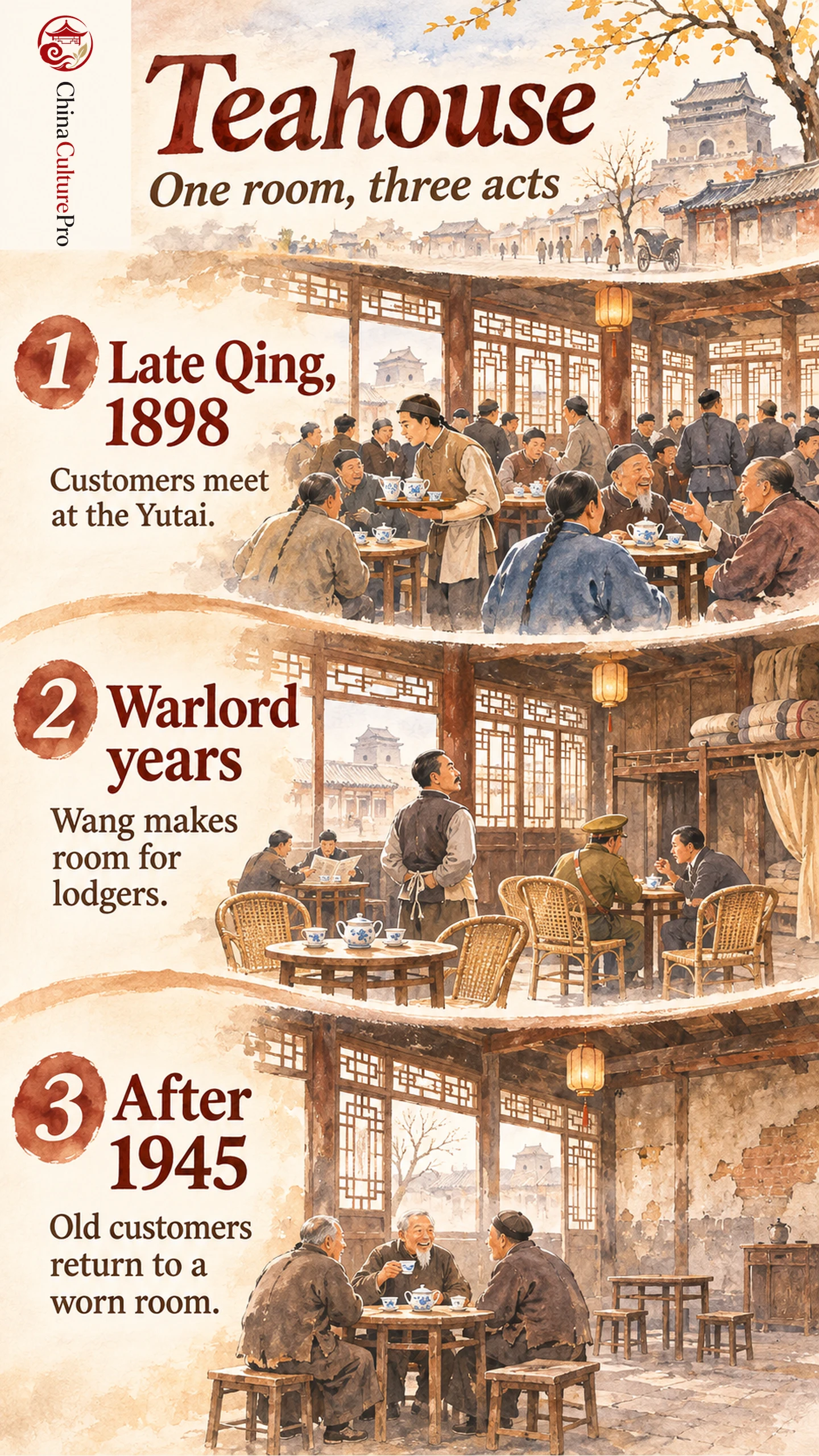
- Act I: The last years of the Qing dynasty, after the failure of the 1898 reforms.
- Act II: Early Republican China during conflict among warlords.
- Act III: The years after the end of the war with Japan in 1945.[1][3][4]
Watch what changes in the room and what people can safely say there.
The play gives its audience a place to return to. See what the proprietor has moved or replaced before you listen to what the customers say about the city.
The Three Acts of Teahouse
| Act | Ситуация | What happens at the Yutai |
|---|---|---|
| I | Beijing in 1898, after the failed reforms | Customers meet to talk, drink tea and do business. The room also gives the powerful a place to make deals at other people’s expense. |
| II | The warlord years after Yuan Shikai’s death | Wang keeps tea service at the front and turns the rear into lodgings as other large teahouses close. |
| III | After Japan’s defeat in 1945 | The business is worn down. Older customers return and face what has become of their plans. |
The Hundred Days Reform gives historical context for the first act. In the play you see its aftermath from the position of people in a public room.[1][3][4]
The Characters to Follow
| Персонаж | Place in the story |
|---|---|
| Wang Lifa | Keeps the business open by adapting what he sells and by accommodating people who have power over it. |
| Qin Zhongyi (秦仲义, Qín Zhòngyì) | Wants to build factories and believes industry can help the country. |
| Fourth Elder Chang (常四爷, Cháng Sìyé) | A Qing bannerman who speaks his mind and takes the consequences. |
| Kang Shunzi (康顺子, Kāng Shùnzǐ) | The daughter of a poor man who sells her to a powerful eunuch. Her later appearances show what she has had to do to survive. |
These people have different resources and reasons to enter the teahouse. When someone comes back in a later act, notice what that person needs from the room now. The same place can be a business address, a refuge or a last chance to be heard.[1][3][4]
What the Room and the Signs Tell You
In the first act, the room is large enough for people to gather around singing or crickets. Customers can order a bowl of noodles with their tea. By the second act, the back rooms house paying guests and the front menu has shrunk. In the front, rattan chairs and small tables take the place of older furnishings. An advertisement replaces older wall decoration. Wang’s decision to update the room has kept him in business longer than other proprietors.[1][3]
The sign asking patrons to avoid discussing affairs of state survives the remodeling and becomes more prominent. It gives an audience a way to see the pressure around conversation. Work and family remain ordinary subjects of conversation. A visitor who talks about his livelihood can find himself talking about the soldiers, officials or agents who have disrupted it.[1][3][4]
In Rickshaw Boy, Lao She follows one worker through Beijing’s streets. Here a range of people bring their news, money and grievances into one place.
What the Final Meeting Brings Together
**Ending spoiler.** Qin comes back with small objects recovered from the remains of his factory. Chang, once able to speak proudly as a regular, sells peanuts in old age. Wang’s life of making room for other people has left him about to lose his own place.[4]
The three men scatter funeral paper money for themselves. The action gives a single shape to three different losses. On stage it lets them do something together with losses they can no longer put right.[4]
FAQs About Teahouse by Lao She
When was Teahouse published and first staged?
The play was published in 1957. The Beijing People’s Art Theatre production premiered on March 29, 1958, with Jiao Juyin and Xia Chun directing.[5][6]
Which English translation can I read?
Look for John Howard-Gibbon’s *Teahouse: A Play in Three Acts*. It appeared in 1980. The Chinese University of Hong Kong Press also publishes a bilingual edition.[2][7]
Источники
[1] Lao She. Teahouse, Act I
[2] Chinese University of Hong Kong Press. Teahouse, bilingual edition
[3] Lao She. Teahouse, Act II
[4] Lao She. Teahouse, Act III
[5] China Culture. Lao She’s Teahouse, publication and production
[6] Beijing Municipal Government. Teahouse premiere and production history
[7] WorldCat. Teahouse, John Howard-Gibbon’s 1980 translation