


Quick Answer: Who Is Tang Sanzang?
Tang Sanzang (唐三藏, Táng Sānzàng) is the scripture-seeking monk of Journey to the West (西游记, Xīyóu Jì). The novel draws on the historical monk Xuanzang (玄奘, Xuánzàng) and gives him a pilgrimage with supernatural companions and tests.[1][2][4]
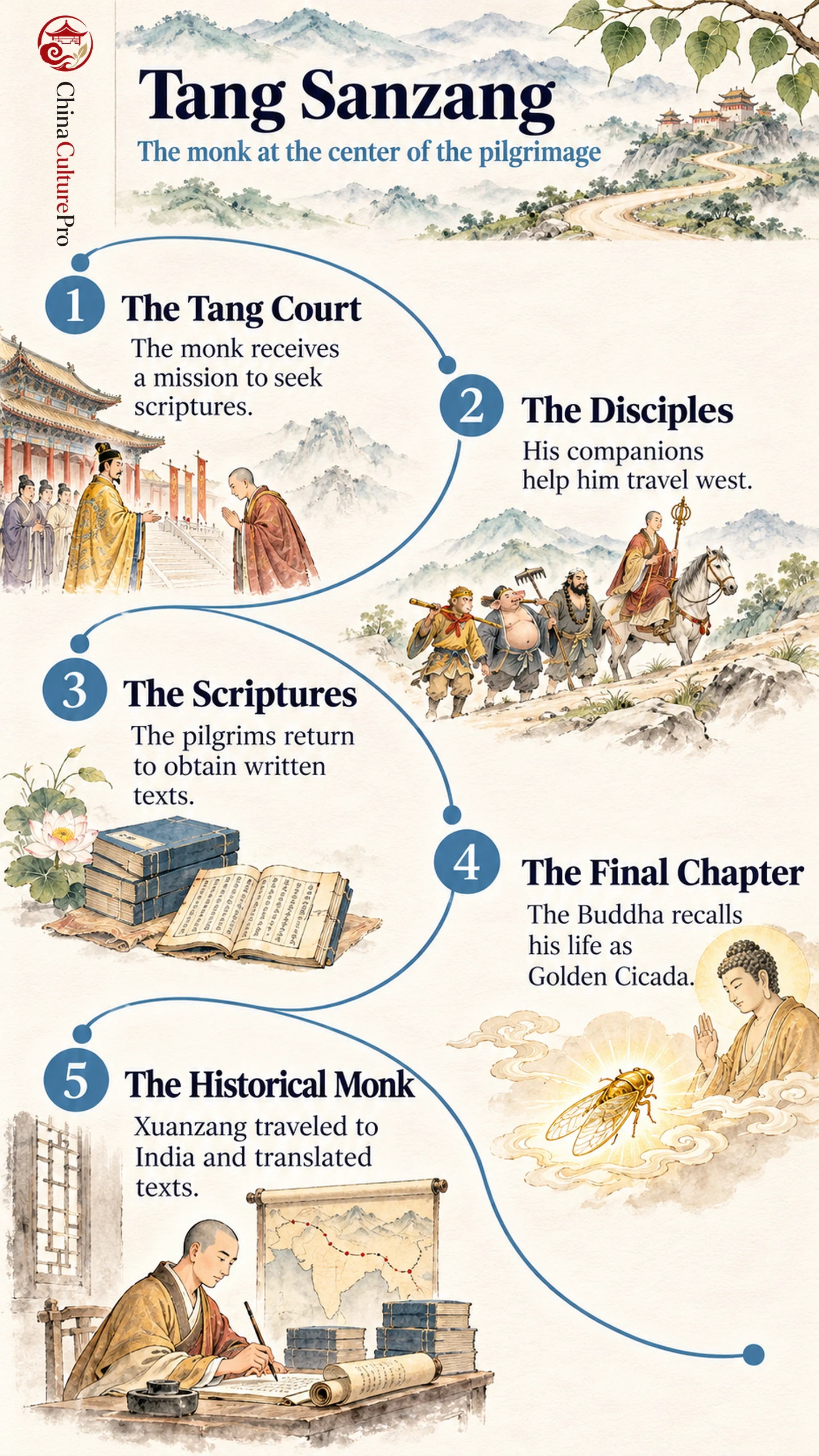
- The Tang court sends the monk west for Buddhist scriptures.[1]
- Sun Wukong (孙悟空, Sūn Wùkōng) and the other disciples protect him on the journey.[2][3]
- The Buddha identifies his earlier life as Golden Cicada (金蝉子, Jīnchánzǐ).[3]
The same names may appear in histories and retellings. Here the chapter numbers refer to the novel.
The travelers reach the far bank of a river near the end of the book. Tang Sanzang thanks his disciples. Wukong answers that they have supported one another. Their exchange puts into words a relationship that the journey has been testing all along.
How the Novel Gives Him a Mission
Chapter 12 places Xuanzang at a Buddhist assembly in Chang’an. The intervention of Guanyin brings the prospect of obtaining scriptures from the west before the court. Xuanzang undertakes the journey with imperial backing.[1]
The historical Xuanzang was a Tang Buddhist scholar who traveled to India, collected texts and translated Buddhist works into Chinese. Sanzang refers to the Tripitaka, the three divisions of the Buddhist canon. The literary character carries the name into a story structured around tests and encounters on the way west.[4]
What the Monk and His Disciples Owe Each Other
The traveling group brings together the monk, Sun Wukong, Zhu Bajie, Sha Wujing and the white horse. In Chapter 98, Wukong explains that the disciples have been able to pursue their own progress by serving their master. The monk, in turn, has depended on their protection.[2][3]
An encounter such as the Scorpion Demon episode shows how that arrangement can be tested. A chapter can follow the disciples’ search for their teacher while keeping the teacher’s goal at the center of the larger story.
The Scriptures and His Final Title
In Chapter 98, the pilgrims arrive before the Buddha and first receive scriptures without writing. They go back and obtain written texts. Chapter 100 follows the scriptures back to Chang’an and later returns the pilgrims to the Buddha. He recalls the monk’s former life as Golden Cicada and grants him a Buddha title. The quest thus ends with a change in the pilgrim’s standing as well as the delivery of the texts.[2][3]
The Wordless Scriptures on Television
CCTV’s episode 25 synopsis for the 1986 series keeps the wordless scriptures and the pilgrims’ return to obtain written texts. The finale also shows another ordeal on their way home. Finding the destination and finishing the journey remain separate moments on screen.[5]
FAQs About Tang Sanzang
Is Tang Sanzang based on a real monk?
Yes. The novel draws on Xuanzang, a historical Buddhist scholar and translator of the Tang dynasty.[4]
What is he seeking?
His mission is to obtain Buddhist scriptures and bring them back to the Tang realm.[1][3]
Who is Golden Cicada?
Golden Cicada is Tang Sanzang’s former identity, revealed in the final chapter.[3]
Источники
[1] Journey to the West. Chapter 12
[2] Journey to the West. Chapter 98
[3] Journey to the West. Chapter 100
[4] Ernest Brewster, Oxford Bibliographies. Xuanzang
[5] CCTV. Journey to the West, episode 25 of the 1986 series