


Quick Answer: What Is Taiwan High Mountain Tea?
Taiwan high mountain tea (高山茶, gāoshānchá) usually refers in tea commerce to mountain-grown oolong, often associated with gardens above about 1,000 meters. That common usage is not a universal quality grade or a complete description of an individual product.[1]
- Origin: a mountain or regional name supplies geographic information.
- Style: many familiar examples are fragrant, rolled oolongs.
- Evaluation: cultivar, manufacture, harvest and storage still affect the cup.
Read the packet as several pieces of information. An elevation figure cannot replace an origin statement, and a pale floral cup does not prove either one.
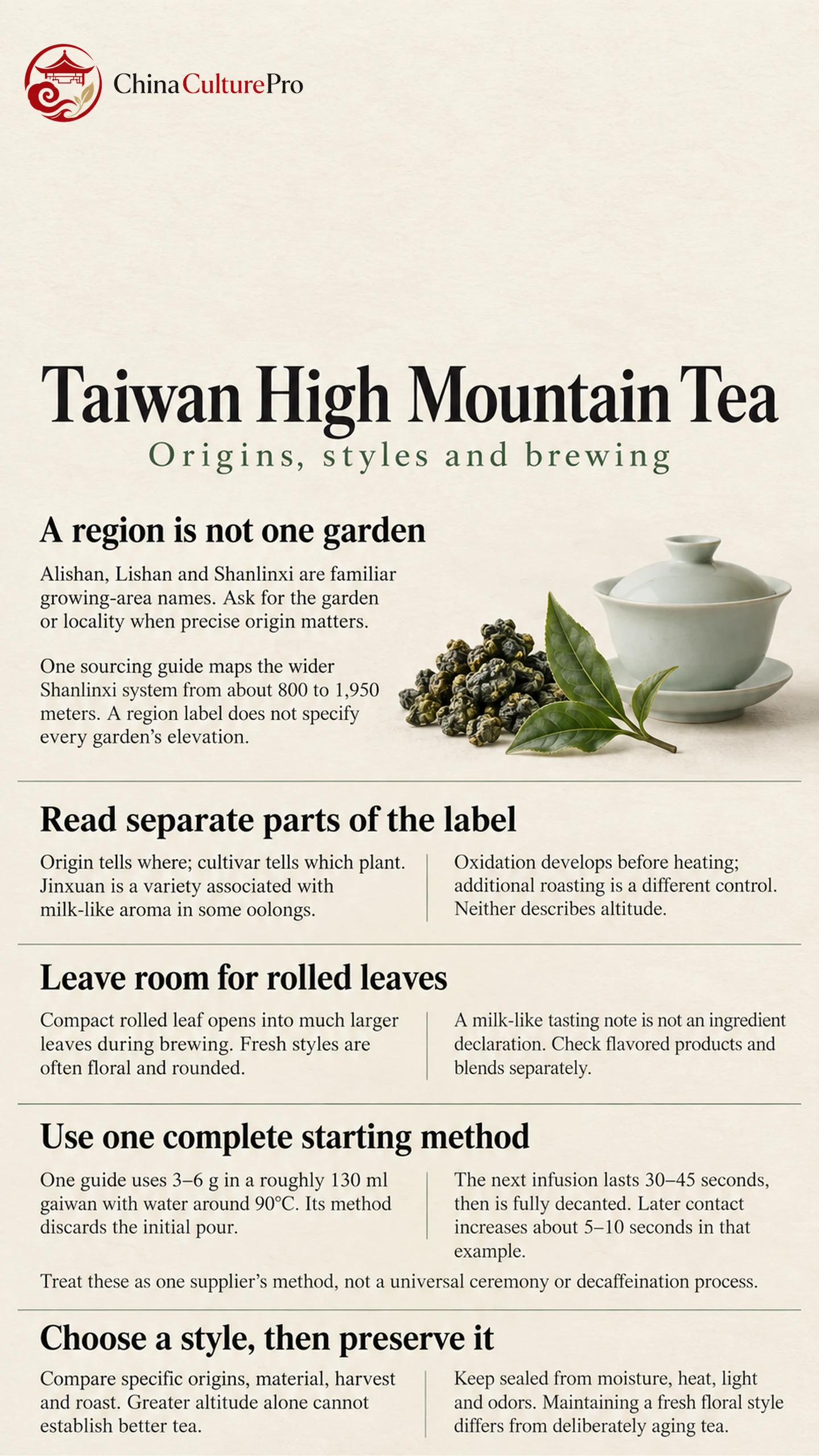
Taiwan high mountain tea (高山茶, gāoshānchá) is often introduced through its elevation and floral aroma. Those clues are useful, but they leave important questions unanswered: where the garden is, which plant was grown, and how the leaf was oxidized, rolled and roasted.
Origins: Alishan, Lishan and Shanlinxi
Alishan (阿里山, Ālǐshān), Lishan (梨山, Líshān) and Shanlinxi (杉林溪, Shānlínxī) are familiar regional names in the high mountain tea trade. They identify different growing areas, not three interchangeable grades. Ask for a named garden or more specific locality if precise origin matters.[1][4]
A regional umbrella can cover varied terrain. One sourcing guide maps the wider Shanlinxi tea system from about 800 to 1,950 meters. That illustrates why a regional label does not establish the altitude of a particular garden. The same curator dates tea cultivation in this area to the 1970s, showing that its modern tea economy has its own history.[4]
Cool mountain conditions, weather at harvest and garden management are parts of the growing context. They do not create a rule that every higher garden tastes better than every lower one. Compare specific teas in the cup rather than ranking whole regions by their highest summit.
Cultivar, Oxidation and Roast Describe Different Things
Jinxuan (金萱, jīnxuān) is a tea plant variety associated with a milk-like aroma in some oolongs. The former describes plant material; the latter identifies an origin. They can appear together on one label because they answer different questions.[2]
| Label information | Что в нём описано | What it leaves open |
|---|---|---|
| Origin or elevation | Where the leaf grew | Does not specify cultivar or roast |
| Культивар | Which plant material was used | Does not fix the entire finished flavor |
| Окисление | How leaf reactions were managed before heating | Different from subsequent roasting |
| Прогрев | Additional heating that develops aroma | Can vary within one regional tea style |
Oolong manufacture develops partial oxidation before heat limits leaf-enzyme activity. Later roasting is a separate treatment. A producer may emphasize freshness and floral aroma or use more roast for a toasted character. Neither roast level nor the word fragrant measures elevation.[5] The distinction between oolong and green tea and the role of tea roasting explain those separate controls.
What to Expect from the Leaf and Cup
Rolled high mountain oolong can look compact in the packet and expand into much larger leaves during brewing. Leave room for that opening rather than packing a small vessel tightly. The familiar fresh style is often floral and rounded; a different roast or harvest can change its balance.[3]
Milk-like, orchid-like and creamy are tasting descriptions. A milk-like note does not require dairy in a plain tea, but it does not certify every product sold as milk oolong either. Flavored versions and blends need their own ingredient check. A descriptive name is not an allergen declaration.
How to Brew Rolled High Mountain Oolong
A гайвань или маленький чайник can support repeated infusions, while a mug and roomy infuser can make a larger serving. Choose a method first so that dose and contact time belong to the same approach.
- Set up a small-vessel example: One original brewing guide uses a roughly 130 ml gaiwan with 3–6 g of rolled leaf and water around 90°C. Its method discards an initial pour before the drinking infusions.
- Infuse and decant: In that guide, the next infusion lasts 30–45 seconds, then all the liquid is poured into a separate vessel. This separates the drink from the leaves and permits sharing.
- Adjust later infusions: The guide increases subsequent contact by about 5–10 seconds. Taste and adjust to your actual leaf and preference; do not assume every rolled tea needs the same schedule.
These parameters are one supplier’s starting method, not a mandatory ceremony. Its discarded first pour is a brewing choice, not proof of decaffeination. A large mug with a lower leaf-to-water ratio needs a different contact time.[3]
Choosing and Keeping a Tea You Enjoy
Choose a packet with a clear origin, material or cultivar, harvest information and a useful style description. Ask what lightly roasted or traditional means for that product. Tea grading language should supply context rather than a universal altitude score.
Keep the tea sealed from moisture, heat, light and odors. Preserve its label so that future tasting comparisons refer to the same product. Storage differs by tea type and purpose: maintaining a fresh floral oolong is a different goal from deliberately keeping an aged style. Start with a small amount if you are still learning which roast and aroma you enjoy.
FAQs About Taiwan High Mountain Tea
Is high mountain tea always oolong?
The familiar retail style is oolong, but altitude itself is a growing condition rather than a processing category. Check the stated tea type instead of inferring it from the mountain name alone.
Is milk oolong made with milk?
Not necessarily. Jinxuan can have a milk-like aroma without dairy being the explanation. A product sold as milk oolong may also be flavored, so read its actual ingredients.
Does a higher altitude always mean better tea?
No. Harvest weather, material, management and manufacture still matter. A regional name can also cover gardens at different elevations, so the highest quoted number may not describe your packet.
Can I use a mug instead of a small teapot?
Yes. Use a roomy infuser and a method suited to the mug’s volume. Rolled leaves expand; do not transfer a concentrated small-vessel dose and long mug steep without adjustment.
Источники
[1] Pure Taiwan Tea, original farm and product guide. Taiwan High Mountain Tea
[2] Pure Taiwan Tea, original cultivar guide. Taiwan Jinxuan Oolong Tea
[3] Beautiful Taiwan Tea Company, original brewing demonstration. Brewing High Mountain Oolong from Taiwan
[4] Liao Chang Xing, original sourcing guide. ShanLinXi Tea Region Guide
[5] Taiwan Tea and Beverage Research Station. 臺灣特色茶分類及加工製程簡介