


Quick Answer: What Is the Suiyuan Shidan?
The Suiyuan Shidan (随园食单, Suíyuán Shídān) is a work on food by Yuan Mei (袁枚, Yuán Méi), a poet of the Цин (清, Qīng) period. Published in 1792, it combines culinary instructions with judgments about taste and accounts of meals and cooks.[1][3][8]
- Structure: Fourteen named parts, beginning with principles and warnings before categories of food and drink.
- Voice: Personal, argumentative and attentive to the difference between flavor and display.
- Reading: A historical gastronomic manual whose compact instructions need contextual explanation.
Read the recipes alongside the criticism and social encounters. Its categories, preferences and measures do not automatically match those of a modern cookbook.
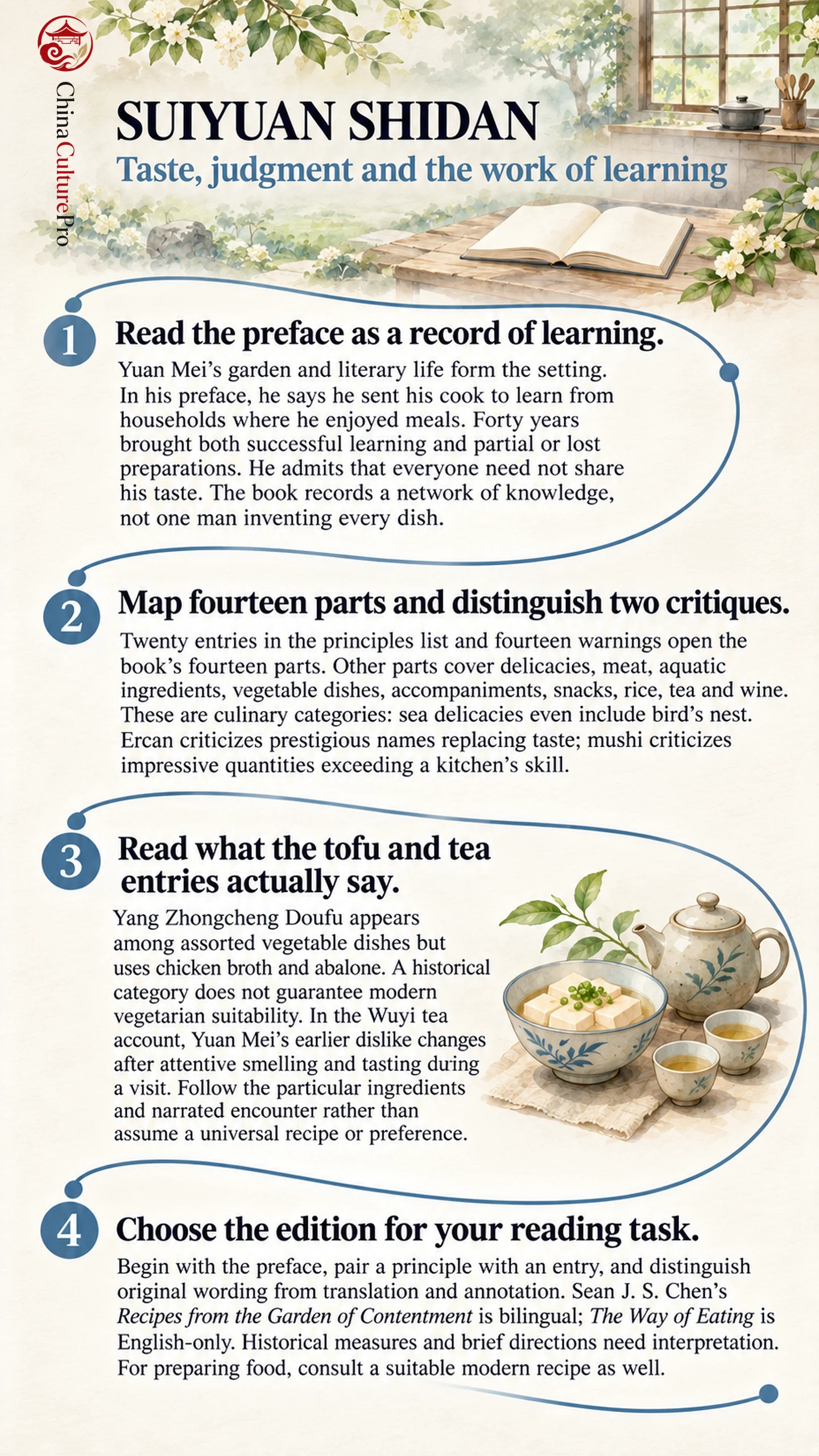
Why might well-prepared tofu deserve more praise than an expensive delicacy? Why does a writer change his mind about a celebrated tea? The Suiyuan Shidan makes eating a subject of judgment, learning and literary argument, as well as preparation.
Yuan Mei’s Preface: Learning Through Cooks and Households
The title refers to Suiyuan (随园, Suíyuán), the garden associated with Yuan Mei after he left official life, in the western part of the city of Jiangning (江宁, Jiāngníng), present-day Nanjing (南京, Nánjīng). His identity as a poet and retired official matters: this is the voice of a cultivated diner with access to household kitchens and networks of hospitality.[1]
In the preface, he says that when he enjoyed a meal in another household, he sent his own cook to learn there with the respect of a pupil. He describes gathering such knowledge over forty years, while acknowledging uneven results: some preparations were learned well, others only partly, and some were lost.[3]
That is a record of collaboration and imperfect transmission, not a claim that he personally invented every dish. He also admits that he cannot make everyone share his preferences. Keep that admission beside his forceful verdicts later in the book.
Its setting connects with Jiangnan (江南, Jiāngnán) literary and social life, but the book should not stand for every household or region. For Chinese food history, it offers situated evidence: what this writer valued, whom he learned from, and how he represented dining to his readers.
Fourteen Parts and a Critique of Display
The Xuzhi Dan (须知单, Xūzhī Dān), a list of things to understand, has twenty entries; the Jie Dan (戒单, Jiè Dān), a list of warnings, has fourteen. These two introductory parts should not be confused with the fourteen parts of the whole book.[2][3]
| Reading group | What the fourteen parts cover |
|---|---|
| Principles and warnings | Ingredient selection, preparation, serving and faults to avoid. |
| Sea and river delicacies | Two categories of prized ingredients and preparations. |
| Pork, other livestock and birds | Three groups of land-animal dishes.[4][5] |
| Aquatic categories and vegetable dishes | Scaled aquatic creatures, scaleless aquatic creatures and assorted vegetable dishes.[6] |
| Accompaniments, snacks and drinks | Side dishes, snacks, rice and congee, and tea and wine.[7] |
This is a reading map, not five original chapters. The culinary categories also differ from modern biological ones: the sea-delicacies part includes edible bird’s nest. Follow the contents and entry headings rather than infer an ingredient solely from its category label.[3]
Two warnings make his critical priorities explicit:
- Ercan (耳餐, ěrcān): “Eating with the ears” means valuing an ingredient’s prestigious name over how it tastes. He argues that tasty tofu can surpass a poorly handled expensive delicacy.
- Mushi (目食, mùshí): “Eating with the eyes” here means seeking an impressive quantity of dishes. His complaint is that abundance can exceed a kitchen’s ability to prepare each dish well.[3]
These are judgments about flavor, skill and hospitality, not a claim that all costly food is bad or that attractive presentation has no value. His prose repeatedly uses comparison, wit and criticism to make distinctions that a bare ingredient list would miss.
Tofu and Wuyi Tea: Reading Beyond the Dish Name
The Zasu Cai Dan (杂素菜单, Zásù Cài Dān), or assorted vegetable-dish section, includes Yang Zhongcheng Doufu (杨中丞豆腐, Yáng Zhōngchéng Dòufu). The entry associated with the official Yang uses chicken broth and abalone alongside mushrooms and other seasoning.[6]
The placement is revealing. A historical heading centered on vegetable ingredients does not guarantee a vegetarian preparation in the modern sense. Distinguish the ingredient tofu from the complete dish, and read the actual entry before deciding what its heading implies.
The account of Wuyi tea (武夷茶, Wǔyí Chá) shows judgment being revised. Yuan Mei recalls disliking its strength and bitterness, then describes a visit where monks and Daoist hosts offered tea in small vessels. Attending to aroma and then taste, he discovered fragrance and a lingering sweetness that changed his earlier opinion.[7]
The point is the relationship between prior expectation, a particular encounter and a changed evaluation. Read the passage as his narrated experience, rather than a claim that every reader must prefer the same tea. Modern Wuyi rock-tea styles deserve their own account; the historical entry should not be made to define every present-day product.
How to Read and Choose an Edition
- Begin with the preface: Identify the writer’s sources of knowledge and his acknowledgment of personal taste.
- Pair a principle with an entry: Read one warning, then ask how a food or drink account supports, complicates or changes that judgment.
- Check the edition: Keep the original entry, translated wording and a modern annotator’s explanation distinct.
Sean J. S. Chen’s Recipes from the Garden of Contentment offers the Chinese text with an English translation and annotations. Berkshire’s The Way of Eating is an English-only version. Choose according to whether you need direct comparison with the Chinese; the presence of explanatory notes does not make them Yuan Mei’s own words.[8]
For a cooking project, consult a suitable modern recipe as well. Historical measures, ingredient names, assumptions about equipment and abbreviated directions require interpretation. A guide to Chinese cooking methods can orient the vocabulary, but it does not turn every old instruction into a verified modern procedure.
FAQs About the Suiyuan Shidan
Is the Suiyuan Shidan only a cookbook?
It includes recipes, but also principles, criticism, meal memories and accounts of learning from other kitchens. Reading only the preparations misses the argument about how food should be judged.
Does it define one standard Chinese cuisine?
No. It records Yuan Mei’s knowledge and preferences within particular social networks. His preface acknowledges personal taste; the book is valuable historical evidence without representing every region or household.
Can its instructions be followed like a modern recipe?
Not directly in every case. Directions can be abbreviated, and historical ingredients, measures and equipment need explanation. Distinguish literary-historical reading from preparing a dish with a tested modern recipe.
Источники
[1] Ministry of Education, Revised Mandarin Chinese Dictionary. Yuan Mei: poet, official and resident of Suiyuan
[2] Jinan University, Department of History. Chen Weiming’s annotated Suiyuan Shidan: book notice and contents
[3] Public-domain Chinese text. Suiyuan Shidan: preface, principles and warnings
[4] Public-domain Chinese text. Suiyuan Shidan: river delicacies and pork contents
[5] Public-domain Chinese text. Suiyuan Shidan: other livestock and birds
[6] Public-domain Chinese text. Suiyuan Shidan: aquatic categories and assorted vegetable dishes
[7] Public-domain Chinese text. Suiyuan Shidan: side dishes, snacks, rice, tea and wine
[8] Berkshire Publishing. Recipes from the Garden of Contentment: translation and edition information