


Quick Answer: What Is the Mythic Shen?
Shen (蜃, shèn) is a large clam associated with mirages in Chinese tradition. The Records of the Grand Historian describes vapor by the sea taking the shape of towers. The image survives in the expression hai shi shen lou (海市蜃樓, hǎi shì shèn lóu), which can mean a mirage or something illusory.[1][4]
- The legend: A great clam’s vapor takes the shape of buildings.
- The observation: Shen Kuo reports a sea market and doubts the explanation involving mythical creatures.
- The expression: The same words can describe an apparent promise that proves insubstantial.
The clam story and the optical explanation offer different accounts of why buildings seem to appear above the water.[1][2][4]
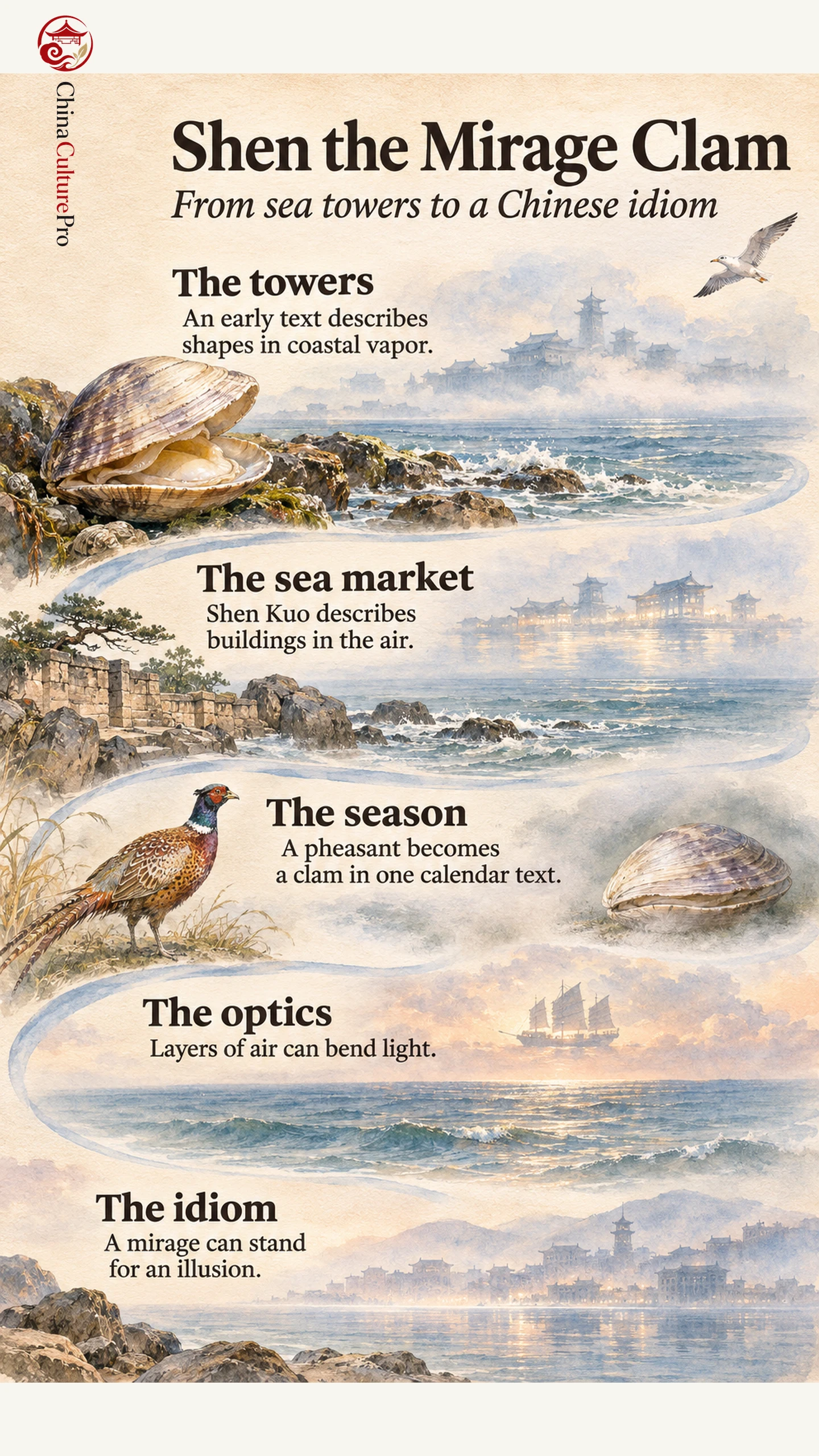
Towers appear in the air and then vanish. That strange view gave Chinese writers an image they could use in a tale, an account of an observation or a metaphor.
The Clam and the Towers in the Records of the Grand Historian
The Treatise on the Celestial Offices in the Records of the Grand Historian describes patterns in the air by comparing them with recognizable things. Near the coast, it says, vapor associated with shen resembles towers. It then compares vapor over open land with palace gates. The architectural comparisons make otherwise elusive shapes recognizable.[1]
The Taiwan Ministry of Education’s idiom dictionary glosses shen as a large clam and explains the traditional idea that it exhales the vapor. A shell beneath a skyline of roofs is a compact way to depict that explanation. The old passage gives the resemblance, while the dictionary spells out the creature’s role in the familiar story.[1][4]
Shen Kuo’s Account of a Sea Market
In Dream Pool Essays, Shen Kuo describes a sea market seen off Dengzhou. The vapor resembles buildings, city walls, people, carriages and horses. He mentions the suggestion that it came from a jiaolong or a shen and expresses doubt. The passage reports what people saw and records a proposed cause as separate matters.[2]
That is a different use of maritime illusion from the account of Penglai, where the shapes of islands are part of a tale about trying to reach the immortals. In the sea-market passage, the visual report remains even after the proposed cause is questioned.[2]
Why an Early Text Turns a Pheasant into a Clam
An early winter entry in the Huainanzi says a pheasant enters a great body of water and becomes a shen. It puts that change alongside the first freezing of water and ground and the disappearance of rainbows. The animal is part of a list of seasonal changes in a calendrical text.[3]
A reader who encounters a pheasant and a clam together can recognize this separate tradition. The calendar’s sequence concerns the turning of the season, while the coastal vapor passage concerns the shapes that appear above the sea.[1][3]
How the Sea Market Became an Idiom
The dictionary gives the expression a literal sense and a figurative one. Different layers of air can bend light and make a distant view seem displaced. That explains how a mirage can arise, without settling the details of every observation preserved in an old account.[2][4]
Figuratively, hai shi shen lou can describe an illusory prospect. A plan or a promise can look as substantial as a city from a distance and then prove to have little behind it. The image works even in a sentence far from the sea.[4]
FAQs About Shen and Mirage Towers
What does hai shi shen lou mean?
It can mean a mirage and, figuratively, something illusory. The words call to mind a market over the sea and towers associated with the mythical clam.[4]
Did ancient writers agree that a clam made the mirage?
Shen Kuo explicitly doubts the explanation involving the clam or water dragon. The old accounts preserve both the explanation and skepticism about it.[1][2]
Is shen the same word as a god or spirit?
Shen for the clam is written 蜃 and has a falling tone. The word for a god or spirit is commonly written 神 and pronounced with a rising tone.
Источники
[1] Chinese Text Project. Records of the Grand Historian, Treatise on the Celestial Offices
[2] Chinese Wikisource. Dream Pool Essays, volume 21
[3] Chinese Wikisource. Huainanzi, Treatise on Seasonal Rules
[4] Taiwan Ministry of Education. Dictionary of Idioms, Hai shi shen lou