


Quick Answer: What Is Sanlun Buddhism?
Sanlun Buddhism (三论宗, Sānlùn Zōng) is a Chinese tradition of Madhyamaka, or Middle Way thought, named for three treatises translated into Chinese. The monk Jizang (吉藏, Jízàng) became a major interpreter of their ideas.[1][2]
- Texts: The Middle Treatise, Hundred Treatise and Twelve Gate Treatise form the core collection.[1]
- Teaching: Jizang used the two truths (二谛, èrdì) to challenge how people hold views.[3][4]
- Practice: The analysis asks what a claim helps us see and what we may wrongly assume from it.[3]
The tradition took shape through the reading and explanation of specific books.
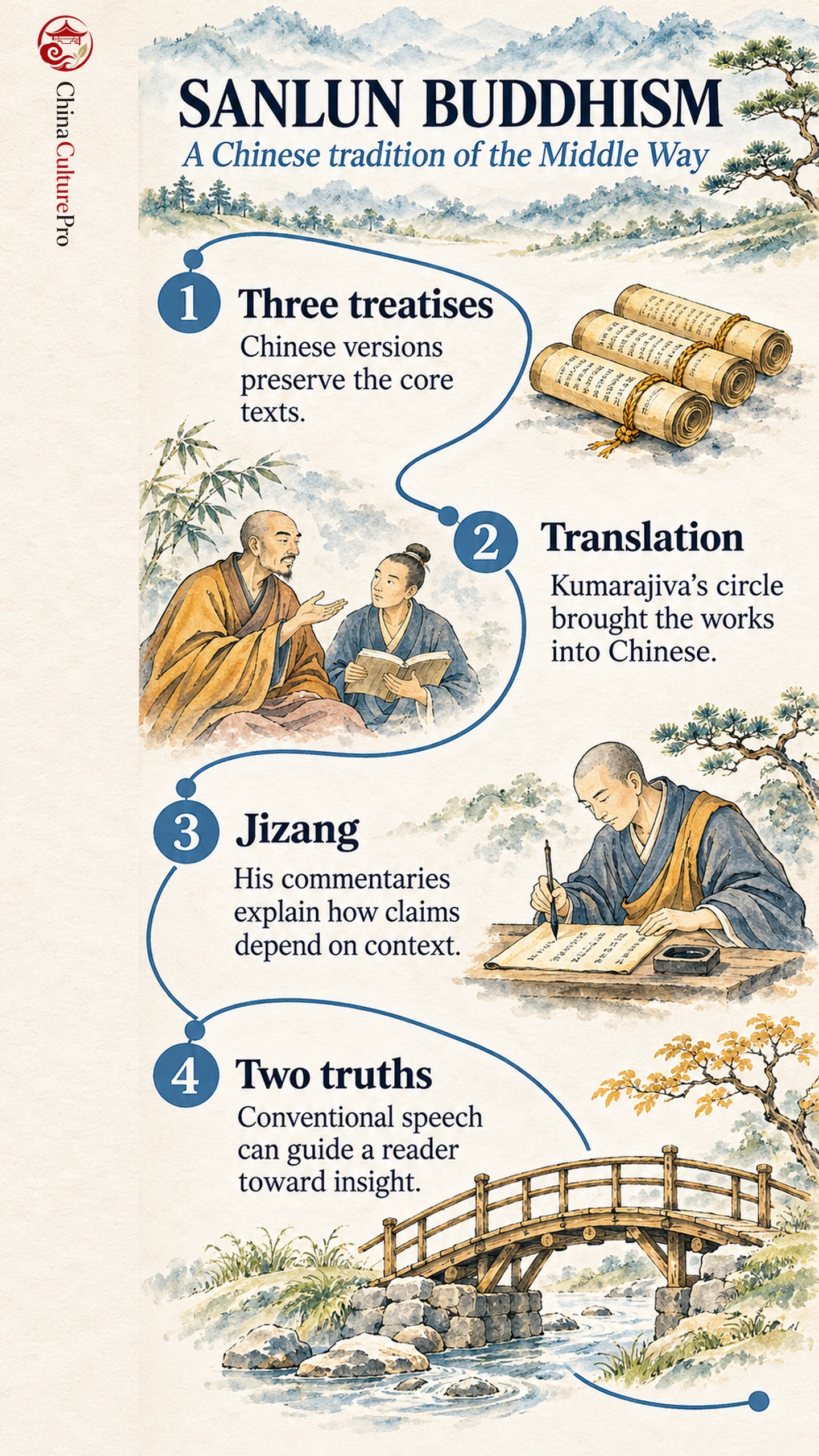
Sanlun Buddhism (三论宗, Sānlùn Zōng) grew from Chinese study of Indian Buddhist argument. Its texts ask what it means to say that something exists and what such a statement can leave out. Chinese commentators used those questions as part of teaching.
Which Three Treatises Give Sanlun Its Name
The three works are the Middle Treatise (中论, Zhōng Lùn), the Hundred Treatise (百论, Bǎi Lùn) and the Twelve Gate Treatise (十二门论, Shí’èr Mén Lùn). Their Chinese versions are associated with the circle of Kumarajiva. The first and third are traditionally associated with Nagarjuna, and the second with Aryadeva. Chinese commentators used the three works as a related body of texts.[1][2]
How Jizang Used the Two Truths
Jizang (吉藏, Jízàng, 549–623) treated the two truths (二谛, èrdì) as a way of teaching. Conventional language can describe a bridge and tell someone how to cross it. Reflection on its parts, builders and use shows how the named thing depends on conditions. The name still guides a traveler while the analysis loosens the assumption that the bridge has an independent nature.[3][4]
The same method can correct the assumption that emptiness means nothing exists at all. That concern gives readers one point of contact with the Heart Sutra, although Sanlun developed its own style of argument and commentary.[3]
Reading a Tradition Through Its Books
Jizang wrote about the meaning of the three treatises and commented on the Middle Treatise. A manuscript title or a page in a later canon can identify the work, while the surrounding commentary can show how it was used. This distinction matters in the history of Chinese Buddhist books. A comparison with Faxiang Buddhism also shows how different Chinese traditions developed different commentarial traditions.[1][5]
FAQs About Sanlun Buddhism
What does Sanlun mean?
It means three treatises and refers to the three Chinese texts at the center of the tradition.
Who was Jizang?
Jizang was a Chinese Buddhist monk and a major commentator in the Sanlun tradition. He lived from 549 to 623.
What is the role of the two truths in Sanlun?
In Jizang’s teaching they help people use ordinary language while examining the assumptions behind their claims.
Источники
[1] PhilPapers, edited by Chien-hsing Ho. The Three-Treatise School of Chinese Buddhism
[2] Journal of the International Association of Buddhist Studies. Chinese Buddhist Three Treatise and Four Treatise Traditions
[3] Hong Kong Baptist University. Po: Jizang’s Negations in the Four Levels of the Twofold Truth
[4] Dao: A Journal of Comparative Philosophy. Chien-hsing Ho, The Nonduality of Speech and Silence
[5] Austrian Academy of Sciences. Madhyamaka in South Asia and Beyond, abstracts