
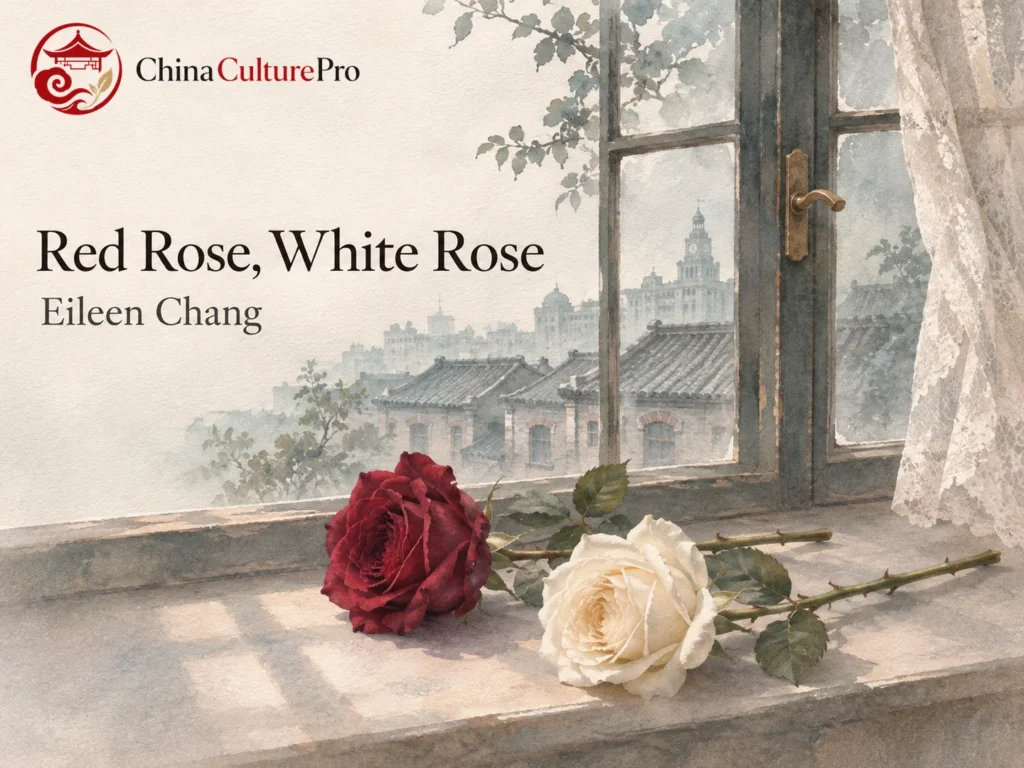

Quick Answer: What Is Red Rose, White Rose About?
*Red Rose, White Rose* (红玫瑰与白玫瑰, Hóng Méiguī yǔ Bái Méiguī) is a 1944 novella by Eileen Chang (张爱玲, Zhāng Àilíng). Tong Zhenbao (佟振保, Tóng Zhènbǎo) has an affair with Wang Jiaorui (王娇蕊, Wáng Jiāoruǐ) and later marries Meng Yanli (孟烟鹂, Mèng Yānlí). He thinks of Jiaorui as his red rose and Yanli as his white rose.[1][2]
- Jiaorui: She wants to make a decision about her marriage that Zhenbao will have to answer for in public.
- Yanli: Zhenbao expects his marriage to confirm his respectability. Daily life brings different demands.
- The colors: A person can appear ordinary once chosen and desirable again when out of reach.
The opening gives Zhenbao’s labels their appeal. The story tests them against what Jiaorui and Yanli do.[1][2]

Begin with the question Zhenbao avoids. What would he have to give up if a woman took his promises as seriously as he wanted her to take his attention?
The Affair and the Marriage
| Персонаж | What to follow |
|---|---|
| Tong Zhenbao | A man educated abroad who wants to keep the regard he has earned at home. |
| Wang Jiaorui | A friend’s wife who starts an affair with Zhenbao and considers ending her marriage. |
| Meng Yanli | The woman Zhenbao marries. The role he expects her to play leaves little room for her own wishes. |
Jiaorui’s willingness to tell her husband changes the stakes. Zhenbao can enjoy the affair as long as it can remain separate from the rest of his life. The prospect of having to acknowledge it makes him withdraw. His marriage to Yanli gives him a way to affirm the kind of man he thinks he should be.[1][2][3]
Marriage also makes his attention and his absence part of someone else’s daily life. Yanli’s involvement with a tailor unsettles the assignment of duty and transgression that Zhenbao has made between the two women.[2][3]
What the Red and White Roses Mean
The opening imagines two marriages. A red rose chosen as a wife can come to look like the mark left by a crushed mosquito. A white rose left behind can stay as lovely as moonlight. With the choice reversed, a white rose becomes the sticky grain of rice you find on your clothes. The absent red one looks like a small red beauty mark.[4] The bedside moonlight also echoes the opening image in Li Bai’s Quiet Night Thought, a poem in which something seen in a room turns a person’s thoughts elsewhere.
The contrast comes from where the person stands. Familiar things become blemishes in his sight. A person he has lost can keep an attraction that daily life would complicate. That pattern makes it possible for Zhenbao to blame the woman he chose for a disappointment built into the way he chooses.[1][4]
Why the Tram Scene Matters
Later, Zhenbao meets Jiaorui on a tram and cries. She has had time to live a life beyond the one he imagined for her. The encounter suggests how much his idea of the past depends on holding Jiaorui in the role he remembers. Years have passed for her, too.[5]
The tears give the reader something different from the measured distinctions of the opening. He can classify two people as red and white, but his response to the encounter escapes his control.[4][5]
How to Read the Story in English
Karen S. Kingsbury’s translation appears in the collection *Love in a Fallen City*. The book also contains the separate title novella. Keep the collection and the individual work distinct when looking for a reading copy.[4][6]
In Chang’s Love in a Fallen City, marriage can offer a woman a way out of family dependence. In Lust, Caution, the distance between a role and a private feeling becomes a matter of survival. Both help show how differently Chang can use a person’s public role to test what that person feels.
FAQs About Red Rose, White Rose
When was Red Rose, White Rose first published?
The novella first appeared in 1944. It later appeared in the expanded 1946 edition of Chang’s Chinese fiction collection *Romances*.[1][7]
Does the white rose refer to a Chinese poem?
The image of moonlight by a bed evokes Li Bai’s Quiet Night Thought. Chang’s opening uses the familiar image to suggest what an absent woman can become in memory. The white rose itself belongs to the novella’s paired metaphor.[4]
Источники
[1] Hong Kong University Press. Romancing Returnee Men in Eileen Chang’s Fiction
[2] Yang Chun. The underlying structure of Red Rose, White Rose
[3] CORE. A Theoretical Study of Zhang Ailing’s Short Story Collection
[4] OhioLINK Electronic Theses and Dissertations Center. Reading Chang’s paired rose metaphor
[5] Cao Fei. Three readings of Zhenbao’s tears
[6] New York Review Books. Love in a Fallen City, English collection
[7] Hebei University of Engineering. Red Rose, White Rose publication history