
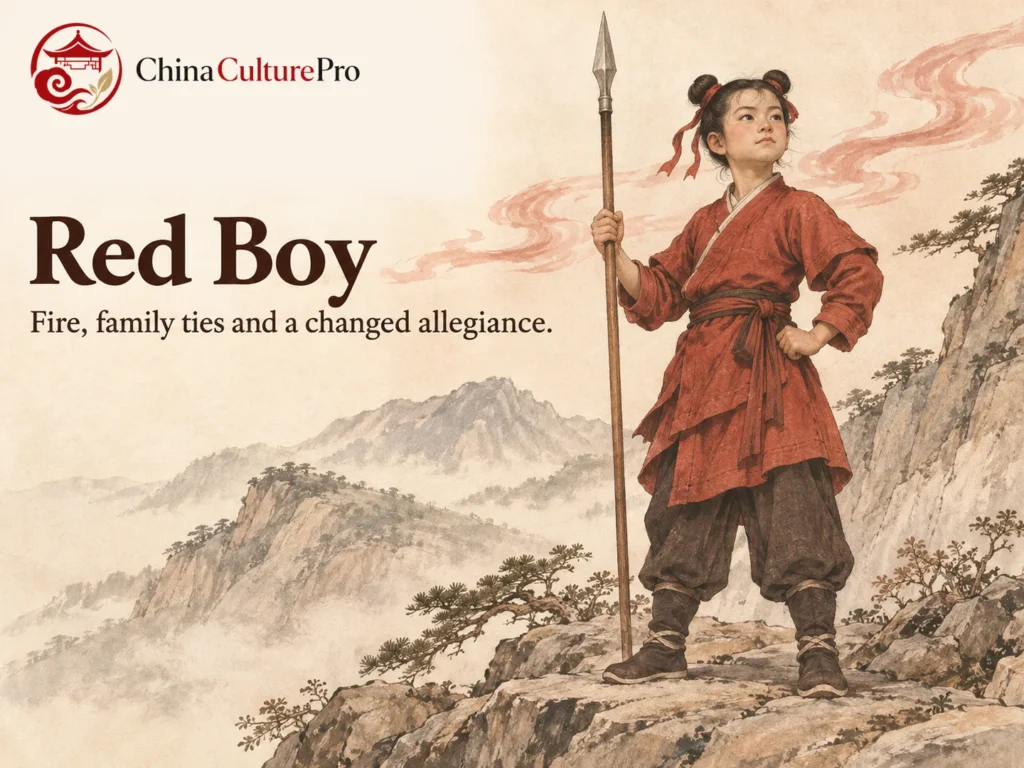

Quick Answer: Who Is Red Boy?
Hong Haier(红孩儿,Hóng Hái’ér), usually called Red Boy in English, is a childlike supernatural opponent of the pilgrims in a Chinese classic.
- Identity: His family connections make an encounter seem easier than it becomes.
- Power: His extraordinary fire challenges the travelers’ usual methods.
- Ending: The episode concludes with a change of allegiance rather than his destruction.
Red Boy belongs to a particular literary story. His ending connects with Buddhist imagery, but it does not make every religious image of a young attendant a portrait of this character.
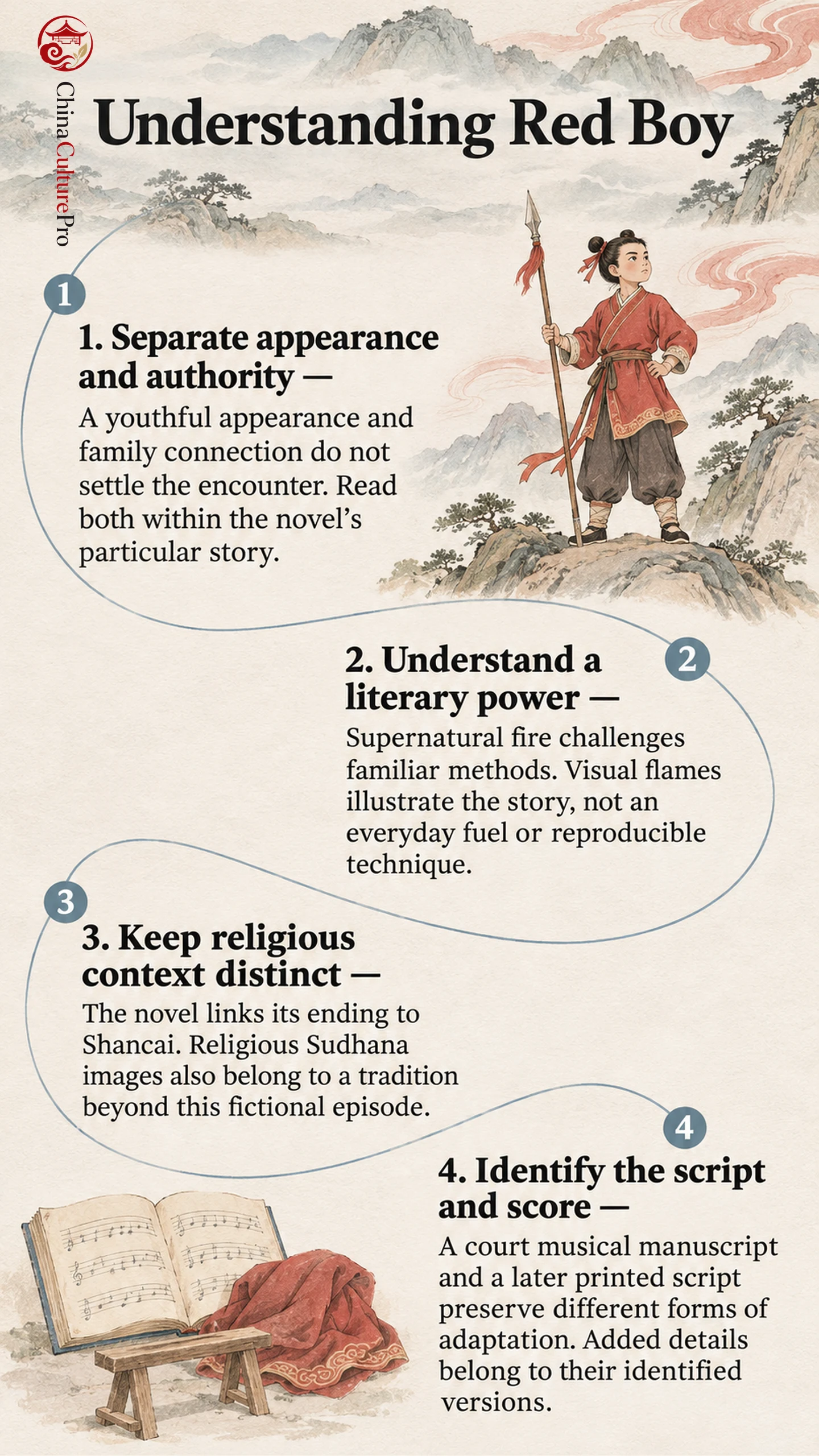
A childlike figure can be more difficult to overcome than a towering monster. Red Boy’s encounter with the westward pilgrims combines an apparently vulnerable appearance, exceptional power and a failed appeal to family ties. Its ending also raises a useful distinction between a novel’s characters and religious traditions beyond the novel.
A Childlike Opponent in Chapters 40–42
Journey to the West(西游记,Xīyóu jì)introduces the encounter across chapters 40–42. Red Boy is the son of the Bull Demon King and the Rakshasa woman associated with Princess Iron Fan. Sun Wukong(孙悟空,Sūn Wùkōng)hopes his old relationship with the father will help. It does not provide an easy resolution.[1]
That family connection changes how the confrontation is approached. As a reading of the episode, it exposes the limits of assuming an older relationship automatically creates authority over someone else’s child. His youthful appearance does not translate neatly into an ordinary human age.
The wider Monkey King narrative contains encounters resolved in different ways. Red Boy’s episode is especially useful for noticing when a familiar advantage stops working.
Samadhi Fire and the Limits of Strength
Red Boy’s samadhi fire(三昧真火,sānmèi zhēnhuǒ)is a supernatural ability in the story. It defeats ordinary expectations about how the travelers can fight back or extinguish a blaze.[1]
The fire therefore does more than decorate a battle scene. In a close reading, it interrupts the assumption that greater force or a familiar remedy must succeed. A capable hero can still face a situation requiring help outside his own repertoire.
“Samadhi fire” is a literary designation here, not the name of an everyday fuel. A depiction of flames in an illustration or on stage gives the power visible form; it does not demonstrate a real technique or supply instructions for producing it. Separating narrative function from spectacle keeps the episode understandable across different visual versions.
Guanyin, Shancai and the Novel’s Ending
Guanyin(观音,Guānyīn)subdues Red Boy and calls him Shancai tongzi(善财童子,Shàncái tóngzǐ)in the novel’s resolution.[1]
The name also belongs to a religious tradition with its own story. Academia Sinica’s Museum of the Institute of Ethnology describes Shancai as Sudhana, a pilgrim seeking Buddhist instruction, and as an attendant associated with Guanyin. Its catalogued wooden figure is a religious object collected in Lukang, not a prop identified as Red Boy.[2]
Another museum object provides a comparison. The Metropolitan Museum of Art catalogues a gilt copper-alloy Sudhana statue dated 1641 by its inscription. The museum describes the boy’s search for instruction and his veneration of the bodhisattva.[3]
These objects should not be relabeled solely from familiarity with the novel. A literary connection can be meaningful without making two bodies of storytelling identical. For religious context, see Guanyin in Chinese Buddhism.
Fire Cloud Cave on the Opera Stage
Huoyun dong(火云洞,Huǒyún dòng), or Fire Cloud Cave, is also the title of a theatrical adaptation. The Palace Museum records a Qing court copy with musical notation beside the lyrics and brief performance cues. The score records a form of performance preparation distinct from prose narration.[4]
A script reproduced by the Chinese Opera Research archive offers a specific comparison. Based on the Wang Lianping text in volume 99 of Jingju Huibian, it lists Red Boy’s royal persona and the Monkey King as martial male roles. Its opening places Red Boy among nine brothers and supplies a plan for a birthday gift to his father. Those details belong to that script; they should not be added automatically to a summary of the novel.[5]
When comparing a stage version with a book, attend to the form of the evidence. A role list, a musical score and a narrative chapter answer different questions. Performance can turn a supernatural struggle into movement, music and visible transformation, while also revising motives and dialogue.
The distinction is especially helpful with a familiar title: a remembered costume or stage scene may come from one production rather than an unchanging tradition.
FAQs About Red Boy
Who are Red Boy’s parents?
The Bull Demon King and the Rakshasa woman associated with Princess Iron Fan.
Is Red Boy the same as Nezha?
No. They are different figures. Similar youthful appearances do not make them the same character.
Does Sun Wukong defeat Red Boy by himself?
No. The episode’s resolution depends on Guanyin’s intervention.
Is every image of Shancai a picture of Red Boy?
No. Sudhana has a religious tradition beyond the novel. Use an object’s identification and context.
Источники
[1] Chinese Text Project, Primary Chinese Text. Journey to the West: Red Boy Encounter, Chapters 40–42
[2] Museum of the Institute of Ethnology, Academia Sinica. Shancai Figure, Object 7449
[3] Metropolitan Museum of Art. Sudhana, Dated 1641
[4] Palace Museum. Huoyun Dong, Qing Court Musical Score
[5] Chinese Opera Research Archive. Huoyun Dong: Wang Lianping Script from Jingju Huibian, Volume 99