
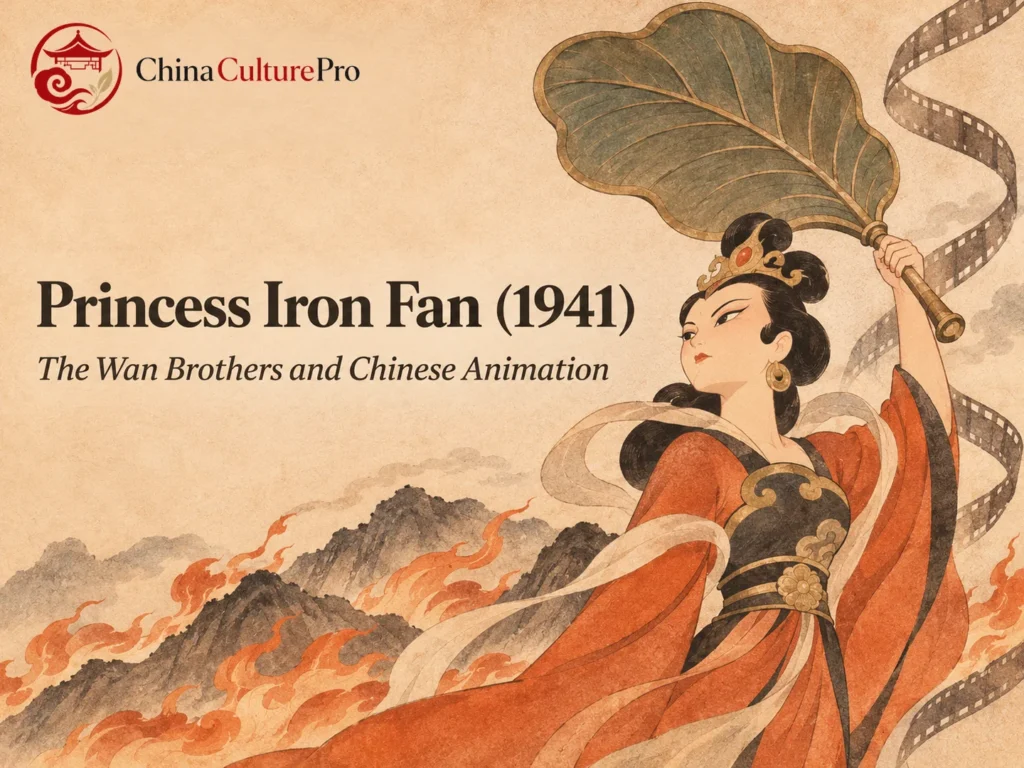

Quick Answer: Why Is Princess Iron Fan (1941) Important?
Princess Iron Fan (铁扇公主, Tiěshàn Gōngzhǔ) is a black-and-white animated feature directed by Wan Laiming (万籁鸣, Wàn Làimíng) and Wan Guchan (万古蟾, Wàn Gǔchán). It premiered in Shanghai in 1941 and is widely credited as Asia’s first feature-length animated film. It adapts the Flaming Mountains episode from Journey to the West (西游记, Xīyóu Jì), in which the pilgrims need a magical fan to continue. [1][2][3]
- Story: The pilgrims need the fan to put out the fires that block their journey. [1][2]
- Technique: The filmmakers combined drawn animation with movement traced from live action and effects made with layers of artwork. [1]
- Afterlife: A Japanese-dubbed version screened in Tokyo in 1942. Later screenings have included a 4K restoration. [3][4]
The film is a useful starting point for seeing how Chinese animators turned a familiar novel episode into a feature.

In the Wan brothers’ film, a mountain fire stops the pilgrims on their way west. The solution is a fan, but getting hold of it requires the Monkey King to outwit its owner and her allies. The search for the fan gives the animators room to play with scale and wind. [1][2]
The Flaming Mountains Story
Sun Wukong (孙悟空, Sūn Wùkōng), the Monkey King, is escorting the monk Tripitaka and his companions. The Flaming Mountains cut off the route. The pilgrims need the magical fan held by the title character, whose family includes the Bull Demon King. The attempts to secure and use the fan give the film its central action. [1][2]
Read the guide to Journey to the West for the pilgrimage around this episode and the profile of Princess Iron Fan for the character’s wider story. The film takes one local crisis from the long novel and gives it a beginning, a series of setbacks and a resolution viewers can follow in one sitting. [1][2]
How the Wan Brothers Made the Film in Shanghai
The brothers produced the film in the part of wartime Shanghai known as the Orphan Island, where filmmaking continued after much of the city fell in 1937. Film historian Daisy Yan Du dates the Shanghai premiere to November 19, 1941. It took place a few weeks before Japanese forces took the International Settlement. The University of Chicago dissertation on the production documents delays and a financial setback before the film was finished. [3][5]
The history of Chinese animation studios places the Wans’ feature within the longer development of animation in Shanghai. The brothers went on to different kinds of animation work. Wan Laiming returned to the Monkey King in Havoc in Heaven, while Wan Guchan made paper-cut films. [3]
What to Watch for in the Animation
Watch the bodies in motion and the way the landscape moves around them. Bucheon’s film festival notes the use of rotoscoping, which uses filmed movement as a reference for drawings. It also identifies multiplane photography, in which separately moving layers give a scene more depth. One gives drawn bodies a movement pattern taken from filmed action. The other lets nearby and distant parts of a scene move at different speeds. [1]
Some sequences also give objects lifelike movement, and the characters’ expressive gestures draw on Chinese performance traditions. The China Cartoon & Animation Museum’s restoration screening highlighted both these local traditions and the use of techniques familiar from American animated features. Compare how a figure moves with the way wind and fire change the space around it. [1][4]
How the Film Traveled After 1941
The Japanese-dubbed film premiered in Tokyo in September 1942. Scholars and film institutions identify it as an influence on Tezuka Osamu, whose later work includes Astro Boy. That is one documented line of influence within a much longer exchange between animation industries. The guide to Chinese donghua and Japanese anime places the exchange in a broader timeline. [1][3][4]
The film had a different afterlife in Hong Kong. Du documents that about twenty minutes of its footage appeared in the Cantonese film Blame It on Father in 1953. In 2024, the China Cartoon & Animation Museum in Hangzhou screened a 4K restoration and presented materials about the production. The Hong Kong film reused selected scenes. The Hangzhou screening presented the restored feature. [3][4]
FAQs About Princess Iron Fan (1941)
Was Princess Iron Fan the first Chinese animated feature?
Yes. Film archives and festival programmers recognize it as China’s first animated feature and commonly describe it as the first produced in Asia. [1][2][4]
How long is Princess Iron Fan (1941)?
The Siskel Film Center lists its digital screening at 73 minutes. The 2025 Bucheon festival program lists its presentation at 78 minutes. Check the listing for the particular screening or release. [1][6]
Does the film tell all of Journey to the West?
It adapts the Flaming Mountains episode, when the pilgrims seek the fan that can extinguish the fires blocking their route. [1][2]
Источники
[1] Bucheon International Fantastic Film Festival. Princess Iron Fan
[2] Virtual Shanghai. Princess Iron Fan: Film Collection Record
[3] Daisy Yan Du, Journal of Chinese Cinemas. Suspended Animation: The Wan Brothers and Their Animated Encounters with Hong Kong
[4] Hangzhou government portal. Restored 4K Version of China’s First Animated Feature Premieres in Hangzhou
[5] University of Chicago dissertation repository. Historical Research on Chinese Animation
[6] Gene Siskel Film Center. Princess Iron Fan