


Quick Answer: How Do Webtoons and Manhua Overlap?
Manhua (漫画, mànhuà) is the Chinese word for comics and a common English label for Chinese-language comics. Webtoon often describes a digital comic arranged to scroll vertically, a form developed in South Korea and used by creators in several countries. A Chinese comic designed that way can be called both manhua and a webtoon.[1][2][4]
- Origin: Manhua identifies the comics and their publishing context.[4]
- Layout: A vertical comic reveals panels as the reader scrolls.[1]
- Edition: A print version can arrange the same images differently.[1][4]
The same title can read differently in a vertical edition and a book.
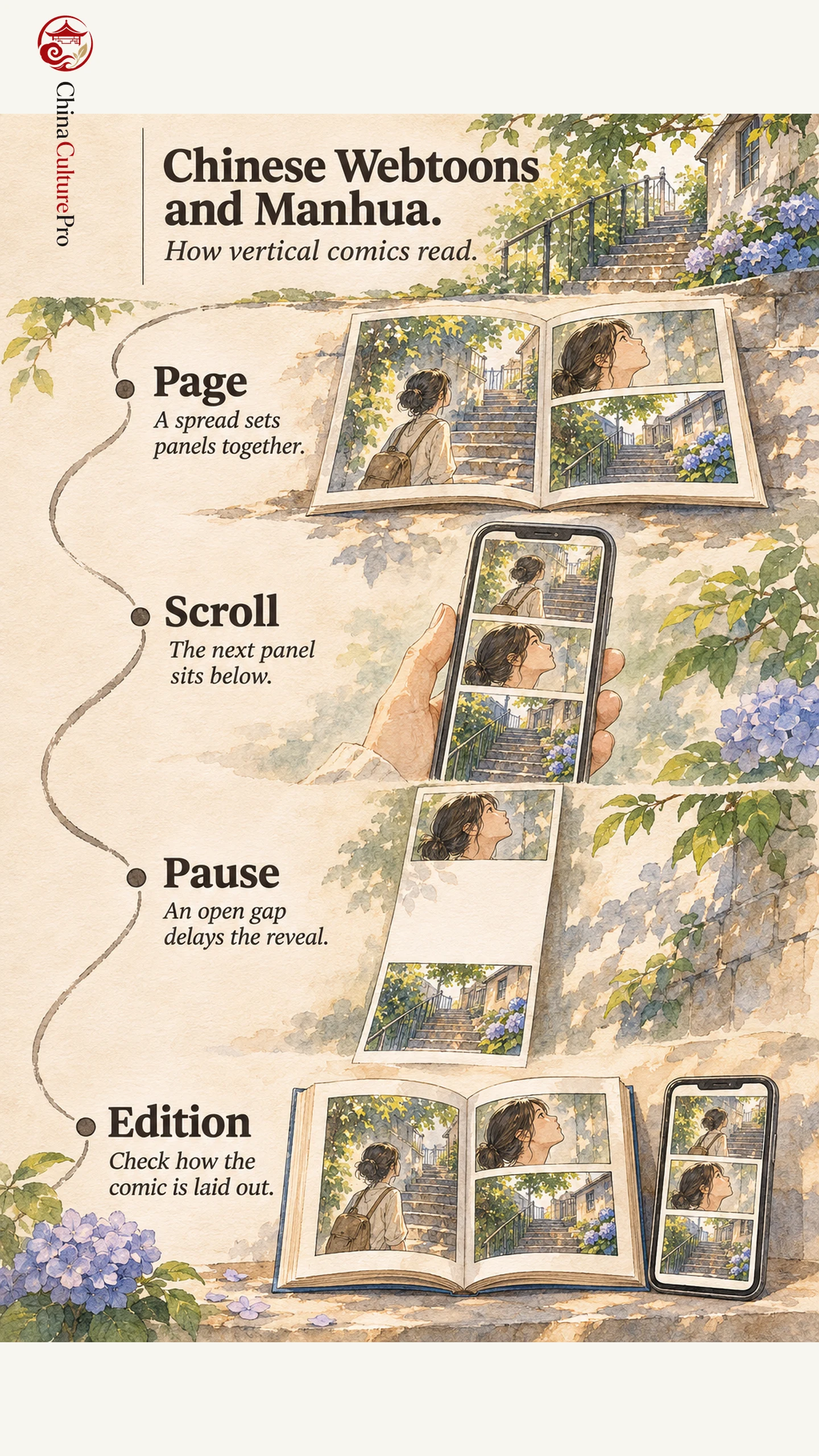
A reader reaches a wide gap on a phone screen and scrolls farther to see the next picture. The gap can be part of how the scene is told. A printed spread gives an artist different ways to control when that picture appears.[1]
Where the Vertical Format Developed
Early Korean webtoons used extended panels, vertical space and gaps that could unfold as a reader moved down the page. Mobile editions adapted those choices to narrower screens. The term webtoon now often describes the reading format in English. Compare Chinese manhua and Japanese manga for a question about publishing traditions instead.[1][4]
How Scrolling Changes the Reveal
A character may look down a staircase in one panel. A long strip of empty space can delay the next image of what the character sees. On a printed page, an artist might put the reveal after a page turn or fit the full staircase into one composition. Notice whether the pause comes from the physical page turn or the distance you scroll.[1]
How Chinese Platforms Use the Format
Kuaikan, which began operating in 2014, describes a mobile format built around scrolling down the screen. Chinese vertical strip comics (条漫, tiáomàn) can use large speech balloons, elongated panels and gaps that read on a phone without zooming. Color is common on that platform, and an individual comic can still choose a different palette.[2][3]
Check the Edition Before Comparing Layouts
Before comparing two versions, check whether a work was laid out for pages, designed for scrolling or reformatted for another edition. A screen can also display animation, which has a fixed duration and may include sound. The guide to manhua and donghua explains that distinction.[1][4]
FAQs About Chinese Webtoons and Manhua
Can a Chinese Comic Be a Webtoon?
Yes. Chinese-language comics can use the vertical webtoon format. In that case the two labels describe publishing context and reading layout.[2][4]
Do All Online Manhua Scroll Vertically?
Some digital editions display pages and others use scrolling strips. Look at how the panels are arranged within the edition.[2][4]
Is a Vertical Comic Always in Color?
Color is common on some platforms. Vertical scrolling describes the order and layout of panels, which can also be drawn in monochrome.[1][2]
Источники
[1] Sang-jung Han. From Webtoon to Apptoon
[2] Kuaikan Comics. Kuaikan app help and reading format
[3] Japan External Trade Organization. Chinese publishing industry report
[4] Penguin Random House. East Asian Comics Glossary