
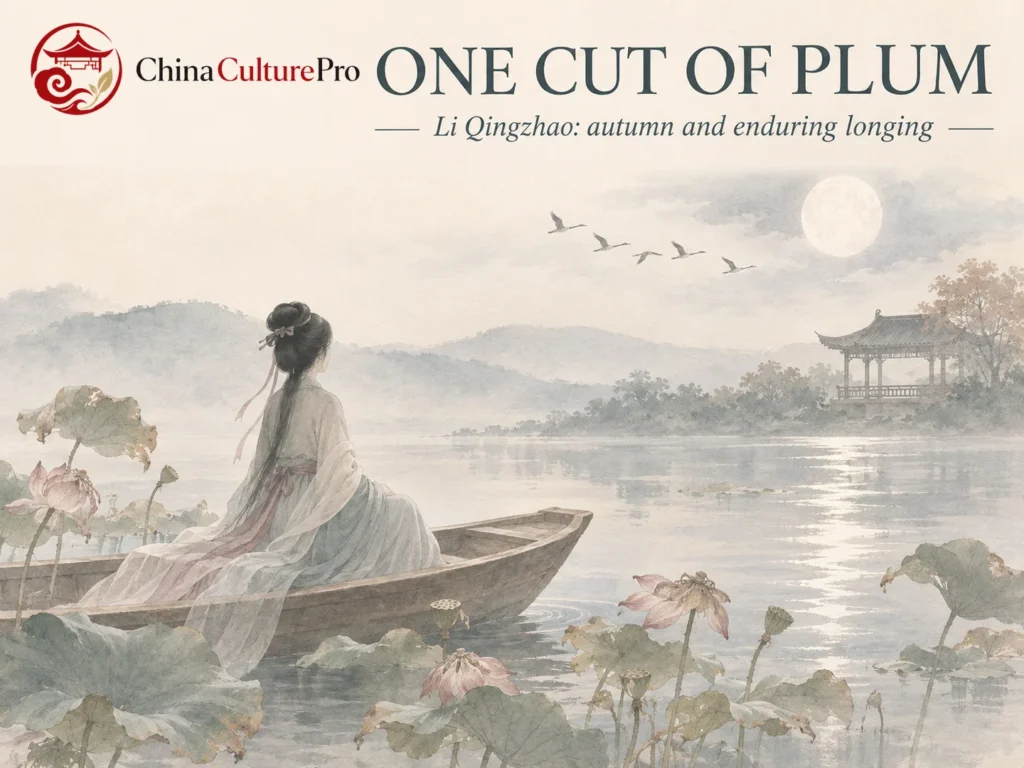

Quick Answer: What Is One Cut of Plum About?
One Cut of Plum (一剪梅, Yī Jiǎn Méi), by Li Qingzhao (李清照, Lǐ Qīngzhào), is a ci (詞, cí), or song lyric, about longing across separation. The title names the tune rather than the particular subject of these words.[1][2]
- Setting: Fading lotus fragrance, an autumn-cool mat, a boat and a western tower under moonlight.
- Central claim: One shared longing produces sorrow in two separate places.
- Ending: Feeling seems to leave the brow, only to rise again within the heart.
The lyric is commonly connected with separation from the poet’s husband, but the words themselves give no personal name or date.[1][2]

Fading fragrance and the cool touch of a mat make autumn intimate before the lyric explains its sorrow. A solitary boat, a hoped-for letter and moonlight keep changing the scene, but they do not bring the absent person home. The ending turns that unresolved longing into a movement from the face to the heart.
The Complete Lyric and an English Sense Translation
The complete text has sixty Chinese characters, divided into two thirty-character stanzas. Each stanza has six phrases, with lengths of seven, four, four, seven, four and four characters. The English below is an original sense translation; the break between stanzas comes after the western tower.[1]
| Chinese text | Смысл |
|---|---|
| 紅藕香殘玉簟秋 | Red lotus fragrance fades; the jade-like mat is cool with autumn. |
| 輕解羅裳 | Softly I unfasten my gauze garment; |
| 獨上蘭舟 | Alone I step aboard a fine boat. |
| 雲中誰寄錦書來 | Who will send a cherished letter from among the clouds? |
| 雁字回時 | When the returning geese form their lines, |
| 月滿西樓 | Moonlight fills the western tower. |
| 花自飄零水自流 | Blossoms fall of themselves; water flows on its own. |
| 一種相思 | One and the same longing, |
| 兩處閒愁 | Yet sorrow in two separate places. |
| 此情無計可消除 | This feeling resists every attempt to dispel it: |
| 才下眉頭 | Just as it leaves the brow, |
| 卻上心頭 | It rises again within the heart. |
“I” makes the speaking position explicit in English where the Chinese can leave it unstated. The translation follows the familiar readings 羅裳, 誰寄, 雁字回 and 卻上 rather than mixing in alternative wording from other versions.[1][2]
A Tune Name, Not a Poem about Cutting Plums
A tune pattern (詞牌, cípái) supplied the formal framework for a song lyric, including its phrase lengths and rhythmic requirements. The tune’s name need not describe what a later set of words says. Here the opening image is lotus, not a plum branch being cut.[2]
This distinction also explains why English titles vary: “One Cut of Plum,” “A Sprig of Plum Blossom” and similar labels can identify the tune in English translations. To identify this particular lyric more securely, add its opening words, 紅藕香殘玉簟秋. A broader guide to Song ci poetry explains how such shared patterns organize many different texts.
Autumn Coolness, a Solitary Boat and a Hoped-for Letter
The opening combines a fading scent outside with a cool surface felt close to the body. 簟 means a bamboo mat; “jade-like” praises its smooth, cool quality rather than naming an object carved from jade. These sensations make seasonal change perceptible through small details.[1][3]
The next action singles out solitude: the speaker boards the boat alone. 蘭舟 is an elegant literary designation for a boat. Its wording does not require an illustration of a vessel covered with orchids or establish the actual timber used for this particular craft.[1][4]
The question about a letter directs attention toward someone absent. The geese’s formation can resemble written characters, linking the sky’s visible shapes with the hope of receiving words. Yet the lyric asks who will send the letter; it does not go on to report that one arrives. Moonlight fills the tower, while the hoped-for communication remains open.[1][2]
The lotus has other meanings in Chinese culture, but the relevant detail here is its diminishing fragrance. An automatic purity explanation would miss the opening’s concern with change and absence.[1]
One Longing Shared across Two Places
The second stanza begins with two repeated instances of 自: flowers fall by themselves, and water flows on its own. These movements happen without waiting for the speaker’s feelings to change. The natural scene therefore continues even as the longing remains unresolved.[1]
The next pair brings human connection back into focus. “One” longing and “two” places hold unity and distance together: affection is imagined as shared, while its sorrow is experienced apart. That is the lyric’s emotional claim, not independent evidence about what a particular absent person was thinking at a documented moment.[1]
This is also why a full reading needs the second stanza. The solitary boat presents an isolated speaker; the later pairing imagines a corresponding feeling elsewhere.
From the Brow to the Heart
The ending gives the feeling two locations within one person. A troubled brow can reveal sorrow to someone looking at the face; the heart represents its inward persistence. The verbs of descending and rising make a brief relaxation of expression different from release from the feeling itself.[1]
“Just as” and “yet” compress the reversal. There is scarcely time for the emotion to leave one place before it occupies another. The final phrase leaves the earlier wait for a letter unresolved. The scene has changed several times, but the feeling continues.[1]
How to Read the Two Stanzas
- Identify the lyric: Pair the tune name with the opening words, so another text to the same tune is not mistaken for this one.
- Follow the first stanza’s senses: Move from scent and cool touch to the solitary boat, the letter question and moonlight.
- Compare one with two: Ask how the second stanza imagines a shared feeling without removing physical distance.
- Watch the ending’s verbs: Keep the movement down from the brow and up into the heart, rather than flattening both into a general statement of sadness.
For another boat scene, compare Like a Dream (如夢令, Rú Mèng Lìng), whose creek-side outing ends amid startled birds. The Li Qingzhao reading guide provides wider context for her work.
FAQs About One Cut of Plum
Is the poem definitely addressed to her husband?
It is often read in relation to separation from her husband. That conventional context is useful, but the lyric itself does not name the absent person or give a date for the separation.[1][2]
Does the letter actually arrive?
The words do not confirm receipt. They present a question about a letter and an image of returning geese, leaving the desired communication unresolved.[1]
Is the jade-like mat made of jade?
No. The word 簟 denotes a bamboo mat. Jade supplies a comparison for its refined, smooth quality, while autumn gives the opening its sense of coolness.[3]
Источники
[1] Li Qingzhao. 一剪梅: complete Chinese text and recorded variants
[2] Global Medieval Sourcebook. Li Qingzhao’s lyric: introduction and notes by Nina Du and Runqi Zhang; translation by Qian Jia
[3] Taiwan Ministry of Education. 簟: dictionary entry
[4] Taiwan Ministry of Education. 蘭舟: dictionary entry