

Quick Answer: What Is the Needham Question?
The Needham Question (李约瑟难题, Lǐ Yuēsè Nántí) asks why what Needham called modern science developed in Europe and why China had been especially effective at putting knowledge to practical use over a long earlier period. Historians debate what counts as modern science, how to make the comparison and which changes need explaining.[1][2][3]
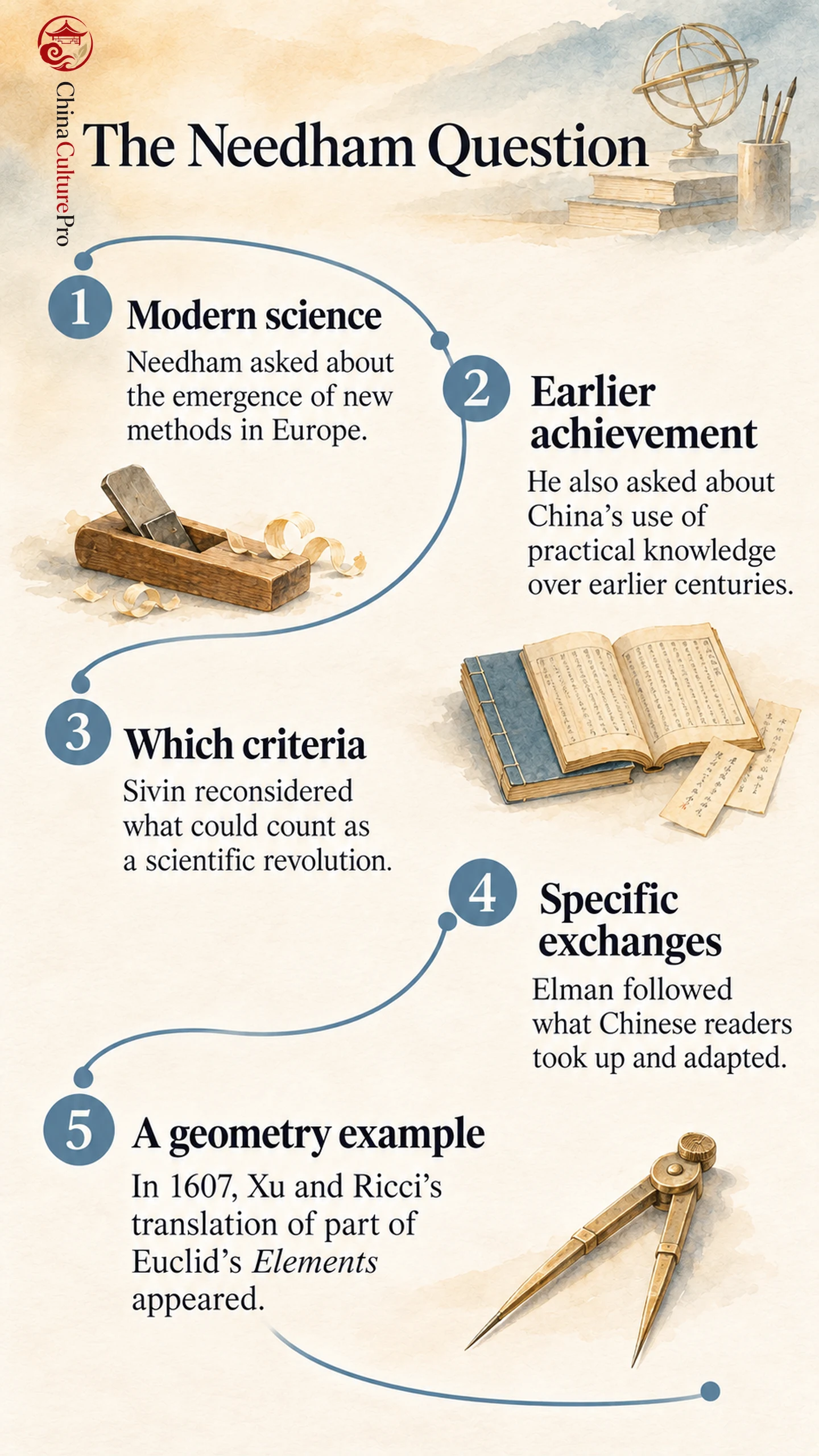
- Scientific change: Needham asked about the emergence of mathematical and experimental approaches associated with early modern Europe.[1]
- Earlier practical achievement: He also asked how Chinese societies applied knowledge so effectively in earlier periods.[1]
- Historian’s test: The answer depends on the practice, period and institutions being compared.[2][3][4]
The two questions have different time frames and concern different kinds of change. Treating them separately helps clarify what a piece of evidence can explain.[1][2]
Why did some forms of scientific work change rapidly in early modern Europe? Why had Chinese scholars and artisans been so effective at solving many practical problems in earlier centuries? Joseph Needham treated both comparisons as part of the history of science.
Why Needham Asked Two Questions
In his later reflections, Needham said he began by asking why modern science developed in Europe. His research led him to give equal weight to a second question: why Chinese civilisation had been so effective at gaining and applying practical knowledge roughly from the first century BCE through the fifteenth century CE. He was comparing the emergence of particular methods and the longer history of practical techniques.[1]
Examples in a history of Chinese inventions can help with the second question. An invention gives evidence about what a group could make or use at a particular time. Explaining changes in scientific institutions or methods requires a wider comparison of who produced knowledge, how they tested it and how it circulated.[1][2][4]
Why Historians Disagree With the Premise
Nathan Sivin questioned whether historians could explain why another society failed to reproduce a European sequence of events. He argued that changes in eighteenth-century China could meet some historians’ criteria for a scientific revolution, even though their social consequences differed. His argument shifts attention to what actually changed in China and what criteria are being applied.[2]
Benjamin Elman’s work traces Chinese scientific traditions through encounters with Jesuits and later Protestant missionaries. He gives attention to what Chinese readers and scholars took up, adapted and taught. Economic historians use the Needham debate in discussions of long-run divergence, where the outcomes being measured can include economic growth and industrial development. Those outcomes need their own evidence.[3][4]
What a Specific Example Can Explain
In 1607, Xu Guangqi and Matteo Ricci’s Chinese translation of the first six books of Euclid’s Elements was published. It introduced a particular tradition of geometrical demonstration into a setting with a long history of Chinese mathematics. The translation gives historians something concrete to study: which methods reached particular readers, how they were rendered in Chinese and how later scholars used them.[3][5]
FAQs About the Needham Question
Was Needham saying that China had no science?
Needham’s project documented Chinese scientific, medical and technological achievements. His questions concerned differences over time in the development and application of particular kinds of knowledge.[1]
Do historians agree on a single answer?
They disagree over the definitions, comparison periods and effects to explain. Studies of particular practices such as geometry offer more specific conclusions about particular exchanges and institutions.[2][3][4][5]
Источники
[1] Joseph Needham. Science and Civilisation in China: General Conclusions and Reflections
[2] Nathan Sivin. Why the Scientific Revolution Did Not Take Place in China, or Didn’t It?
[3] Benjamin A. Elman. On Their Own Terms: Science in China, 1550–1900
[4] Patrick K. O’Brien. The Needham Question Updated
[5] Journal of Chinese History. Literati–Jesuit Translation of Euclidean Geometry and Its Reception