
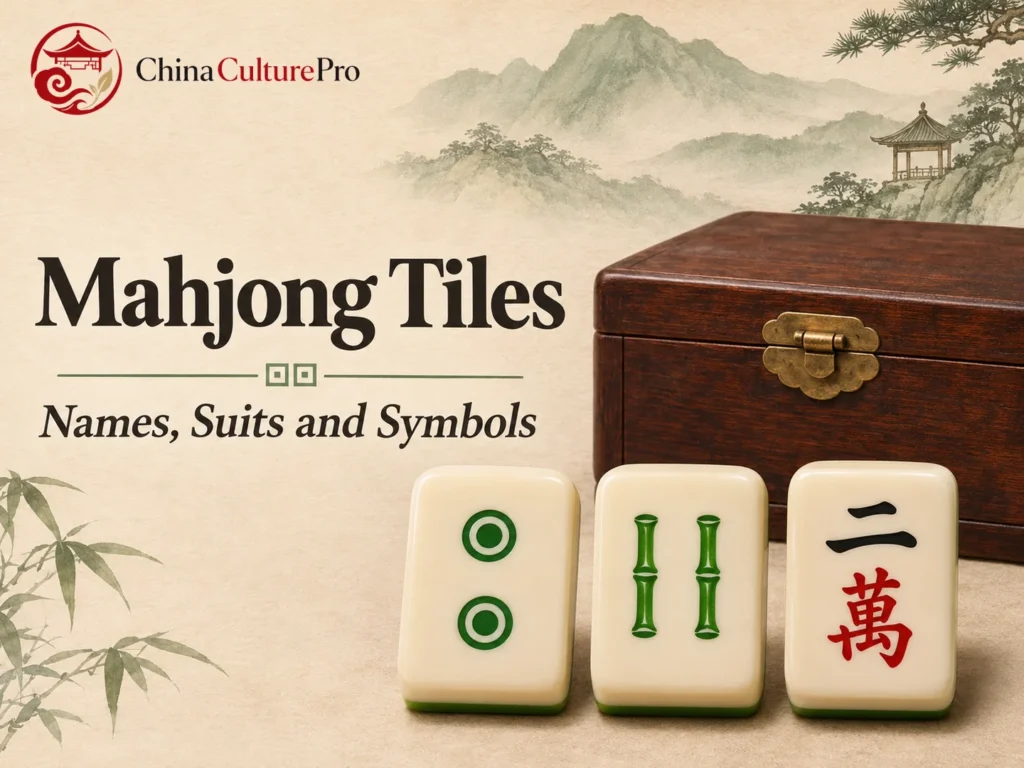

Quick Answer: What Is in a Mahjong Tile Set?
Mahjong (麻将, májiàng) has a common core of 34 different tile faces, with four copies of each: 136 physical tiles. The core divides into 108 numbered suit tiles and 28 honors (字牌, zìpái).
- Three numbered suits each have ranks one through nine.
- The unnumbered core consists of four winds and three dragons.
- Eight individual flower and season tiles bring many Chinese-style sets to 144.
- American play commonly adds eight jokers to that 144-tile inventory.
A box may contain unused spares or tiles for another version. Identify the rules and the actual playing inventory rather than treating the advertised box count as universal.
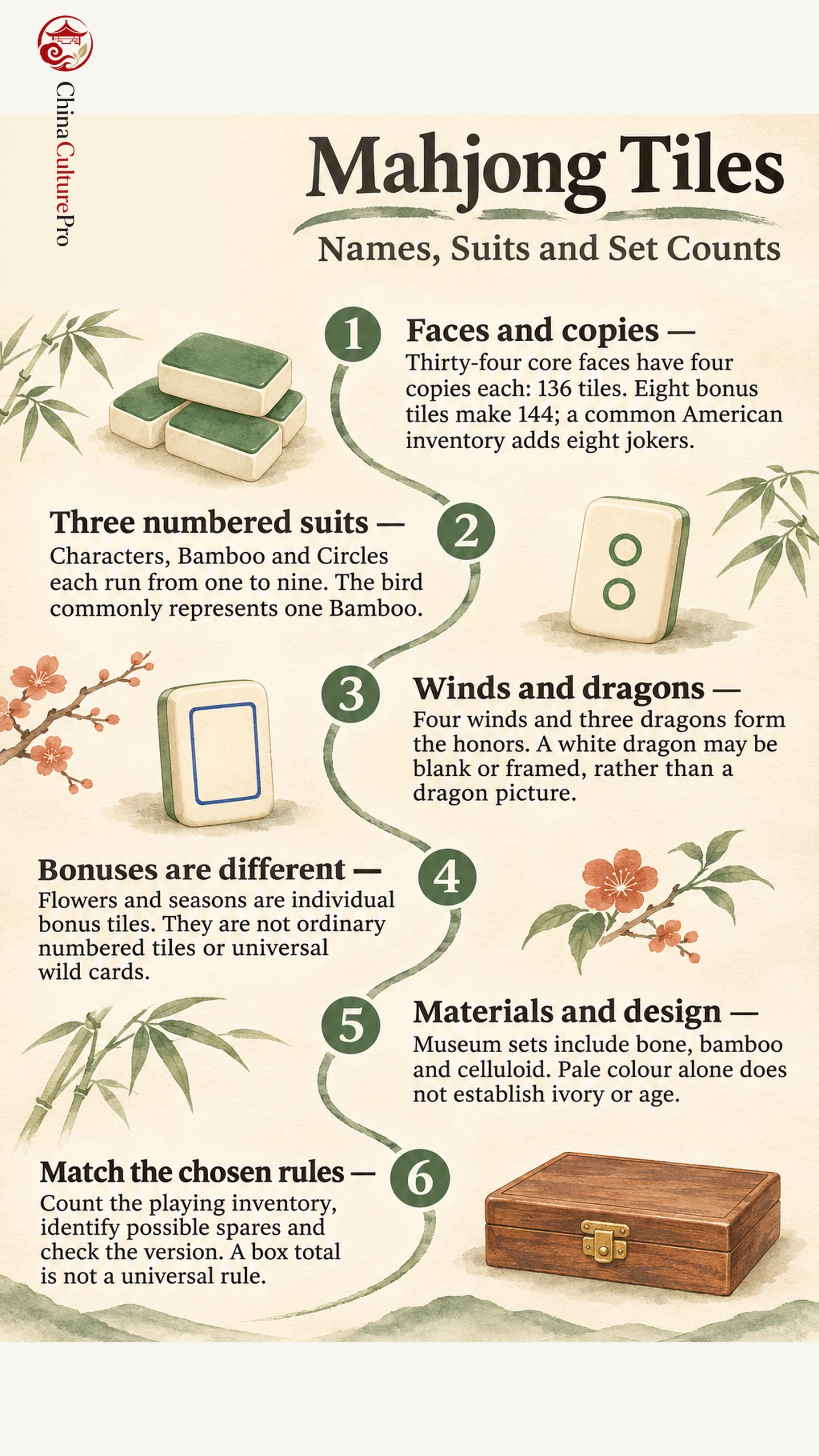
Learning the faces is the first step toward understanding mahjong as a playing tradition. Begin with the recurring structure, then learn the exceptions: a bird can be a numbered tile, and a blank face can be a real honor.
Why 34, 136, 144 and 152 Mean Different Things
“34” counts distinct core faces, not the tiles you shuffle. There are 27 numbered faces—nine in each of three suits—and seven honor faces. Four copies of each produce 108 numbered tiles plus 28 honors, or 136 altogether.[1][5]
| Inventory | Total used | Что включает |
|---|---|---|
| Common core | 136 | Three numbered suits and seven honor types, with four copies of each face. |
| Core with flowers and seasons | 144 | The 136 core tiles plus eight individual bonus tiles. |
| Common American configuration | 152 | The 136 core tiles plus eight flower tiles and eight jokers. |
The last row describes tiles used in a common American game. A manufacturer’s box may include additional replacements; one published product guide explicitly distinguishes its 166 supplied pieces from the 152 used in play.[3] It does not follow that every 166-piece box has the same extras.
Other regional rules may leave out entire tile groups. Our Chinese and American mahjong comparison explains why similar-looking sets do not necessarily support identical play.
Read the Three Numbered Suits
Each suit contains four copies of ranks one through nine, making 36 tiles per suit. The following Mandarin names help connect English labels with Chinese terminology; local pronunciations and names differ.[1][4]
| Suit | Other English names | Признак для распознавания |
|---|---|---|
| Characters (万子, wànzi) | Craks | A Chinese numeral above the character for ten thousand. |
| Bamboo (索子, suǒzi) | Sticks or Bams | Stick-like designs, with a bird commonly representing rank one. |
| Circles (筒子, tǒngzi) | Dots | Circular marks counted to identify the rank. |
Characters may use the traditional form 萬 or simplified 万 beneath the numeral. The number above it distinguishes, for example, one from two; the common lower character does not mean that all nine faces are identical.[4]
When naming a numbered tile, give both rank and suit: “three dots” identifies a face, while “three” alone does not. The ones and nines are often called terminals; ranks two through eight are simples.[1][2]
The bird on one Bamboo varies between sets. Learn its role from the complete suit rather than deciding that an animal picture must be a flower or joker.[2]
Recognize Winds and Dragons
The four winds are East (東, dōng), South (南, nán), West (西, xī) and North (北, běi). Simplified sets may show 东 for East. There are four copies of each direction, giving sixteen wind tiles.[9] A wind tile’s printed identity does not change when your seat or the round changes.
The three dragons also have four copies each, giving twelve tiles:
- Red Dragon (红中, hóngzhōng): usually carries 中, the character for centre.
- Green Dragon (发财, fācái): usually carries 發, or simplified 发.
- White Dragon (白板, báibǎn): may be blank, framed or marked with a character, depending on the set.
These are tile identities, not a promise that every manufacturer uses the same shade or drawing. A white dragon does not need a literal picture of a dragon.[2][4]
Honors have no numbered sequence. East–South–West does not function like two–three–four of one suit under ordinary Chinese meld rules. Learn their role in the chosen mahjong rules rather than treating the printed directions as numerical ranks.[5]
Separate Flowers, Seasons and Jokers
A familiar eight-tile bonus group contains four flowers—plum, orchid, chrysanthemum and bamboo—and four seasons: spring, summer, autumn and winter. Each is individual rather than repeated four times like a core face. Their exact pictures can differ.[1]
In Chinese competition rules, flower tiles are exposed separately and replaced; they do not fill an ordinary suit sequence in the concealed hand.[5] The bamboo flower picture is therefore different in function from a numbered Bamboo-suit tile. Check the complete eight-tile group instead of relying on one decorative feature.
American mahjong gives flowers and jokers their own roles under a card of permitted hands. The card changes annually, and a joker is not a universal replacement for any tile in every situation.[3][6] For how bonuses affect a result, use the relevant mahjong scoring system rather than assigning value from the artwork alone.
Materials and Designs Have Changed
Old sets show that mahjong tiles were never made from just one material. A nineteenth-century set given to the British Museum in 1908 combines bone, wood and bamboo. Only 140 tiles survive; the exhibition describes it as incomplete, not as evidence for a normal 140-tile rule.[7]
A different museum set has bamboo tiles with laminated celluloid tops. That construction provides a concrete alternative to the assumption that every pale old tile must be ivory.[8] Material, age and cultural interest cannot be reliably established from colour alone.
For recognition, concentrate on the face’s category and rank. Birds, borders, lettering and colours may change, while the intended tile identity remains familiar. A contemporary decorative redesign still needs a clear key if players cannot recognize which faces correspond.
Match the Set to the Rules
A playing inventory is more informative than the box total. Four matching copies of each core face, the required bonus groups and an explanation of unused extras are useful checks. A missing core copy and an unused bonus tile are different problems.
Blank pieces need particular attention. A set may use a blank white dragon and also supply unmarked replacements; the expected four white dragons and a separate spare inventory help distinguish their roles.[4] Confirm the convention with the owner or the set’s guide.
Compatibility also depends on the version. A set suitable for Hong Kong mahjong does not automatically supply the jokers needed for American play, while a Japanese set may omit flower tiles.[2][3] Familiar faces are an invitation to ask about the rules, not evidence that every table plays alike.
FAQs About Mahjong Tiles
Is the bird tile a flower?
Usually it is one Bamboo in the numbered suit. Check its position among the other numbered faces before treating it as a bonus tile.
Is a blank tile always a spare?
No. A white dragon may be blank. Some boxes also include blank replacements, so use the complete inventory and the set’s instructions to distinguish them.
Do flowers work as wild cards?
Not in ordinary Chinese competition mahjong. They are handled as separate bonus tiles; American jokers have a different, rule-specific function.
Must I read Chinese to recognize the tiles?
No. Learning the recurring numeral and honor symbols can be enough to identify them. English indices can help, but do not assume every set prints them.
Does a red five add an extra tile?
No. When used, red fives replace ordinary fives within the existing inventory. They are a Japanese-rule variation and are not used in the cited European competition rules.[2]
Источники
[1] Mahjong International League, hosting organization. A Guide to Mahjong: Chinese International Rules
[2] European Mahjong Association. Riichi Rulebook 2025, version 1.1
[3] Yellow Mountain Imports. How to Play American Mahjong
[4] Chen Zhuang and colleagues. Revised Proposal to Encode Mahjong, Domino and Draughts Symbols in the UCS, 2006
[5] World Mahjong Organization. Mahjong Competition Rules
[6] National Mah Jongg League. About the Game
[7] British Museum. China’s Hidden Century: Large Print Exhibition Text
[8] National Museum of American History. Mah Jong Set, 2006.0098.1475
[9] Unicode Consortium. Mahjong Tiles Code Chart