


Quick Answer: Who Was Ma Yuan?
Ma Yuan (马远, Mǎ Yuǎn) was a Southern Song court painter active around 1190–1225, celebrated for lyrical landscapes.[2]
- Composition: Concentrated foreground forms open toward misty distance.[7]
- Brushwork: Angular rock textures contrast with supple branches.[1]
- Range: His works include intimate poetic scenes, large landscapes and studies of water.[2][3][4]
“One corner” is a useful starting point for looking, rather than a formula for every picture.
A small figure, a dark rock and a broad stretch of pale silk can create an expansive scene. Look at where Ma Yuan’s image becomes dense, where it loosens and how the eye travels between those areas.
A Painting Family at the Southern Song Court
Ma Yuan served as a painter-in-attendance under emperors Guangzong and Ningzong. He belonged to a family of court artists stretching from his grandfather’s generation to his son’s.[1]
The Southern Song dynasty court was based in Hangzhou. Its painters developed small, lyrical landscape formats as well as larger works.[7] Ma Yuan’s landscape practice drew on Li Tang while developing its own character.[3]
How One-Corner Composition and Brushwork Work
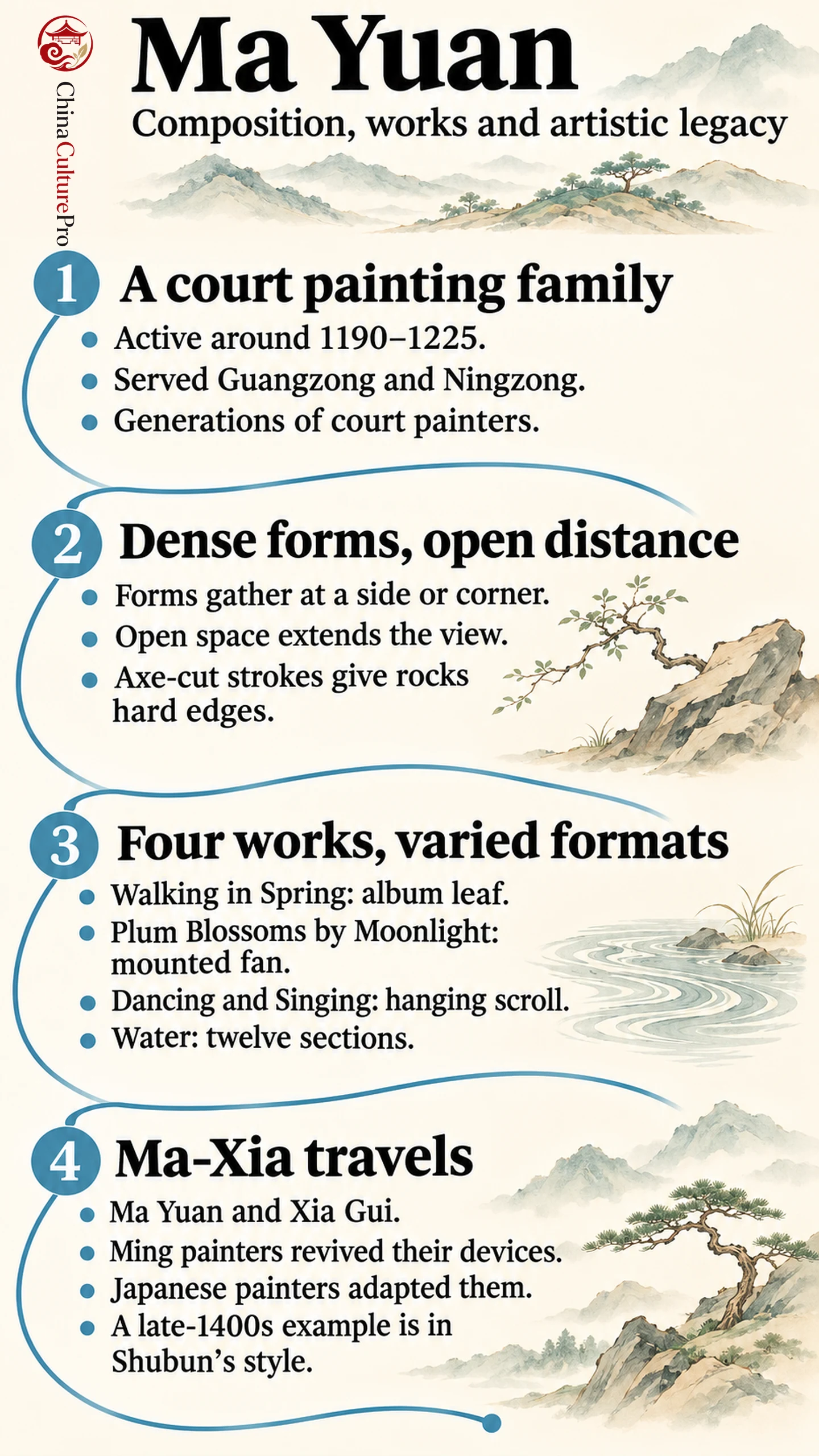
In one-corner composition (边角构图, biānjiǎo gòutú), substantial forms gather at one side or corner, leaving a large open area. The approach earned him the nickname “One-Corner Ma” (马一角, Mǎ yījiǎo).[1]
The open area has a spatial job. Follow the scholar’s position into the distance: a figure can give the viewer a place from which to enter the scene.[7] In this kind of Chinese landscape painting, a lightly indicated passage can make nearby trees or rocks feel more substantial.
Axe-cut texture strokes (斧劈皴, fǔpī cūn) use the side of the brush to suggest hard, fractured stone.[3] Compare those edges with a bending willow branch. The contrast shows how brush technique changes the character of a form.
Four Works, from Poetic Moments to Moving Water
The formats below range from a hand-sized scene to a tall hanging scroll and a twelve-part sequence.
| Work | Medium and format | Collection and dimensions |
|---|---|---|
| Walking on a Mountain Path in Spring | Ink and color on silk; album leaf | National Palace Museum, Taipei; 27.4 × 43.1 cm.[1][7] |
| Viewing Plum Blossoms by Moonlight | Early thirteenth century; ink and color on silk, fan mounted as an album leaf | Metropolitan Museum of Art; image 25.1 × 26.7 cm.[2] |
| Dancing and Singing | Southern Song; color on silk, hanging scroll | Palace Museum, Beijing; 192.5 × 111 cm.[3] |
| Вода | Southern Song; light color on silk, twelve sections | Palace Museum, Beijing; each section 26.8 × 41.6 cm.[4] |
In Walking on a Mountain Path in Spring, a scholar pauses beside willows while an attendant carries a qin. The birds, flowers and movement correspond to Ningzong’s inscribed poem.[1] Read the inscription alongside the figures: text directs attention to a fleeting encounter with the spring landscape.
Viewing Plum Blossoms by Moonlight balances a white-robed man and dark angular forms against the moon and pale distance. A thatched pavilion places the scene in a garden.[2] Light and dark organize the experience before any individual blossom is examined.
Dancing and Singing uses six villagers, including two children, to convey communal celebration. Its imperial inscription expresses a wish for peace and prosperity; the familiar corner emphasis is less pronounced here.[3]
Water makes water itself the subject. Different strokes distinguish ripples, layered waves and surging movement, with very little land.[4] Compare the repeated marks instead of searching first for a solitary scholar.
The Ma-Xia Legacy in China and Japan
Ma-Xia (马夏, Mǎ Xià) joins Ma Yuan’s name with Xia Gui’s to identify their influential court landscape tradition. Its diagonal arrangements and axe-cut rocks were revived in Мин court and professional painting, often on larger surfaces with broader handling.[5]
A late-fifteenth-century Japanese Landscape in the style of Tensho Shubun offers a concrete comparison. Foreground axe-cut rocks, tall pines at the right and misty space at the left show the transmission of Ma-Xia devices.[6] The Japanese painting shows how that visual language could be adapted in a later setting.
FAQs About Ma Yuan
Did every Ma Yuan painting use one corner?
No. Dancing and Singing shows his range beyond the strongest version of that arrangement.[3]
Was Ma Yuan only a landscape painter?
No. His wider practice also included figures, flowers and birds.[3]
What does Ma-Xia mean?
It is the paired name for Ma Yuan and Xia Gui and the landscape style associated with them.[5]
Источники
[1] National Palace Museum. Walking on a Mountain Path in Spring
[2] Metropolitan Museum of Art. Viewing Plum Blossoms by Moonlight
[3] Palace Museum. Ma Yuan’s Dancing and Singing
[4] Palace Museum. Ma Yuan’s Water
[5] Tokyo National Museum. The Spread of Court Landscape Painting Styles
[6] Seattle Art Museum. Landscape, in the Style of Tensho Shubun
[7] University of Washington. Southern Song Landscape Painting