

Quick Answer
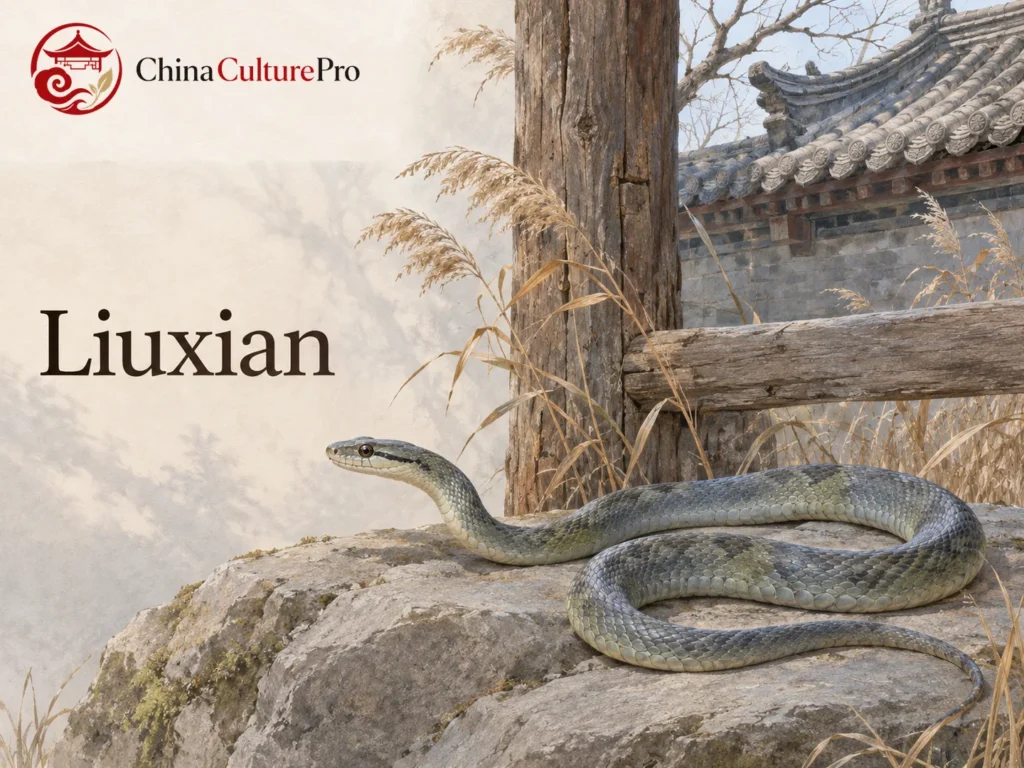
Liuxian (柳仙, Liǔxiān) is a name for the snake spirit in northern Chinese folk religion. Historical accounts call the snake family Liu or Chang. Stories give sacred snakes powers of transformation, and at least one devotional print presents the spirit as a seated human figure with a snake behind it.[1][2][3]
- Group: The snake belongs to accounts of four animal families and to common five-member lists.
- Folklore: Household stories can portray a snake as a protector or source of good fortune.
- Image: One Qing print pairs a human figure with a visible snake.
The name belongs to a regional animal-spirit tradition. Other Chinese snake stories have their own characters and settings.[1][3][4]
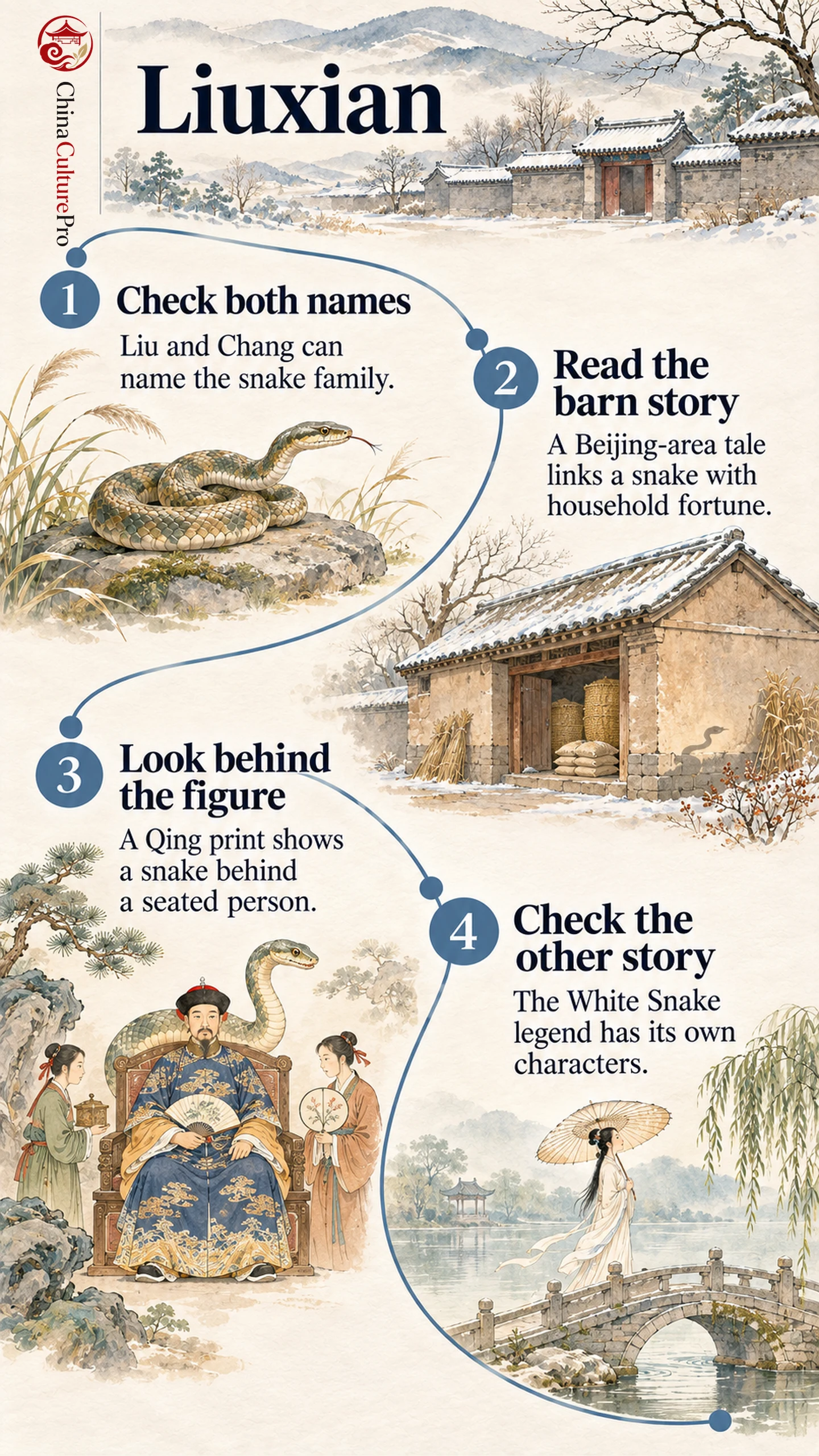
In a late Qing devotional print, a person sits at the center with an attendant on either side. A snake looks out from behind the seated figure. The human figure and the animal can both appear in one devotional image.[3]
Why the Snake Family Has Two Names
Li Wei-tsu’s account of the Beijing area calls the snake family the Liu family (柳門, Liǔmén) or the Chang family (常門, Chángmén). Both names appear as surnames for the snake in a grouping that also includes the fox, weasel, and hedgehog. An account that uses Chang may therefore still be talking about the snake family.[1][2]
Some regional lists add a rat. The catalogue for the devotional print identifies the figure as Liuxian. The print uses an individual image to represent the snake spirit, while the field study applies Liu and Chang to a family.[1][2][3]
What the Household Stories Attribute to Snakes
Accounts collected around Beijing distinguish ordinary snakes from those credited with changing size or shape. One story about a household in the northern suburbs connects its growing prosperity with a sacred snake. The family’s cook reportedly saw a very large snake in the barn. The barn places the encounter within the household’s livelihood.[1]
The same study records a shrine where a family understood a snake spirit to occupy the second floor and a hedgehog spirit the first. Stories of household prosperity and reports of shrine arrangements preserve different kinds of evidence about relationships with animal spirits. The guide to Chinese folk religion provides context for such household and local practices.[1]
What the Print Shows and What Other Stories Mean
The print’s title, Snake Immortal (蛇仙, Shéxiān), and the animal behind the main figure support the identification together. The faces and title have added color, while the rest is drawn in a single ink color. The museum records the print’s donation in 1961, long after its late Qing dating.[3]
In the White Snake legend, a snake takes human form and becomes part of a named story about a marriage. The motif is shared. To identify the spirit in another story or picture, look for a name, a caption, or a documented link to a particular tradition.[3][4]
FAQs About Liuxian
Is Liuxian the snake or the weasel spirit?
Liuxian refers to the snake in the northern family names discussed here. The weasel is associated with the Huang family.[1][2]
Can the snake family be called Chang?
Yes. Li Wei-tsu records both Liu and Chang as names for the snake family in accounts from the Beijing area.[1]
Does Liuxian always look like a snake?
The late Qing print gives the spirit a human figure and includes a snake behind it. Both the image and the written title identify the connection.[3]
Источники
[1] Li Wei-tsu, Asian Ethnology. On the Cult of the Four Sacred Animals in the Neighbourhood of Peking
[2] Wang Wei, Chinese Academy of Social Sciences. Buddhist Spiritual Powers and the Four Great Families
[3] National Museum of History, Taiwan. Snake Immortal woodblock print, 07487
[4] Smithsonian Hirshhorn Museum. Ai Weiwei: Circle of Animals/Zodiac Heads, Snake