

Quick Answer: Who Was Lin Fengmian?
Lin Fengmian (林风眠, Lín Fēngmián, 1900–1991) was a modern Chinese painter and educator who helped establish the Hangzhou National Academy of Art in 1928.[1]
- Visual language: He brought expressive color, fluid lines and carefully organized shapes into Chinese painting.[1]
- Opera: Chinese opera (戏曲, xìqǔ) gave him a way to explore movement and overlapping moments.[5]
- Teaching: His students included Wu Guanzhong, who developed his own artistic path.[6]
His preferred square compositions are one feature of a practice that also includes other formats and media.
Calling Lin Fengmian a bridge between Chinese and Western art gives only a starting point. Look instead at a colored petal, a curved sleeve or a sharply divided stage scene. Each makes the relationship between line, color and structure visible.
Education in France and an Academy in Hangzhou
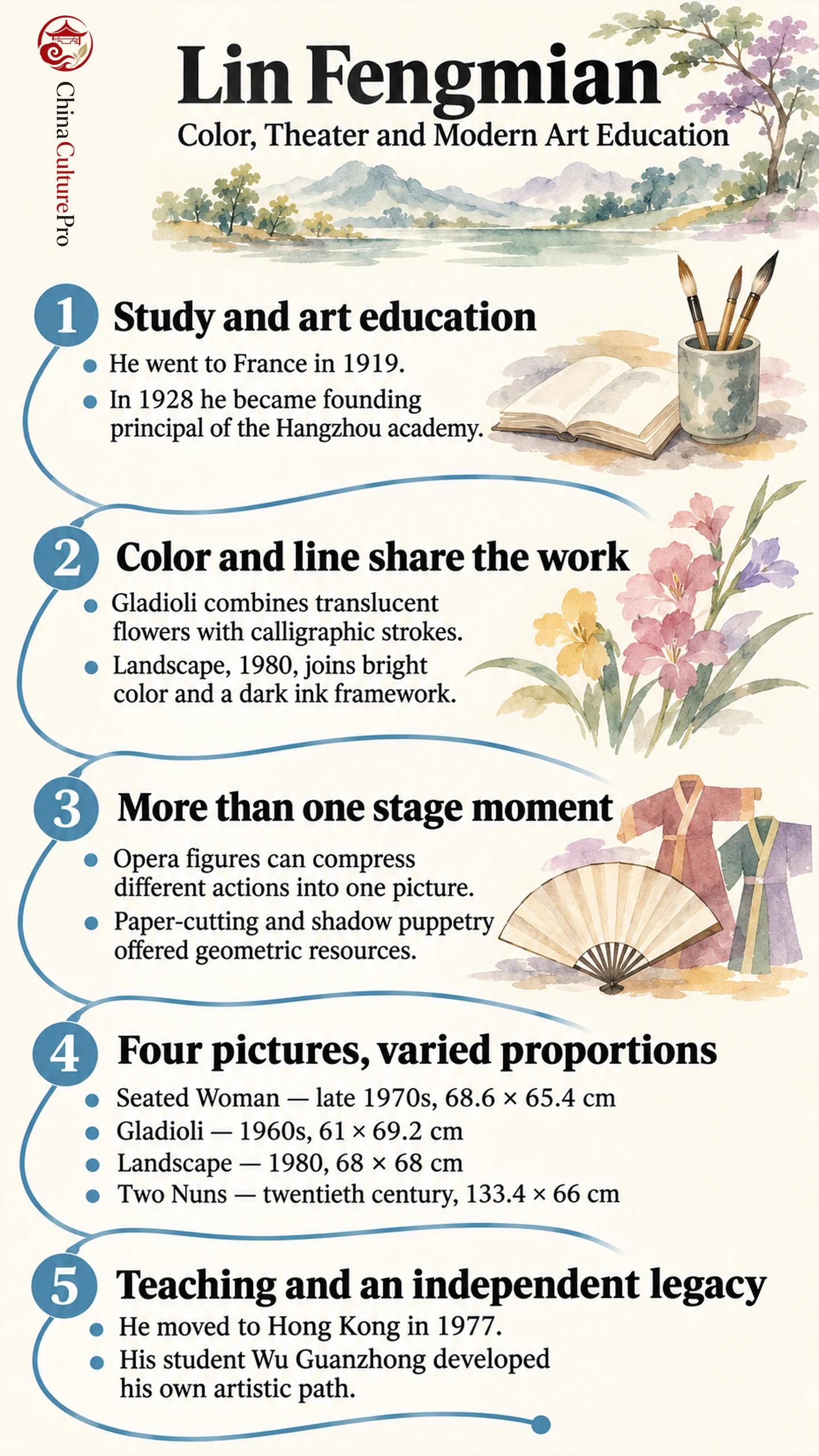
Born in Meixian, Guangdong, Lin went to France in 1919 and studied in Dijon and Paris. In 1928 he became the founding principal of the art academy in Hangzhou, a predecessor of today’s China Academy of Art.[1]
His educational approach connected Chinese and Western painting within a shared program. Structural drawing, art history and theory supported experimentation rather than treating the traditions as sealed compartments.[5] That institutional work mattered alongside his individual contribution to Chinese painting.
How Color, Line and Shape Work Together
Lin often favored a square composition with little empty ground, allowing color and ink to occupy the picture as a continuous field.[1]
Gladioli combines color suggestive of Fauvism with translucent blossoms recalling the boneless technique (没骨, mògǔ): flowers built without defining outlines. The leaves retain forceful, calligraphic strokes.[3] Watch where a wash makes a petal and where a stroke supplies direction.
Landscape, dated 1980, combines red and yellow with backlighting and a dark ink framework.[4] Comparing these effects makes “fusion” concrete: light, color and brushwork have to function together within the same image.
Opera Figures and the Picture’s Sense of Time
Китайская опера offered more than costumes to reproduce. Lin’s figure arrangements have been understood as compressing actions from different moments into one space, in dialogue with Cubist approaches to structure. Folk arts including paper-cutting and shadow puppetry (皮影戏, píyǐngxì) also supplied geometric and decorative resources.[5]
In looking at this strand of figure painting, follow the edges of sleeves and overlapping bodies. Does the picture give a single stage instant, or suggest a sequence? The flat silhouettes of shadow theater offer a useful comparison.
Four Museum Paintings to Compare
Compare the subject, medium and proportions before applying a single stylistic label.
| Живопись | Date, medium and format | Collection and dimensions |
|---|---|---|
| Seated Woman | Late 1970s; ink and color on paper, hanging scroll | Metropolitan Museum of Art; 68.6 × 65.4 cm.[2] |
| Gladioli | 1960s; ink and color on paper, hanging scroll | Metropolitan Museum of Art; 61 × 69.2 cm.[3] |
| Landscape | 1980; colored ink | Art Museum of China Academy of Art; 68 × 68 cm.[4] |
| Two Nuns | Twentieth century; ink and color on paper, hanging scroll | Metropolitan Museum of Art; 133.4 × 66 cm.[7] |
For a comparison beyond opera, place the near-square landscape beside the much taller Two Nuns. Shape is a choice serving the particular picture, rather than a formula imposed on every subject.
Later Life, Teaching and Artistic Legacy
Lin was imprisoned during the Cultural Revolution. He moved to Hong Kong in 1977 and lived there until his death.[2]
His legacy also continued through teaching. Wu Guanzhong studied with him, then pursued a distinct course between representational and abstract painting.[6]
To assess that legacy, compare how each artist makes a figure or a landscape hold together. Shared commitment to experimentation does not require identical results.
FAQs About Lin Fengmian
Did Lin Fengmian paint only in ink?
No. His early work included oil painting; later he devoted much of his practice to renewing Chinese painting with ink and color.[1]
Are all his paintings square?
No. Two Nuns is a tall hanging scroll measuring 133.4 × 66 cm.[7]
How was Wu Guanzhong connected with him?
Wu was his student. Their shared place in modern Chinese art includes different approaches to personal expression.[6]
Источники
[1] China Academy of Art. Lin Fengmian
[2] Metropolitan Museum of Art. Seated Woman
[3] Metropolitan Museum of Art. Gladioli
[4] Art Museum of China Academy of Art. Landscape, 1980
[5] China Art Museum, Shanghai. Xiang Liping on Lin Fengmian’s Modern Painting
[6] Tsinghua University Art Museum. The Road to China Modern Art: Lin Fengmian and Wu Guanzhong
[7] Metropolitan Museum of Art. Two Nuns