

Quick Answer: What Is Laoshan Green Tea?
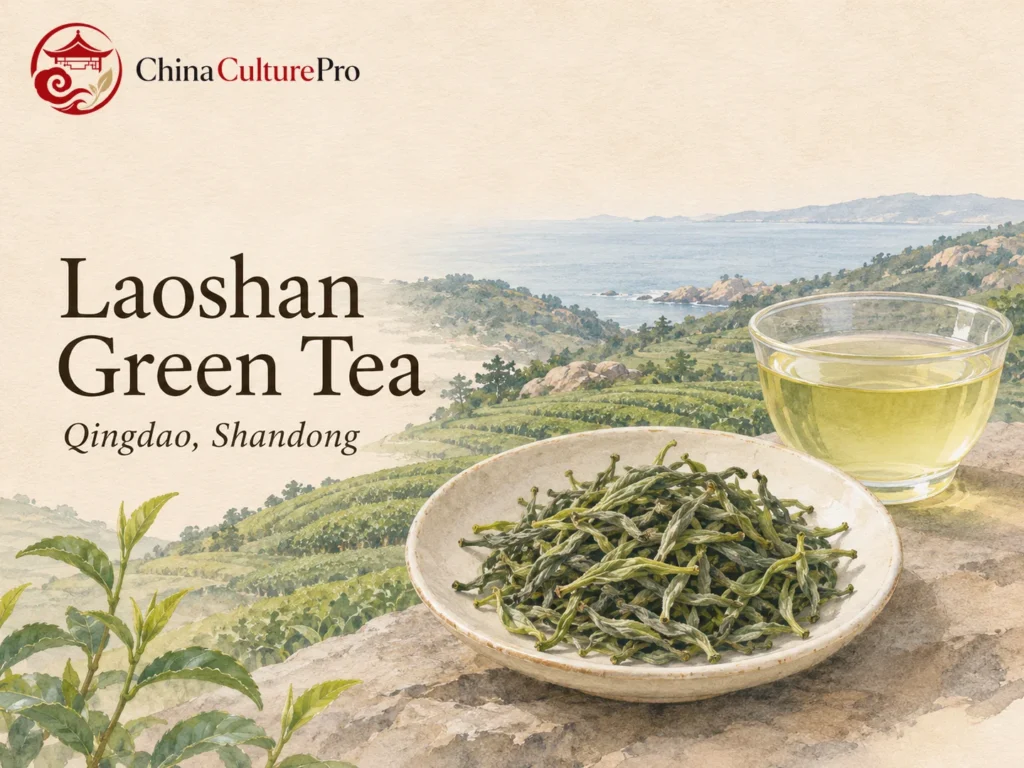
Laoshan green tea(崂山绿茶,láoshān lǜchá)is green tea from the Laoshan area of Qingdao, Shandong. Its modern cultivation developed through attempts to establish southern tea plants in a colder northern region.[1]
- Origin: Laoshan identifies the growing region, not one tea-plant cultivar.
- Craft: Fresh leaf is heated, worked into shape and dried.
- Form: Curled and flat-finished products both exist.
- Flavor: Vegetal and toasty notes appear in documented lots.
The regional name does not promise one leaf shape or the same taste in every harvest.[2][3][5]
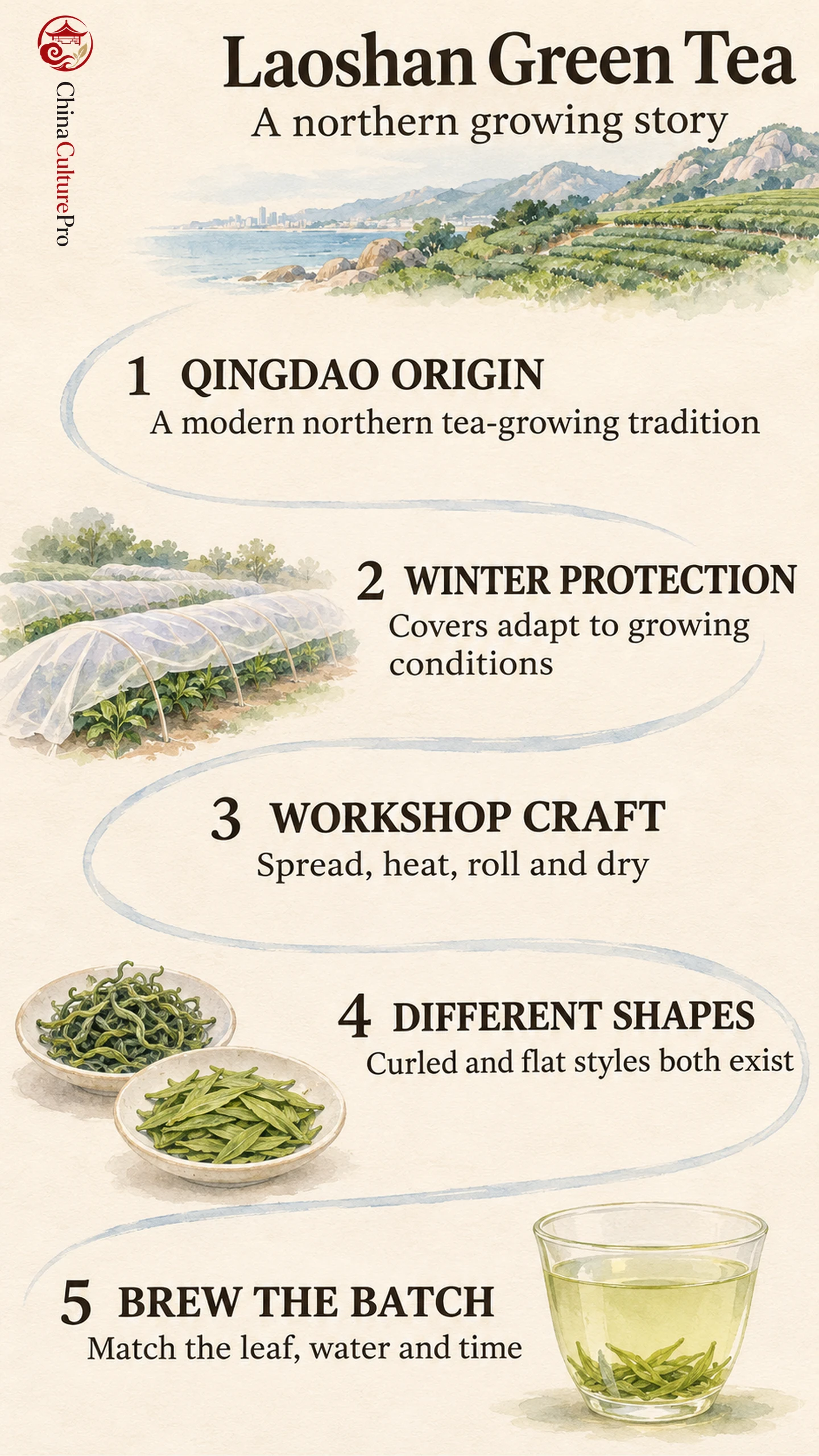
Coastal hills, winter protection and workshop choices all contribute to Laoshan’s distinctive place in China’s green-tea landscape.
A Northern Tea Region with a Modern Growing History
Qingdao’s northward tea-introduction experiments began in 1957 with seedlings from Huangshan. That attempt failed; plants brought from Hangzhou were tried in 1958. In 1959, tea was planted near Taiqing Palace in Laoshan, followed by continued cultivation and management.[1]
The mountain’s long cultural history and its modern tea industry have different timelines. Rizhao green tea provides another Shandong regional comparison.
Cold Winters and Protected Tea Gardens
Protective covers and greenhouses shelter bushes during winter and early spring. Their use is tied to conditions and the grower’s decisions.[5]
In one family’s 2026 spring fields, cool weather kept covers in place through April. Its flat-finished spring tea came from the transition around removing those coverings and exposing the shoots to direct sunlight. That is a particular harvest account, not a fixed annual calendar for the whole district.[5]
How Laoshan Green Tea Is Processed and Shaped
A contemporary Xiaowang village workshop records the sequence as spreading the fresh leaf, heating it for fixation, rolling, and drying with aroma finishing. The green-tea route keeps this separate from the prolonged oxidation stage used for black tea.[2]
At another family workshop, makers repeatedly inspect the leaf between processing stages, remove imperfect material, and use machinery to assist curling and drying. “Traditional” need not mean every movement is performed without equipment.[4]
A recorded spring lot has small, wiry, curled leaves, while a separate spring product is finished flat. Shape is a processing choice, rather than a complete test of regional identity.[3][5]
What Does Laoshan Green Tea Taste Like?
Vegetal and toasted notes are useful starting points. One curled-leaf product has yellow-green liquor, toasted-corn aroma, and savory, nutty and grassy impressions. The description belongs to that batch rather than every packet with the regional name.[3]
A pea-like fragrance also appears in the Xiaowang workshop record. A flat-finished product instead emphasizes butter-lettuce and other softer aromatic impressions. These comparisons describe the brewed tea; they do not mean peas, corn or butter have been added as ingredients.[2][5]
Choosing and Brewing a Particular Batch
Read the producer, growing area, harvest and leaf style together. GB/T 26530-2011 identifies Laoshan green tea as a geographical-indication product; a large place-name on a packet still needs its supporting product details. Our guide to tea origin labels explains the distinction.[6]
One April lot lists Longjing No. 43(龙井43号,lóngjǐng sìshísān hào)as its cultivar while naming Laoshan as its origin. Our comparison of tea cultivar and tea type separates plant, place and processing.[3]
For a complete starting method, that product recommends the following preparation:[3]
- Measure 2.5 g of leaf and 250 ml of water.
- Use water at 80°C and infuse for 3 minutes.
- Separate the liquor from the leaf and taste before adjusting another infusion.
Keep your brewing water consistent when comparing cups. If a packet carries a seasonal label, use Mingqian and Yuqian to understand the terminology rather than assuming the same harvest calendar throughout China.
FAQs About Laoshan Green Tea
Is Laoshan Tea Always Green Tea?
No. The regional name also appears on black-tea products. Check the tea category rather than identifying it from the place-name alone.
Does Laoshan Green Tea Always Have Curled Leaves?
No. Curled leaves are familiar, but flat-finished green teas are also produced. Read the product’s particular style.
Does Longjing No. 43 Mean the Tea Came from Hangzhou?
No. It identifies plant material. A Laoshan-grown batch can use that cultivar without changing its growing location to Hangzhou.
Источники
[1] Min Yu, Jiao Xiangpeng and Yang Meiqing, Qingdao Early News. “南茶北引”档案曝光 崂山茶“老家”原在江南
[2] Yi Tao, Qingdao Daily. 崂山湾:秀丽山海演绎精彩“甜蜜故事”
[3] Curious Tea. Shandong Laoshan Green
[4] David Duckler. Making Green Tea with the He Family in Laoshan Village
[5] Verdant Tea. Reserve Flat Pressed Laoshan Green
[6] State Administration for Market Regulation. 地理标志产品 崂山绿茶