

Quick Answer: What Is Jianyang Xiaobai White Tea?
Jianyang white tea comes from Jianyang, a district of Nanping in northern Fujian. Xiaobai (小白, xiǎobái) is the Jianyang white-tea line made from local Caicha (菜茶, càichá), a population of tea plants with relatively small leaves. Shou Mei (寿眉, shòuméi) names a finished white-tea product. On a Jianyang Xiaobai Shou Mei label, the three terms identify a place, a local raw-material tradition and a finished tea. [1][2][3][4]
- Jianyang: Look for the place of production or where the leaves were grown.
- Xiaobai: In Jianyang’s association standard, it refers to white tea made from local Caicha.
- Shou Mei: The national white tea standard allows several raw materials for this product category. [1][2][3][4]
Jianyang also makes white tea using the Shuixian (水仙, shuǐxiān) cultivar. A Jianyang place name on its own leaves that raw-material detail open. [1][2][5]
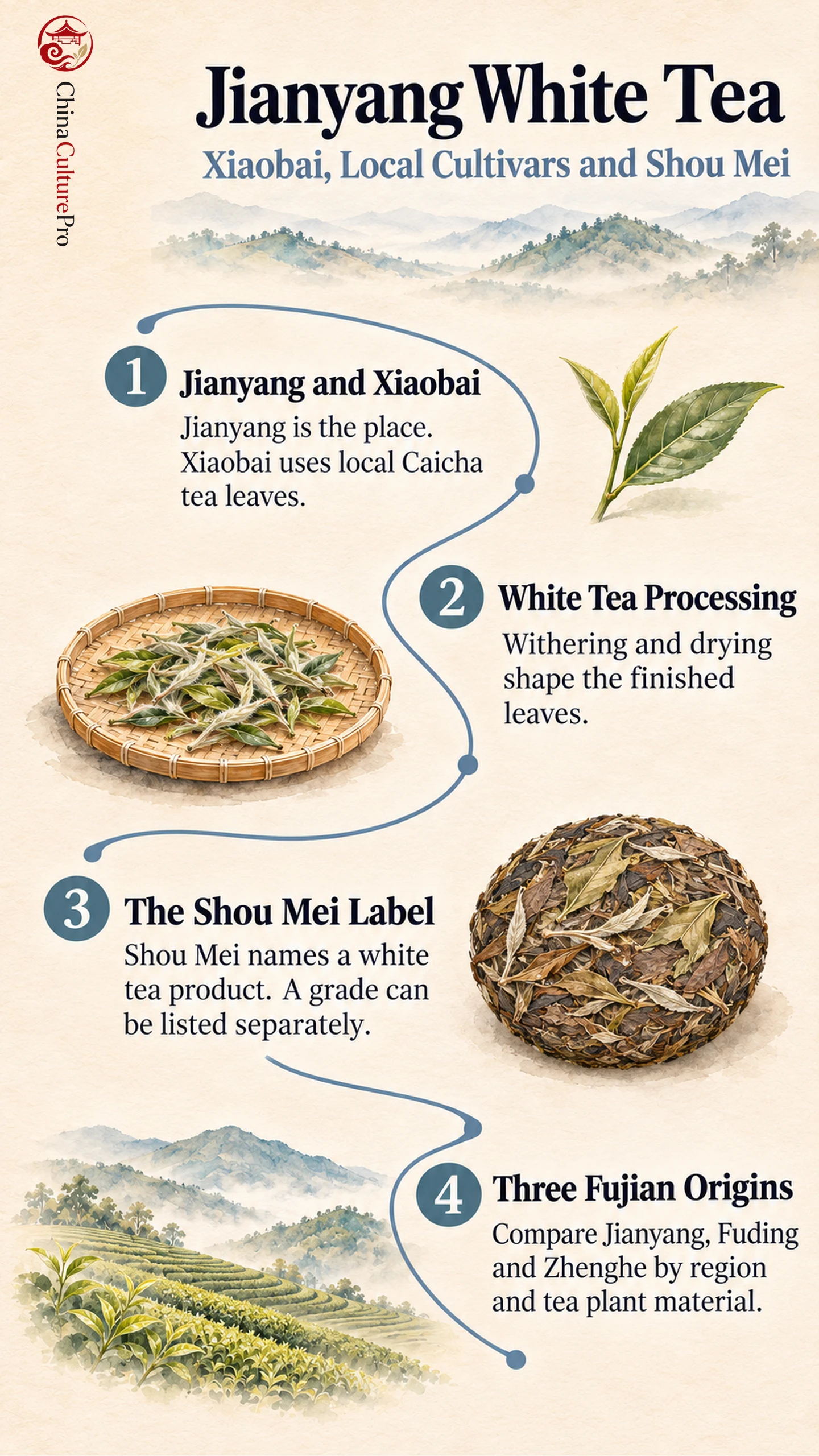
A tea cake labelled Jianyang Xiaobai Shou Mei brings three tea terms into one line of print. Each gives you a different way to compare it with a Fuding or Zhenghe tea. The combination also makes it possible to compare two teas called Shou Mei that were made from different plants. [1][2][4][7]
Why Jianyang Calls This White Tea Xiaobai
Jianyang sources associate Xiaobai with Nankeng village in Zhangdun Town. The name refers to the local small-leaved population of tea plants used for the fresh material. Caicha in this context describes a group of local tea plants, so a label need not give a named clone. For an introduction to the overall category, see Chinese white tea. [1][2][5]
Jianyang practice also includes Shuixian white tea, associated in local accounts with Xiaohu Town. An association standard separates the Xiaobai line from the Shuixian line. The place name Jianyang covers both. Ask which plant material was used when comparing two teas from the district. [1][2][5]
What Withering and Drying Do
Jianyang’s local account describes the traditional sequence as withering (萎凋, wěidiāo) and drying (干燥, gānzào). During withering the fresh leaves soften and lose moisture. Drying completes the basic process. The local account describes a traditional method without pan-firing or rolling. The finish can also involve sorting under the national standard. [1][4]
When a label also says cake, it tells you that the leaves were pressed into a disc. The 2015 cake listed under Jianyang Xiaobai Shou Mei is a specific commercial example. Its age, shape and seller’s tasting description apply to that product. [1][4][7]
Where Shou Mei Fits in Jianyang and in the National Standard
GB/T 22291-2017 defines Shou Mei as one of four white-tea products. It can use tender shoots or leaves from Da Bai (大白, dàbái), Shuixian or tea-plant population material, made through white-tea processes. Each product can also have grades. Thus ‘Shou Mei’ names the product, and the grade is a separate specification. [3][4]
The Jianyang association’s terminology is more specific about the raw material when the label says Xiaobai Shou Mei. Its Xiaobai line also includes Xiaobai Silver Needle and Xiaobai Gong Mei (贡眉, gòngméi). In each name, Xiaobai identifies the local material and the rest identifies the finished white tea. See the Shou Mei tea guide for how that white-tea product fits alongside the other styles. [1][2][4]
Jianyang, Fuding and Zhenghe White Tea Compared
| Fujian place | Plant material to look for | How to use the place name |
|---|---|---|
| Цзяньян | Local Caicha in Xiaobai. Shuixian is used in the separate Shuixian line. | Read the local style name with the place. |
| Фудин | Fuding Da Bai and Fuding Da Hao are prominent examples. | Read the material statement alongside the Fuding origin. |
| Чжэнхэ | Zhenghe Da Bai and local population material are among the documented inputs. | An origin label and a declared raw material give different information. |
All three places make white tea. When looking at two packets, compare the named plant material, the tea product, and whether the leaves are loose or pressed. Then compare the harvest and the producer. Our Fuding white tea guide и Zhenghe white tea guide give the regional context for the other two names. [1][2][4][5][6][7]
FAQs About Jianyang White Tea
Is all Jianyang white tea called Xiaobai?
Jianyang’s association standard distinguishes the local Caicha Xiaobai line from white tea made with the Shuixian cultivar. [1][2]
Is Shou Mei a cultivar or a grade?
The national standard defines it as a finished white-tea product that may include several kinds of raw material. A producer can specify the grade separately. [3][4]
Does Xiaobai Shou Mei have to come as a tea cake?
Cake describes how a product has been pressed. One published listing shows a pressed example. Xiaobai and Shou Mei identify the material tradition and product type. [1][2][4][7]
Источники
[1] Jianyang News. White Tea Basics: Jianyang Xiaobai and Shuixian
[2] Cross-Strait Tea Industry Exchange Association. T/CSTEA 00014.2-2020, Jianyang Xiaobai White Tea
[3] State Administration for Market Regulation. GB/T 22291-2017, White Tea
[4] Fujian Tea Information Network. Text of GB/T 22291-2017
[5] Fujian Provincial Government. Fujian Tea Industry and Regional White Teas
[6] Ministry of Agriculture and Rural Affairs. International Tea Day: Fuding White Tea
[7] Min Tea Shop. 2015 Jianyang Xiaobai Shou Mei Tea Cake