


Quick Answer: What Are Hua’er Songs?
Hua’er(花儿,huā’ér) is a folk singing tradition shared across parts of northwestern China, especially Gansu, Qinghai and Ningxia. Singers choose familiar tunes and can fit new words to them. [1] A verse might express affection, describe a day’s work or respond to someone singing nearby.
People sing Hua’er alone, in exchanges and at gatherings where several performances can happen within earshot. Tune names, verse patterns and accompaniment vary by locality. The tradition entered UNESCO’s Representative List of the Intangible Cultural Heritage of Humanity in 2009.
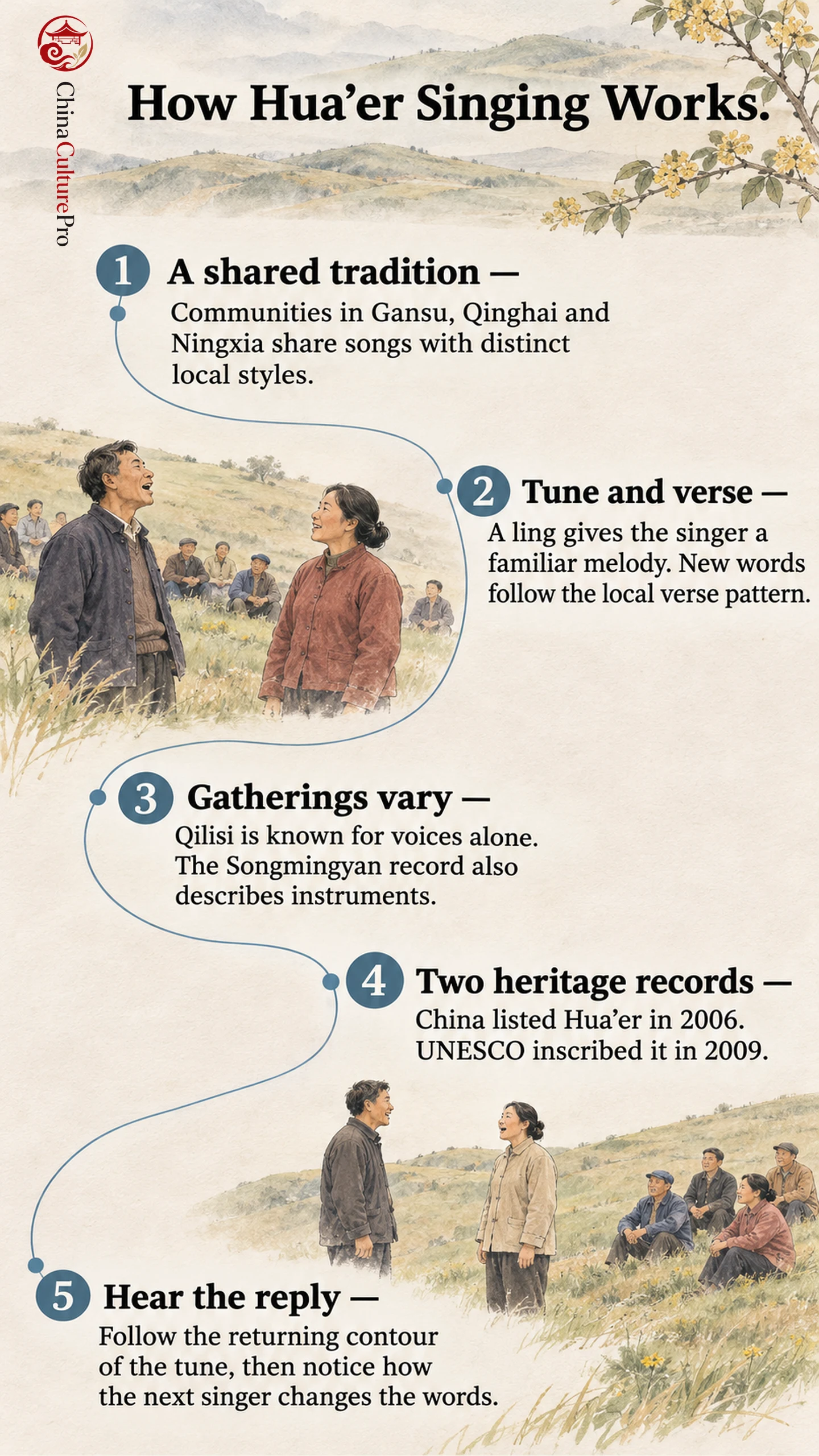
At a hillside gathering, two singers can trade verses. An audience familiar with the tune may be listening closely for the words that change. That interplay between a melody people know and a line composed for the moment is one way into the tradition.
A Tradition Shared Across Northwestern Communities
Hua’er belongs to several overlapping local singing traditions. China’s National Ethnic Affairs Commission describes Hehuang, Taomin and Liupanshan as three broad branches, named for regions. The branches are associated with different localities, melodic styles and verse conventions. [2]
UNESCO’s description covers a tradition shared by nine ethnic groups. The Chinese account names communities including Han, Hui, Tu, Salar and Dongxiang and describes singing in local varieties of Chinese. A common singing language provides a way for people from different communities to exchange verses. Each locality can still have its own repertoire and practices. That combination of local sound and shared forms also helps explain the variety within Chinese folk songs. [2]
How a Ling Shapes an Improvised Verse
A ling(令,lìng) is a named tune or melodic pattern. Its title may refer to a place, a community or a flower. UNESCO gives the Tu People’s Tune and the White Peony Tune as examples. A title identifies the melodic pattern, and different verses can share that title. [1]
A singer has to fit words to the pattern of a verse, with constraints on such features as line length and rhyme. UNESCO describes forms with lines of seven syllables. That is an example within a large repertoire. A verse can refer to farm work, separation or falling in love. When singers answer each other, a new line can pick up the previous singer’s image and give it a new meaning. The tune gives an audience a familiar shape against which to hear that change. [1]
Hua’er Festivals in Gansu and Qinghai
A hua’er hui(花儿会,huā’ér huì) is a song gathering. The examples below show how the location, tune and way of performing can each help identify a local tradition. The Gansu and Qinghai heritage records describe gatherings outdoors, where listeners may hear a solo, a reply or several voices together. [3]
| Gathering | Место | One feature in the heritage record |
|---|---|---|
| Lianhua Mountain | Kangle County, Gansu | The Lianhua Mountain Tune is part of a tradition of spontaneous verses with established rhyme and rhythm. |
| Songmingyan | Hezheng County, Gansu | Singers perform Hezhou tunes and the Peony Tune. The record describes solo, group and exchange singing, with some instrumental accompaniment. |
| Qilisi | Minhe, Qinghai | The account describes unaccompanied solo, paired and group singing, with local tunes such as the Gushan Tune. |
The first two examples appear in the national heritage center’s account of local gatherings. Qilisi has its own inventory entry, which describes singing in a gorge and names individual tradition bearers. These records describe the musical practices associated with each gathering. [4]
From Local Singing to Heritage Recognition
Accounts of Hua’er describe singing outdoors during work and travel as well as at organized gatherings. Some accomplished singers also teach apprentices or perform onstage. Each setting changes what listeners hear. A festival exchange can include a response from another singer, while a staged solo brings one voice and one set of words to the foreground. [1]
China included Hua’er and named local gatherings in the first batch of its national heritage inventory in 2006. [3] In 2009, UNESCO inscribed Hua’er on its Representative List. These are two different records for a living form of intangible cultural heritage. The local entries preserve details about particular communities, while the international entry documents the shared tradition. [5]
How to Listen to a Hua’er Exchange
Start with two consecutive verses from the same exchange. Listen for the point where the voice rises or stretches a syllable, then for how the line ends. If the next singer uses a similar contour, follow the new words against that familiar shape. A translation can help you hear whether the response extends an image, answers a question or shifts the subject.
When a recording gives the tune name, place and singer, keep those details together. Compare a recording from Qilisi with one from Songmingyan, where the heritage account mentions instrumental accompaniment. A difference in backing or delivery may tell you about the gathering or the recording as much as about the tune. [4]
FAQs About Hua’er Songs
What does hua’er mean?
The name means “flower” or “little flower.” In music, it names the northwestern song tradition.
Are Hua’er songs always unaccompanied?
No. The Qilisi account describes voices alone, while the Songmingyan account also lists instruments used at its gathering.
Do singers make up the tune as they go?
Singers draw on familiar melodic patterns. They can improvise the words within the conventions of the verse.
Источники
[1] UNESCO. Hua’er, Representative List Bulletin
[2] National Ethnic Affairs Commission. Hua’er
[3] China Intangible Cultural Heritage Digital Museum. Hua’er Songs and Gatherings in Northwestern China
[4] China Intangible Cultural Heritage Digital Museum. Qilisi Hua’er Gathering
[5] UNESCO. Decision 4.COM 13.16