
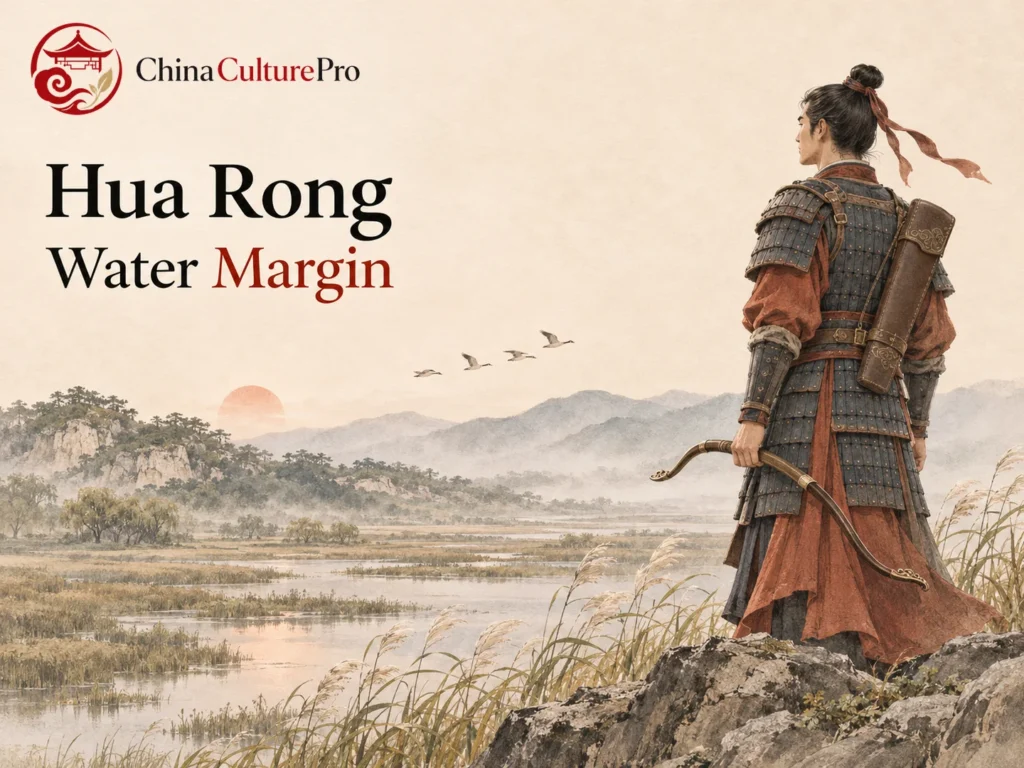

Quick Answer: Who Is Hua Rong?
Hua Rong (花荣, Huā Róng) is an archer in Water Margin (水浒传, Shuǐhǔ Zhuàn). He is a military officer before joining the outlaws. His nickname, Little Li Guang (小李广, Xiǎo Lǐ Guǎng), invokes a Han general whose archery became famous in historical writing.[1][4]
- Hua Rong welcomes his friend Song Jiang (宋江, Sòng Jiāng) at Clear Wind Fort (清风寨, Qīngfēng Zhài).[1]
- At Liangshan (梁山, Liángshān), he wins over doubters by shooting a goose in flight.[2]
- He ranks ninth in the final roster of 108 heroes.[3]
A Japanese print also uses the goose episode to identify him.[5][6]

Hua Rong arrives at the outlaw stronghold with a story already circulating about his marksmanship. He has an audience, a reputation to defend and a flock flying overhead. Chapter 35 makes the shot a test of whether the other leaders should believe what they have heard.
From Clear Wind Fort to Liangshan
Chapter 33 places Hua Rong and a civilian counterpart, Liu Gao, in different quarters of Clear Wind Fort. The military officer greets Song Jiang as a respected friend. When Liu Gao has the visitor arrested, Hua Rong intervenes. Their dispute brings official duty and personal loyalty into conflict before Hua Rong reaches the outlaw camp.[1]
The nickname brings another archer into view. In the Han Shu, Li Guang mistakes a stone for a tiger and is said to lodge an arrow in it. The comparison prepares readers for the fictional officer’s remarkable shot without making Hua Rong a version of Li Guang’s biography.[4]
The Goose Shot and the Two Rankings
In Chapter 35, the leaders hear that Hua Rong once shot through a ribbon. He thinks Chao Gai doubts the story. Before loosing an arrow at the flying flock, he specifies the third goose. The bird falls, and the leaders praise him. His announcement matters because they can judge the claim against the result.[2]
The next seating puts Hua Rong fifth, immediately below Lin Chong, in a group of only twenty-one leaders. The final roster in Chapter 71 puts him ninth and gives him the title Tianying Star (天英星, Tiānyīng Xīng). These are rankings of the band at different points in its growth. The larger roster establishes his place among the 108 Liangshan heroes.[2][3]
How Kuniyoshi Pictured the Archer
In a Japanese woodblock print from about 1827 to 1830, Utagawa Kuniyoshi chose the shot at the wild goose for Hua Rong’s portrait. The figure is titled Shoriko Kaei in Japanese. The print belongs to a series about the heroes of the popular Water Margin. It condenses the episode into a scene centered on the archer and bird.[5][6]
FAQs About Hua Rong
What does Little Li Guang mean?
It is a comparison with the Han general Li Guang, whose skill with the bow was celebrated in early historical accounts.[4]
Why do some lists give Hua Rong different ranks?
Chapter 35 puts him fifth in the group assembled at that point. Chapter 71 ranks him ninth after all 108 leaders gather.[2][3]
How does Hua Rong’s story end?
In Chapter 120, Hua Rong and Wu Yong go to Song Jiang’s grave. Hua Rong’s final scene returns to the loyalty that brought him into the story at Clear Wind Fort.[7]
Источники
[1] Water Margin. Chapter 33, 120-chapter text
[2] Water Margin. Chapter 35, Chinese Text Project
[3] Water Margin. Chapter 71, 120-chapter text
[4] Ban Gu. Han Shu, Biographies of Li Guang and Su Jian
[5] Smithsonian National Museum of Asian Art. Hua Rong, the Little Li Guang, by Utagawa Kuniyoshi
[6] McMaster Museum of Art. Hua Rong, the Little Li Guang, Shooting a Wild Goose
[7] Water Margin. Chapter 120, 120-chapter text